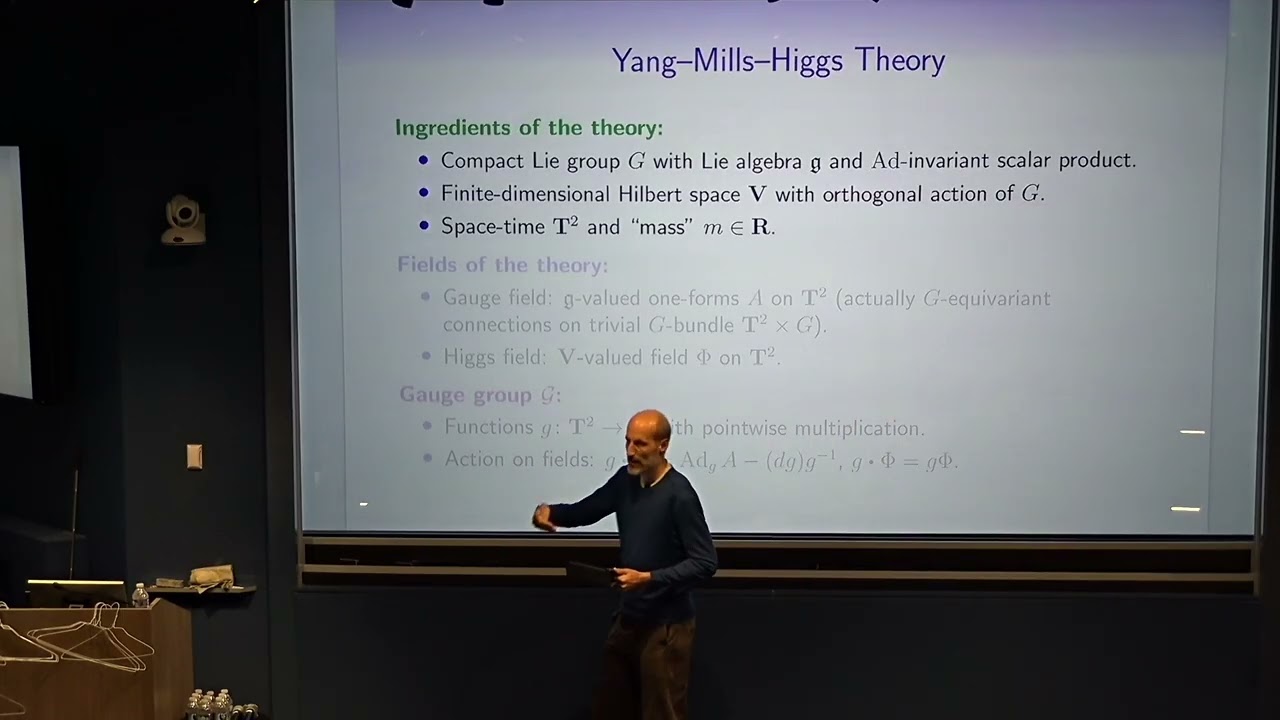
Martin Hairer: Stochastic Quantisation of Gauge Theories (April 30, 2026)
Keywords
Summary
176 words
Critical Evaluation
Value of the Information & Strength of the Argument
The talk provides a high-value exposition of a cutting-edge research topic, presenting both the conceptual framework and recent technical advances. The argumentation is rigorous, building from the basic Parisi-Wu idea to the specific challenges of gauge theories. Hairer clearly explains the separation of UV and large-field problems, and how regularity structures address the former. He also gives a thorough geometric introduction to gauge fields, making the talk self-contained for a mathematically mature audience. The presentation is well-structured, with clear motivation and a logical progression from general principles to specific results.
Scientific Rigor, Source Quality, Title Accuracy
The talk demonstrates high scientific rigor, with careful definitions and precise statements. Hairer references key works in the field, including Parisi and Wu’s original paper, the work of Jona-Lasinio, and the development of regularity structures. He also mentions alternative approaches by Kupiainen and others. The title accurately reflects the content, focusing on stochastic quantisation of gauge theories. The talk is based on joint work that is not yet published, but the speaker indicates high confidence in the results. The presentation is suitable for experts in the field, and the mathematical details are handled with precision.
200 words
Title / Content Match
The title accurately reflects the content: the talk focuses on stochastic quantisation applied to gauge theories, specifically Yang-Mills-Higgs.
Quality & Reliability
9/10
Talk by a leading mathematician (Fields Medalist) presenting joint work with collaborators, with rigorous mathematical framework and references to established literature. The content is technical and appears accurate, though not yet peer-reviewed (as stated).
Key Moments
Markers derived by PSI from the transcript: the creator did not define chapters.
- Introduction and overview of stochastic quantisation
- Parisi-Wu idea: invariant measure of stochastic gradient flow
- Separation of UV and large-field problems
- Geometric setup: gauge fields, connections, curvature
- Yang-Mills-Higgs action and role of Higgs field
- Regularity structures and solving UV problem
- Large-field problem and global solutions
- Discussion of open problems and future directions
Cited Sources
- Simons Foundation Event Page — Official event page for the talk, providing context and related information.
Concurring Sources
- Parisi and Wu, 1981 — Original paper introducing stochastic quantisation.
- Jona-Lasinio and Mitter, 1985 — Early rigorous work on stochastic quantisation.
- Hairer, 2014 — Paper introducing regularity structures.
Contribution & Novelties
The talk presents a novel approach to constructing Yang-Mills-Higgs measures via stochastic quantisation, using the machinery of regularity structures. This is a significant advance in the field, as it provides a rigorous construction for a non-trivial gauge theory with matter fields. The work is not yet published, but the methods and results are likely to have a major impact on the mathematical understanding of quantum field theories.
Pour aller plus loin :
- Regularity structures — A framework developed by Hairer for solving singular stochastic PDEs.
- Stochastic quantization — The Parisi-Wu approach to quantum field theory.
- Yang–Mills–Higgs equations — The classical field equations for the model discussed.
106 words
Radar Profile
The radar profile shows very high scores in all dimensions, with a particularly high level of technical depth and information quality. This reflects a highly specialized and rigorous presentation, suitable for experts in the field.
💬 No comments were provided for analysis.