Vitor Cardoso: Listening to Black Holes
Keywords
Summary
226 words
Critical Evaluation
Value of the Information & Strength of the Argument
The talk provides a valuable overview of black hole spectroscopy, synthesizing recent results and outlining key open questions. Cardoso’s argumentation is solid, grounded in established theoretical frameworks (e.g., perturbation theory, numerical relativity) and supported by recent observational evidence. He effectively communicates complex ideas, such as the instability of the quasinormal mode spectrum and the potential for resonant excitation, with clear explanations and illustrative examples. The discussion of nonlinear effects, including the analogy to Tartini tones, is particularly insightful and highlights the frontier of current research. While some results are preliminary, Cardoso is careful to distinguish established knowledge from ongoing investigations, making the talk both informative and intellectually honest.
Scientific Rigor, Source Quality, Title Accuracy
The talk is scientifically rigorous, reflecting the expertise of a leading researcher in the field. Cardoso references the Kerr metric, the no-hair theorem, and the standard framework of black hole perturbation theory, all well-established in the literature. He also mentions a forthcoming community review on black hole spectroscopy, indicating a comprehensive and up-to-date synthesis of the field. The title ‘Listening to Black Holes’ is apt, as the talk focuses on extracting information from the gravitational wave ’tones’ of black holes. The content is well-aligned with the title, providing a thorough exploration of the methods and implications of black hole spectroscopy. No comments were provided for analysis.
229 words
Title / Content Match
The title accurately reflects the content, which focuses on the analysis of gravitational waves from black holes, metaphorically 'listening' to their characteristic tones.
Quality & Reliability
8/10
Presentation by a leading expert in gravitational physics, based on established theoretical frameworks and recent numerical simulations. The talk is technical and rigorous, with appropriate caveats about ongoing research. However, it is a conference talk, not a peer-reviewed publication, and some claims are preliminary.
Key Moments
Markers derived by PSI from the transcript: the creator did not define chapters.
- Introduction and motivation: the incompleteness of our knowledge of gravity and matter, and the simplicity of black holes.
- Black hole spectroscopy: linear perturbations, quasinormal modes, and the 'black hole piano' analogy.
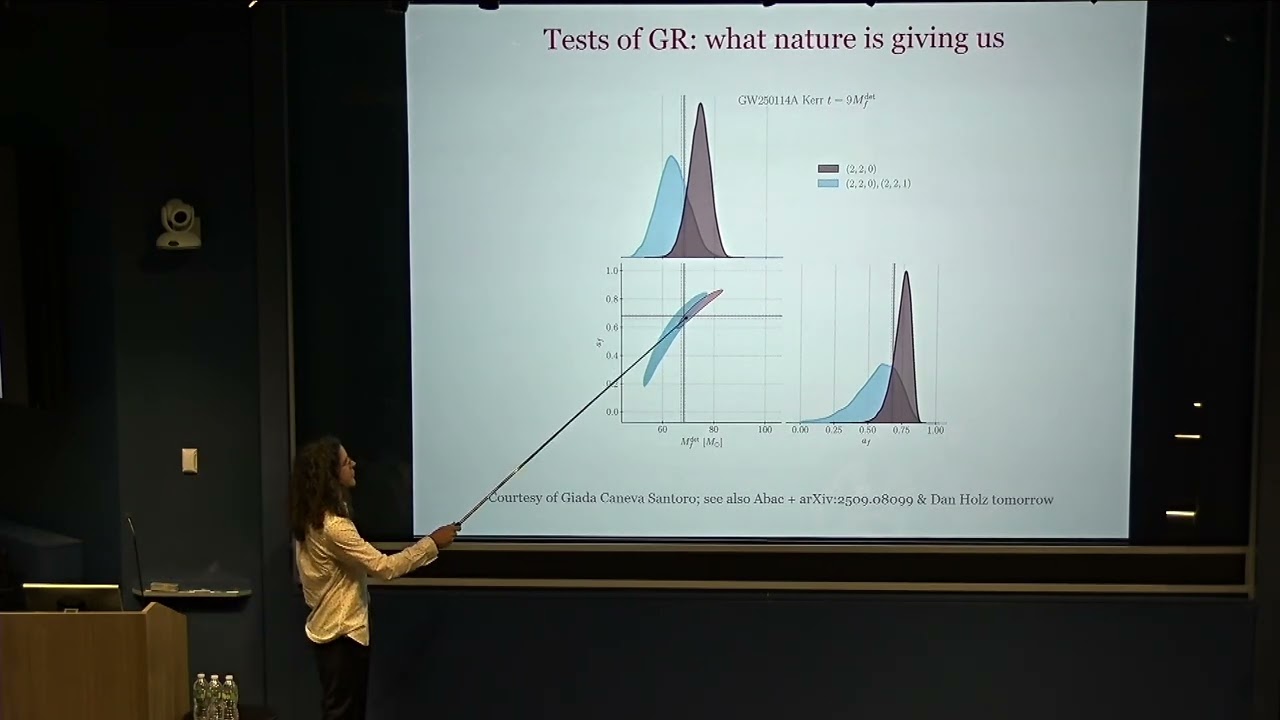
- Observational evidence: detection of multiple modes in GW150914 and the potential for testing general relativity.
- Open questions: why are mergers so simple? The role of environments and the instability of the mode spectrum.
- Excitation mechanisms: striking the black hole with pulses, accretion disks, and hierarchical triples.
- Resonant excitation of quasinormal modes by a stellar-mass binary orbiting a supermassive black hole.
- Nonlinear effects: Tartini tones, second-order perturbations, and the generation of higher harmonics.
- Scattering experiments: throwing gravitational waves at a black hole and measuring the nonlinear response.
- Conclusions and future directions: the need for a better understanding of nonlinearities and matter effects.
Cited Sources
- Simons Collaboration on Black Holes and Strong Gravity Annual Meeting 2026 — Event page for the meeting where this talk was presented.
Concurring Sources
- Simons Collaboration on Black Holes and Strong Gravity Annual Meeting 2026 — The event page confirms the context of the talk.
Contribution & Novelties
This talk provides a comprehensive and up-to-date overview of black hole spectroscopy, highlighting recent advances and open questions. It emphasizes the importance of nonlinear effects and the potential for resonant excitation of quasinormal modes, offering new perspectives on how to extract information from gravitational wave signals. The discussion of hierarchical triples and the possibility of observing Doppler beaming and lensing in gravitational waves is particularly novel.
Pour aller plus loin :
- Quasinormal modes of black holes — Overview of the concept and its applications.
- Kerr metric — The rotating black hole solution in general relativity.
- Gravitational wave astronomy — The field that studies the universe through gravitational waves.
- Numerical relativity — The computational approach to solving Einstein’s equations for binary mergers.
- LIGO — The observatory that made the first direct detection of gravitational waves.
134 words
Radar Profile
The radar profile shows a well-balanced presentation with high scores across all dimensions, indicating a technically rigorous and informative talk with strong scientific grounding. The slightly lower score in 'quantite_information' relative to others suggests that while the talk is dense, it could have included more specific data or references.