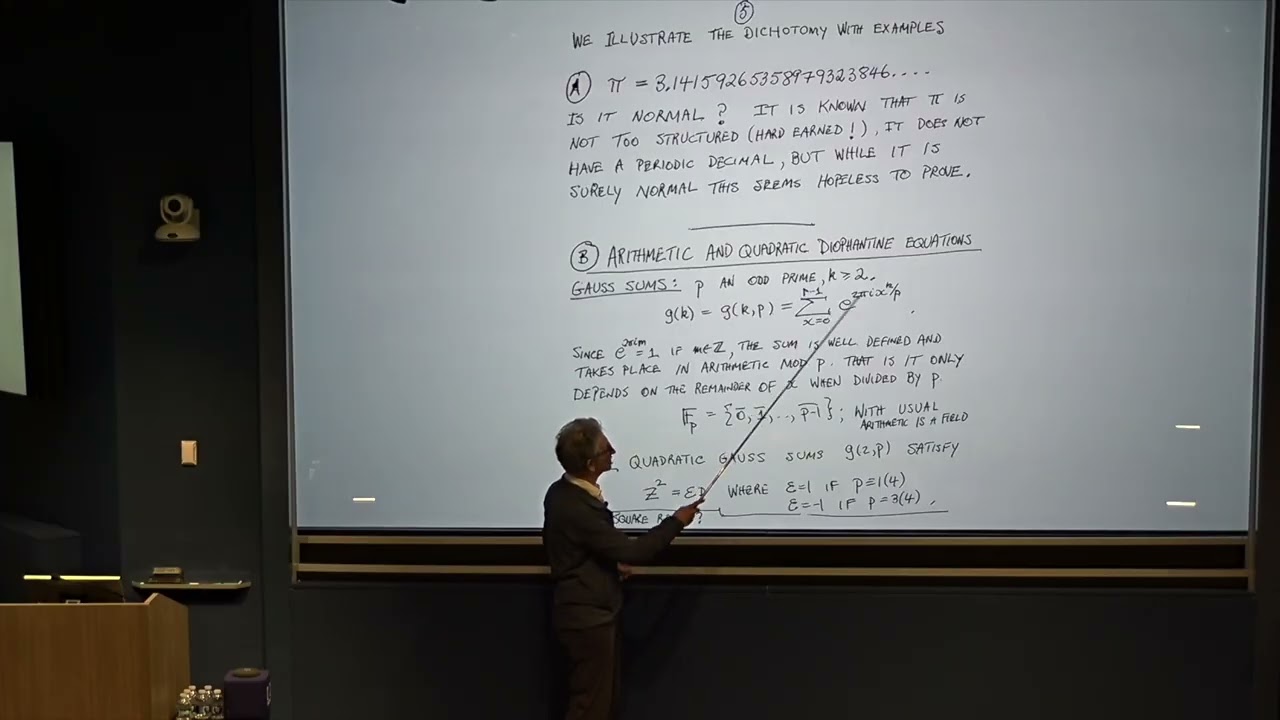
Randomness in Number Theory
Keywords
Summary
153 words
Critical Evaluation
Value of the Information & Strength of the Argument
The lecture provides valuable insights into the role of randomness in number theory, blending historical context with cutting-edge research. Sarnak’s argumentation is clear and persuasive, using concrete examples to illustrate abstract concepts. He effectively demonstrates how probabilistic models can guide conjectures and how proving randomness is often the central challenge. The presentation is well-structured, moving from classical results to recent breakthroughs, and includes personal anecdotes that humanize the subject.
Scientific Rigor, Source Quality, Title Accuracy
The lecture is scientifically rigorous, with references to specific theorems (e.g., Gauss’s reciprocity, prime number theorem, Hasse-Minkowski) and recent results (e.g., the 2026 theorem on isotropic quadratic forms). Sarnak cites the work of Gauss, Serre, Heath-Brown, Patterson, and others, and mentions the Simons Foundation event page for further information. The title accurately reflects the content, which explores randomness in number theory. The lecture does not include any promotional or advertising content.
155 words
Title / Content Match
The title accurately reflects the content, which explores the role of randomness in number theory through various examples.
Quality & Reliability
9/10
Lecture by a leading number theorist, presenting both classical results and recent research, with references to specific theorems and conjectures. The content is mathematically rigorous and reflects the current state of the field.
Key Moments
Markers derived by PSI from the transcript: the creator did not define chapters.
- Introduction and quote from Paul Cohen on proof and statistical evidence.
- Discussion of the structure vs. randomness dichotomy in number theory.
- Introduction of pi and the question of its normality.
- Gauss's work on quadratic forms and the sign of Gauss sums.
- Explanation of the prime number theorem and Gauss's counting of primes.
- Presentation of recent theorem on isotropic ternary quadratic forms (2026).
- Application to quantum computing: optimal rotations in SU(2).
- Discussion of Lubotzky-Phillips-Sarnak construction and its implications.
- Conclusion and remarks on the future of number theory.
Cited Sources
- Simons Foundation Event Page — Official event page for the lecture, providing additional context and information.
Concurring Sources
- Simons Foundation Event Page — Official event page, consistent with the lecture content.
Contribution & Novelties
The lecture provides a unique perspective on the role of randomness in number theory, synthesizing classical results with recent breakthroughs. It highlights the importance of probabilistic models in guiding conjectures and the challenges of proving randomness. The discussion of the 2026 theorem on isotropic quadratic forms and its connection to homogeneous dynamics is particularly novel, as is the application to quantum computing.
Pour aller plus loin :
- Prime number theorem — Foundational result on the distribution of primes.
- Gauss sum — Key concept in number theory, central to the lecture.
- Hasse–Minkowski theorem — Criterion for isotropy of quadratic forms over the rationals.
- Homogeneous dynamics — Technique used in the recent proof.
- Lubotzky–Phillips–Sarnak — Construction of expander graphs, related to the quantum computing application.
123 words
Radar Profile
The radar profile shows high scores across all dimensions, indicating a lecture that is rich in information, technically deep, and highly reliable. The balance between quantity and quality of information is excellent, with a strong emphasis on rigorous mathematical content.