Spectral Analyses of Graph Neural Networks
Keywords
Summary
166 words
Critical Evaluation
Value of the Information & Strength of the Argument
The talk provides valuable insights into the theoretical foundations of graph neural networks, unifying them with classical signal processing and convolutional networks. The argumentation is rigorous, building from basic definitions to advanced results. Ribeiro clearly explains the algebraic structure of convolutions and demonstrates how spectral analysis enables transferability guarantees. The empirical validation supports the theoretical claims, though the presentation is concise and assumes prior knowledge. The trade-off between discriminability and transferability is a novel and important contribution, highlighting practical limitations.
Scientific Rigor, Source Quality, Title Accuracy
The talk is scientifically rigorous, with clear derivations and references to the speaker’s own work and the broader literature. The speaker cites his own teaching materials and the Simons Foundation event page. The title accurately reflects the content, focusing on spectral analysis of GNNs. The presentation is well-structured, but as a conference talk, it does not provide exhaustive citations or proofs. The speaker’s expertise and the mathematical framework lend high credibility.
166 words
Title / Content Match
The title accurately reflects the content, which focuses on spectral (frequency-domain) analysis of graph neural networks.
Quality & Reliability
8/10
Presentation by a leading expert in the field, based on established mathematical frameworks and published research. The talk is rigorous, with clear derivations and references to the speaker's own work and the broader literature. However, as a conference talk, it does not provide full proofs or exhaustive citations.
Key Moments
Markers derived by PSI from the transcript: the creator did not define chapters.
- Introduction to graph convolutional filters as polynomials of the graph shift operator.
- Explanation of graph neural networks as compositions of graph convolutions and nonlinearities.
- Comparison of GNNs to CNNs, highlighting the algebraic equivalence.
- Introduction of algebraic convolution and its frequency representation.
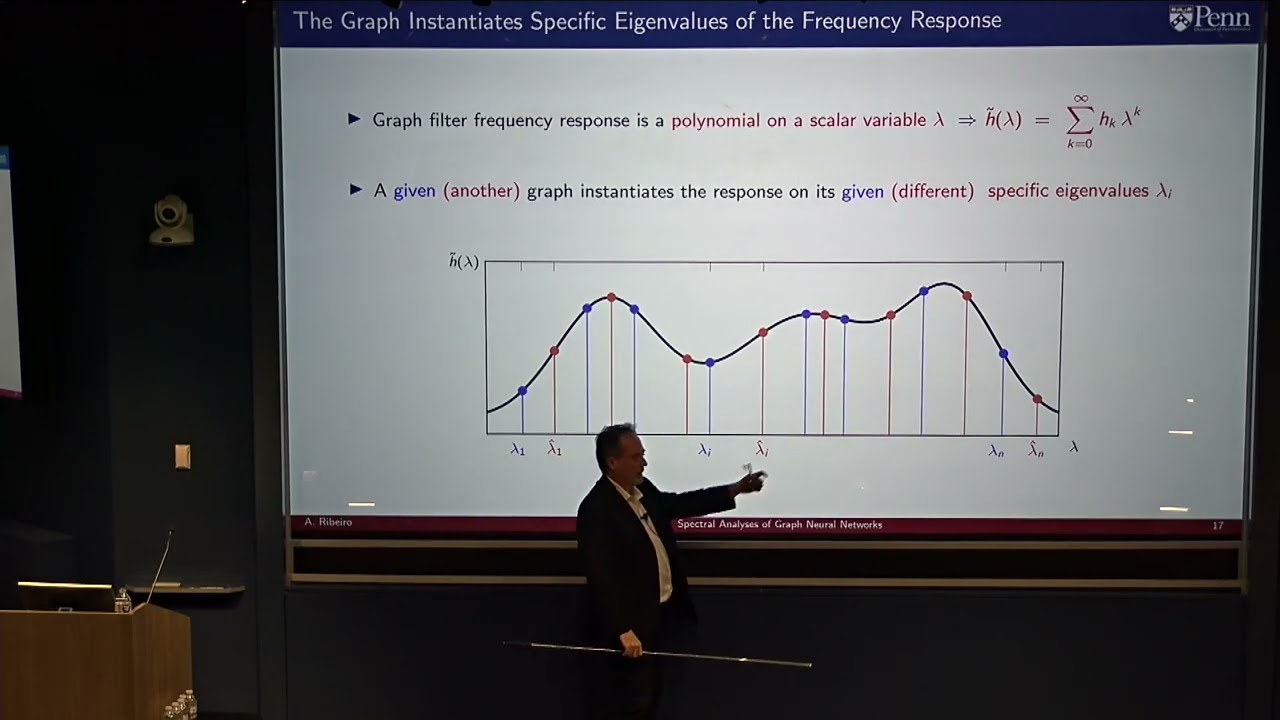
- Derivation of frequency response for graph filters and its independence from the graph.
- Discussion of stability and transferability of graph filters.
- Introduction of graphons as limit objects and graphon filters.
- Proof of convergence of graph filters to graphon filters under Lipschitz condition.
- Empirical results showing transferability of GNNs across graph sizes.
- Discussion of the trade-off between discriminability and transferability.
Cited Sources
- 2025 Mathematical and Scientific Foundations of Deep Learning Annual Meeting — Event page for the talk, providing context and related resources.
Concurring Sources
- Graph Neural Networks: A Review of Methods and Applications — Comprehensive review of GNN methods, supporting the framework presented.
- Convolutional Neural Networks on Graphs with Fast Localized Spectral Filtering — Foundational work on spectral graph convolutions, aligning with the talk's approach.
Dissenting Sources
- On the Transferability of Graph Neural Networks — This paper discusses limitations of transferability in GNNs, providing a contrasting perspective on the guarantees presented.
Contribution & Novelties
The talk provides a unified algebraic framework for understanding graph neural networks through spectral analysis, offering a rigorous foundation for transferability. It introduces a universal bound on transferability based on the Lipschitz constant of the frequency response, highlighting a trade-off between discriminability and transferability. This is a novel contribution that bridges graph signal processing and deep learning theory.
Pour aller plus loin :
- Graph neural network — Overview of GNNs and their applications.
- Graphon — Limit objects for graph sequences, central to the transferability analysis.
- Spectral graph theory — Mathematical foundations for graph spectral analysis.
- Convolutional neural network — Background on CNNs, which GNNs generalize.
105 words
Radar Profile
The radar profile shows high scores in information quantity, quality, and technical level, with slightly lower but still strong reliability. This indicates a technically dense and reliable presentation, suitable for an expert audience.