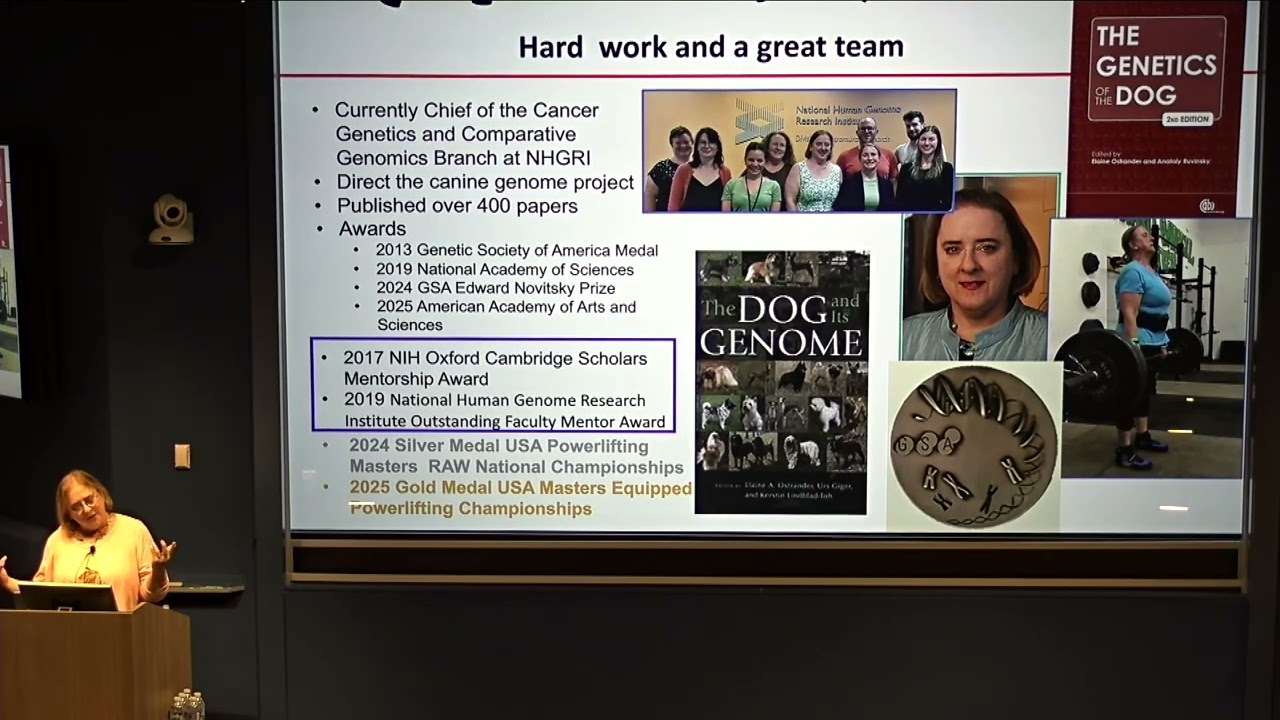
Elaine A Ostrander: Where Did All the Dogs Come From? Dogs, Ancestors, Breeds and Genomes
Keywords
Summary
175 words
Critical Evaluation
Value of the Information & Strength of the Argument
The lecture provides valuable insights into canine genetics, presenting a compelling argument for dogs as a model system for human health. Ostrander effectively demonstrates how breed structure facilitates genetic mapping, with traits controlled by few genes of large effect, contrasting with human genetics. She supports her claims with specific examples, such as the IGF-1 gene and its ancient origin, and the PDGFR mutation linked to bifid nose, which also informs human cleft lip/palate. The argumentation is solid, grounded in published research and collaborative studies, though the presentation is accessible and lacks detailed methodological explanations.
103 words
Title / Content Match
The title accurately reflects the content, which covers the evolutionary origins, breed relationships, and genomic basis of traits in dogs.
Quality & Reliability
8/10
Lecture by a leading expert in canine genetics, presenting peer-reviewed research from her lab and collaborators. The content is well-supported by scientific evidence, though presented in a popular science format without detailed citations in the talk itself.
Key Moments
Markers derived by PSI from the transcript: the creator did not define chapters.
- Introduction to why study dogs: practical reasons, medical relevance, and diversity.
- Overview of dog domestication timeline and breed development.
- Explanation of breed relationships using dendrogram of 160 breeds.
- Discussion of body size genetics, focusing on IGF-1 and its regulation.
- Discovery of ancient wolf with small-size allele, suggesting ancient origin.
- Genotype-first approach: identification of PDGFR mutation in bifid nose.
- Implications for human cleft lip/palate and genetic penetrance.
- Health of mixed-breed dogs and inheritance of disease variants.
- Introduction to behavioral genetics, including herding behavior.
- Summary of Dog10K project and future directions.
Cited Sources
- Simons Foundation Presidential Lectures — Lecture series page where this talk is hosted.
Concurring Sources
- Dog10K project — Mentioned in the talk as a collaborative effort to sequence dog genomes.
Contribution & Novelties
The lecture provides an up-to-date overview of canine genomics, highlighting recent findings from the Ostrander lab, such as the ancient origin of the small-size IGF-1 allele and the genotype-first approach to identify PDGFR in bifid nose. It emphasizes the utility of dogs as a model for human disease, with examples like histiocytic sarcoma and cleft lip/palate. The talk also discusses the Dog10K project, which aims to sequence thousands of dog genomes, a significant resource for the community.
Pour aller plus loin :
- Dog10K project — An international effort to sequence 10,000 dog genomes, directly relevant to the talk’s mention of this project.
- IGF1 gene in dogs — OMIM entry for IGF1, providing details on its role in growth and size.
- Genome-wide association studies in dogs — A review on GWAS in dogs, relevant to the methods discussed.
- Canine cancer genetics — Article on comparative oncology in dogs, relevant to cancer susceptibility discussion.
152 words
Radar Profile
The radar profile shows high scores in quantity and quality of information, reflecting the depth and reliability of the content. The technical level is moderate, suitable for a general scientific audience. The overall reliability is high, consistent with the expert status of the speaker.