Do Mathematicians Need Computers?
Keywords
Summary
152 words
Critical Evaluation
Value of the Information & Strength of the Argument
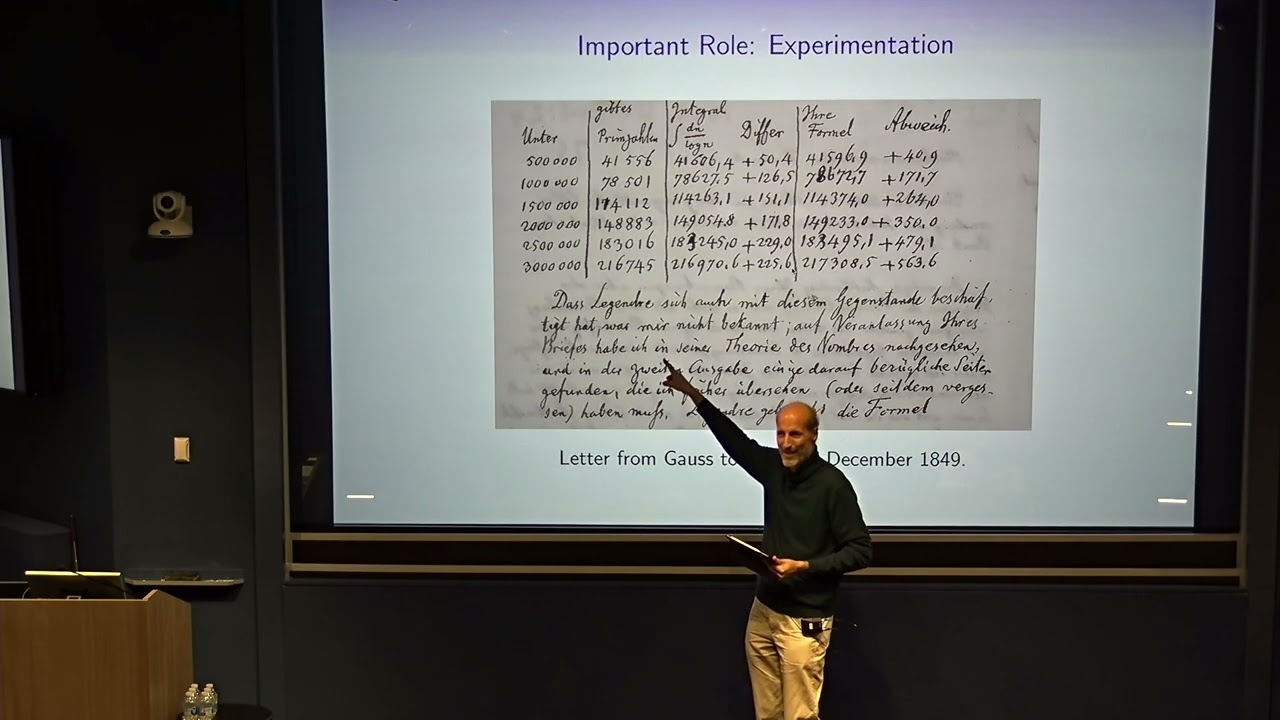
The lecture provides valuable insights into the relationship between mathematics and computation, drawing on historical examples and personal research. Hairer’s argumentation is clear and well-structured, effectively illustrating how computations can serve as experimental tools and how computer-assisted proofs have become part of mathematical practice. He presents a balanced view, acknowledging both the power and limitations of computation in mathematics.
Scientific Rigor, Source Quality, Title Accuracy
Hairer demonstrates scientific rigor by grounding his discussion in concrete examples and his own research. He references historical figures like Gauss and the four-color theorem, and mentions the KPZ equation, a topic he has contributed to. The title accurately reflects the content, and the lecture is well-organized. The sources cited are primarily his own work and well-known mathematical results, lending credibility to his arguments.
138 words
Title / Content Match
The title accurately reflects the content, which explores the role of computers in mathematics.
Quality & Reliability
9/10
Lecture by a Fields Medalist, based on personal research and historical examples, with clear reasoning and no apparent bias.
Key Moments
Markers derived by PSI from the transcript: the creator did not define chapters.
Cited Sources
- Simons Foundation event page — Official event page for the lecture
Concurring Sources
- Simons Foundation event page — Official event page
Contribution & Novelties
The lecture offers a personal perspective from a leading mathematician on the role of computation in mathematics, highlighting both its utility and limitations. It provides concrete examples from research, such as the discovery of unexpected scaling limits, and discusses the evolution of computer-assisted and computer-verified proofs.
Pour aller plus loin :
- Four color theorem — Historical example of computer-assisted proof.
- KPZ equation — Central to Hairer’s research on scaling limits.
- Edwards–Wilkinson model — Related model in interface growth.
78 words
Radar Profile
The radar profile shows high scores in quality and reliability, with slightly lower but still strong scores in quantity and technical level, indicating a well-balanced and authoritative presentation.