Ryotaro Arita: From Equations to Superconductors: Matter Under Pressure (November 12, 2025)
Keywords
Summary
121 words
Critical Evaluation
Value of the Information & Strength of the Argument
The lecture provides valuable insights into the predictive power of first-principles calculations for superconductors. It clearly explains the theoretical framework, from BCS theory to Ginzburg-Landau and DFT, and supports arguments with benchmark results showing good agreement with experiments. The argumentation is solid, building logically from basic concepts to advanced applications, and effectively demonstrates the role of theory in guiding experimental discovery.
Scientific Rigor, Source Quality, Title Accuracy
The scientific rigor is high, with the presenter being a recognized expert. He references key works such as BCS theory, DFT, and specific studies on hydrogen sulfide. The sources are credible, though not all are explicitly cited with URLs. The title accurately reflects the content, and the lecture is well-structured. No public comments were provided for analysis.
133 words
Title / Content Match
The title accurately reflects the content: the lecture moves from theoretical equations to predicting superconducting properties under pressure.
Quality & Reliability
8/10
The lecture is given by a leading expert in computational condensed matter physics, presenting established theoretical frameworks (DFT, BCS) and comparing with experimental data. The content is rigorous and well-structured, though it is a popular science lecture without detailed derivations.
Key Moments
Markers derived by PSI from the transcript: the creator did not define chapters.
- Introduction to superconductivity and emergent phenomena using the story of Swimmie.
- Explanation of BCS theory and phonon-mediated pairing.
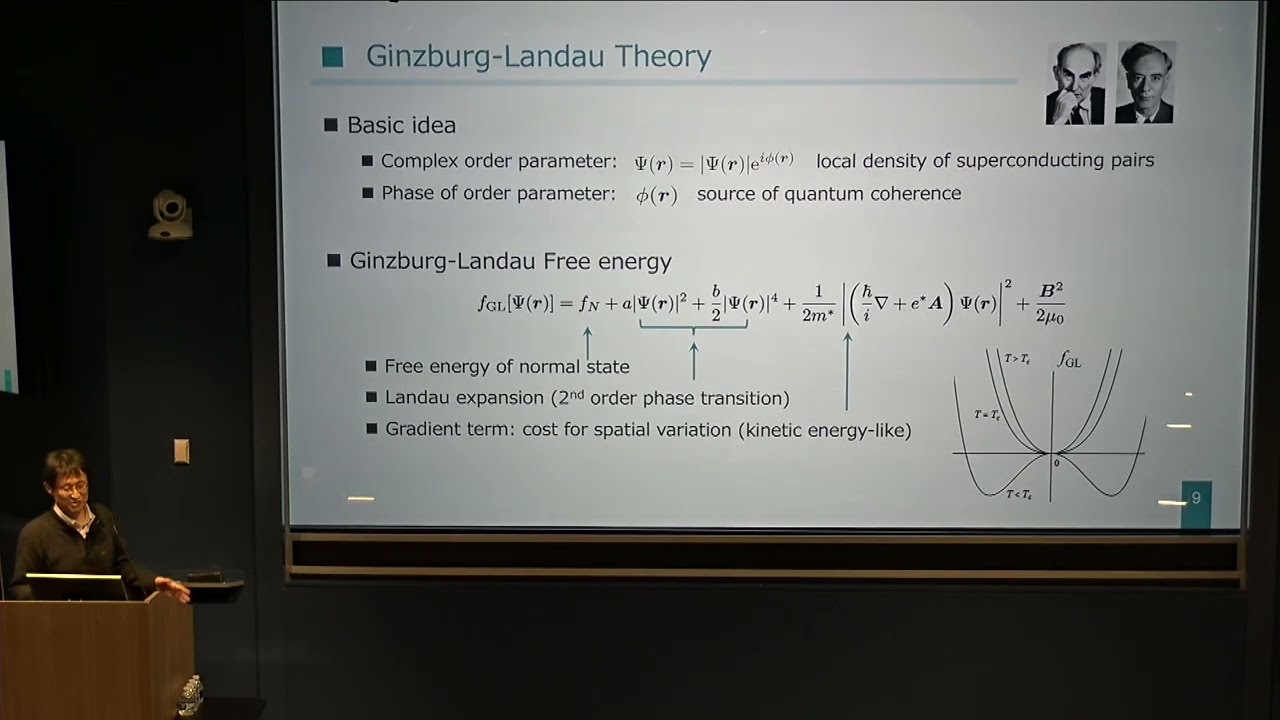
- Introduction of Ginzburg-Landau theory and key parameters (Tc, coherence length, penetration depth).
- Discussion on type I and type II superconductors and vortex state.
- Importance of first-principles calculations for extreme conditions.
- Introduction to density functional theory (DFT) and its extension to superconductors (SCDFT).
- Calculation of Tc, coherence length, and penetration depth for aluminum and niobium.
- Application to hydrogen sulfide under pressure, predicting superconductivity before experiment.
Cited Sources
- BCS theory — Mentioned as the standard mechanism for superconductivity.
- Density functional theory (DFT) — Mentioned as the basis for first-principles calculations.
- Superconducting DFT (SCDFT) — Mentioned as the extension for superconducting states.
- Hydrogen sulfide superconductivity prediction — Mentioned as a successful prediction before experimental discovery.
Concurring Sources
- Density functional theory — The lecture's approach is based on DFT, which is widely accepted.
- BCS theory — The lecture's explanation of superconductivity aligns with BCS theory.
Contribution & Novelties
The lecture provides a clear overview of how first-principles calculations can predict superconducting properties without experimental input, emphasizing their importance for extreme conditions. It highlights the predictive success for hydrogen sulfide, demonstrating the power of theory. The presentation is accessible yet technically informative.
Pour aller plus loin :
- BCS theory — Overview of the microscopic theory of superconductivity.
- Density functional theory — Foundation of first-principles calculations.
- Ginzburg–Landau theory — Phenomenological theory for superconducting phase transitions.
- Superconductivity — General overview of the phenomenon.
82 words
Radar Profile
The radar profile shows high scores in quality and reliability, with slightly lower scores in quantity and technical level, indicating a well-balanced but not overly detailed lecture.