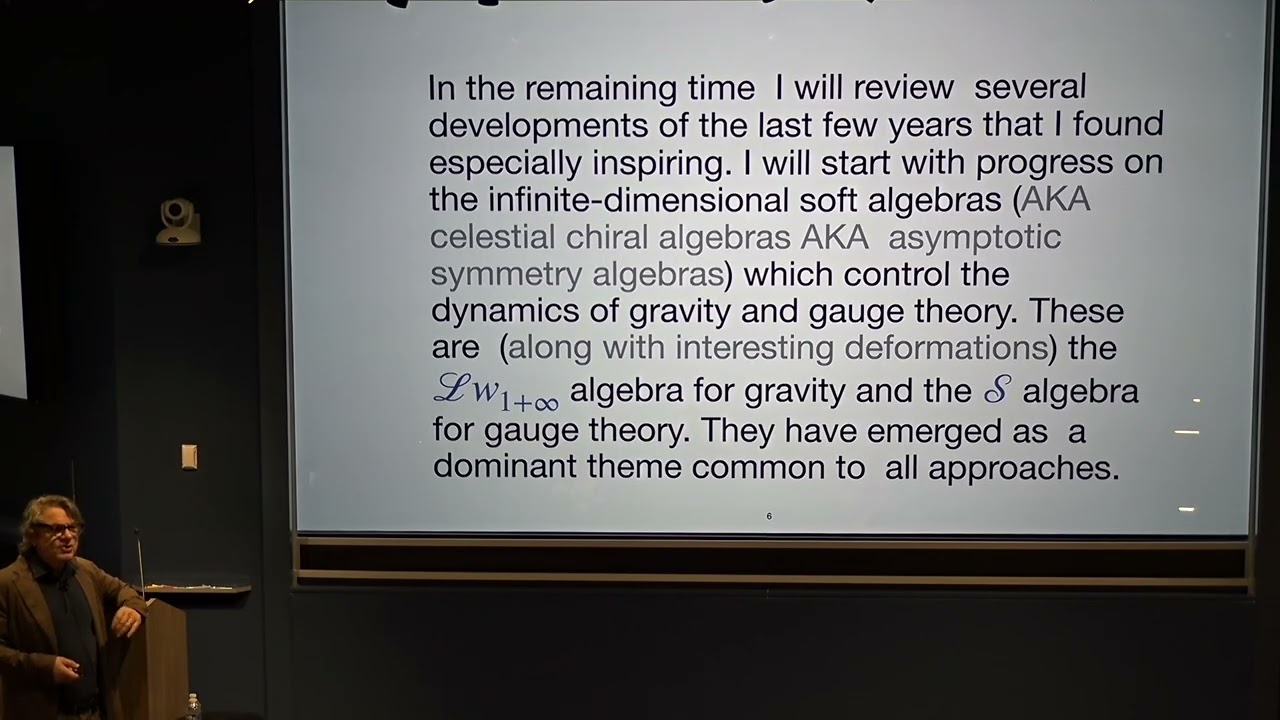
Andrew Strominger: Celestial Holography: Past, Present & Future
Keywords
Summary
176 words
Critical Evaluation
Value of the Information & Strength of the Argument
The talk provides a high-level overview of recent developments in celestial holography, emphasizing the unifying role of infinite-dimensional soft algebras. Strominger presents a coherent narrative, connecting diverse approaches (twistor theory, asymptotic symmetries, amplitudes, CFT) and highlighting a recent deformation that links flat space, AdS, and dS. The argumentation is solid, grounded in established research, and he is transparent about open questions and uncertainties. The value lies in the synthesis of a complex field and the identification of key future directions.
Scientific Rigor, Source Quality, Title Accuracy
The talk is scientifically rigorous, given by a leading expert, and references a body of literature (though specific citations are not given in the talk). The title accurately reflects the content. The description provides a link to the Simons Foundation event page, which is a reliable source. As a conference talk, it is not peer-reviewed, but it is based on published research and ongoing collaborations.
160 words
Title / Content Match
The title accurately reflects the content: a review of celestial holography's past, present, and future.
Quality & Reliability
8/10
Talk by a leading expert in the field, presenting recent developments and open questions. The content is technical and based on established research, but as a conference talk it is not peer-reviewed and includes speculative elements.
Key Moments
Markers derived by PSI from the transcript: the creator did not define chapters.
- Introduction and overview of the collaboration's goals.
- Discussion of the holographic principle and the need to extend beyond AdS.
- Introduction of infinite-dimensional soft algebras as common denominator.
- Explanation of the S algebra and W algebra, and their origins.
- Discovery of the deformed W algebra and its connection to AdS and dS.
- Realization of the deformed algebra via light ray operators in CFT3.
- Discussion of celestial holography vs. amplitude methods.
- Open questions and future directions.
Cited Sources
- Simons Collaboration on Celestial Holography Annual Meeting 2026 — Event page for the talk, providing context and related information.
Concurring Sources
- Simons Foundation event page — Official event page, confirming the talk's context.
Contribution & Novelties
The talk synthesizes recent advances in celestial holography, particularly the emergence of infinite-dimensional soft algebras as a unifying framework. It highlights a new deformed W algebra that connects flat space, AdS, and dS, and its realization via light ray operators in CFT3. This provides a concrete link between previously disparate approaches.
Pour aller plus loin :
- Celestial holography - Wikipedia — Overview of the field.
- Asymptotic symmetry - Wikipedia — Related concept of asymptotic symmetries.
- AdS/CFT correspondence - Wikipedia — Background on holography in AdS.
- W-algebra - Wikipedia — Mathematical structure of W algebras.
94 words
Radar Profile
The radar profile shows high scores across all dimensions, indicating a technically dense and reliable presentation. The talk is particularly strong in technical depth and information quality, with slightly lower but still high scores in information quantity and global reliability.