Yilin Wang: Holography from a Geometric Perspective (May 1, 2026)
Keywords
Summary
193 words
Critical Evaluation
Value of the Information & Strength of the Argument
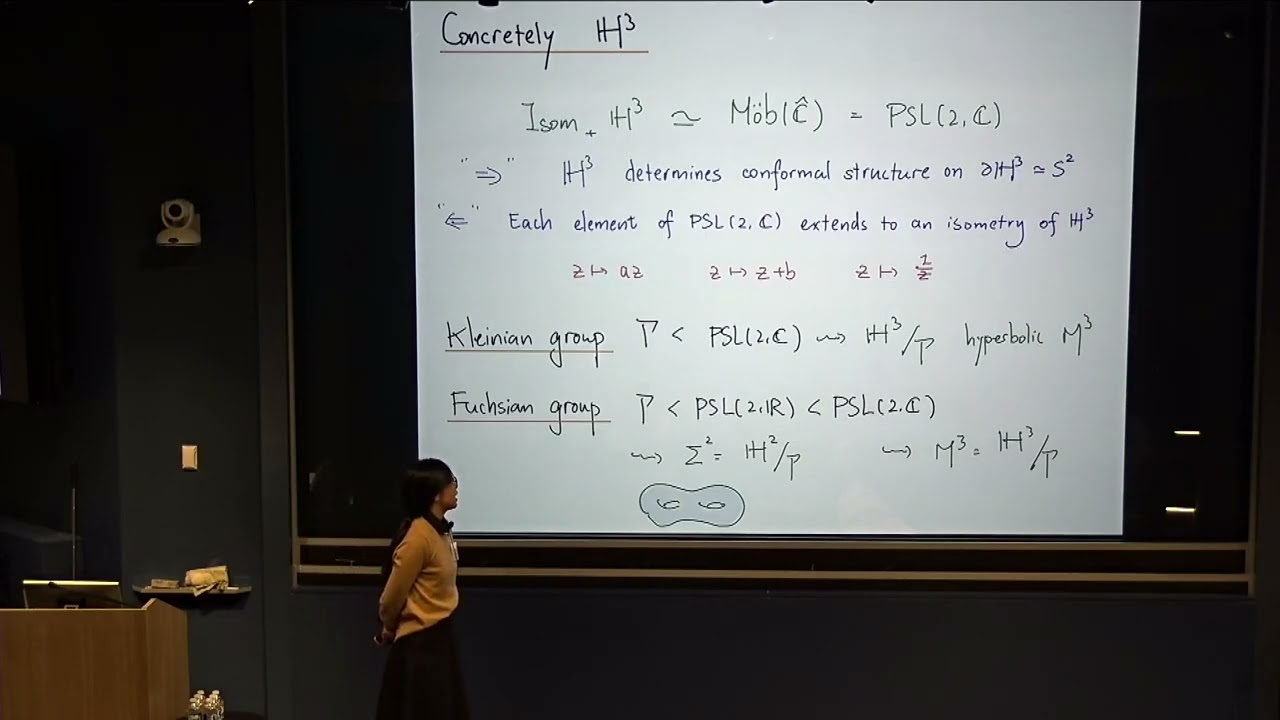
The talk provides a clear and insightful survey of a sophisticated mathematical topic. The value lies in its conceptual unification: it shows how a single geometric construction (Epstein’s truncation) can be used to derive multiple actions in QFT, thereby offering a unifying perspective. The argumentation is logically structured, starting from basic concepts (Möbius transformations) and building up to more complex ideas (quasi-Fuchsian manifolds, renormalized volume). The speaker effectively uses analogies (string art) and visual aids to convey abstract ideas. However, the talk is more of an overview than a detailed proof, and some steps are presented without full justification, which is typical for a seminar talk.
Scientific Rigor, Source Quality, Title Accuracy
The talk demonstrates scientific rigor by grounding its arguments in well-established mathematical concepts (hyperbolic geometry, conformal geometry, Teichmüller theory). The speaker references classical results (Bers’ simultaneous uniformization) and mentions the work of Epstein, Fefferman-Graham, and others. However, no specific citations are given in the video itself; the only link in the description is to the Simons Foundation event page. The title accurately reflects the content, as the talk indeed focuses on holography from a geometric perspective. The talk is not aimed at a general audience but at specialists in mathematics or physics, which is appropriate for the context.
219 words
Title / Content Match
The title accurately reflects the content: the talk focuses on holography from a geometric perspective, discussing the correspondence between bulk hyperbolic geometry and boundary conformal geometry.
Quality & Reliability
8/10
The talk is given by a recognized expert in the field, presents a coherent mathematical framework, and references established concepts (Epstein's truncation, renormalized volume, Fefferman-Graham coordinates). However, it is a survey talk without detailed proofs or peer-reviewed citations in the video itself.
Key Moments
Markers derived by PSI from the transcript: the creator did not define chapters.
- Introduction to holography with string art analogy.
- Definition of holographic principle and hyperbolic manifolds.
- Introduction to Epstein's truncation and its relation to Fefferman-Graham coordinates.
- Discussion of quasi-Fuchsian manifolds and Bers' simultaneous uniformization.
- Definition of Epstein map and its properties.
- Example of Epstein surface for round metric.
- Renormalized volume and Gibbons-Hawking-York term.
- Application to Liouville action and Loewner energy.
- Application to Schwarzian action and relation to Loewner energy.
- Conclusion and outlook for higher dimensions.
Cited Sources
- Simons Collaboration on Probabilistic Paths to Quantum Field Theory Annual Meeting 2026 — Event page for the conference where this talk was given.
Concurring Sources
- Simons Foundation Event Page — Confirms the context of the talk within a scientific collaboration.
Contribution & Novelties
The talk provides a clear geometric perspective on holography, emphasizing the role of Epstein’s truncation as a unifying tool. It connects several seemingly disparate actions in QFT (Liouville, Loewner energy, Schwarzian) through this geometric construction, offering a novel viewpoint for mathematicians and physicists. The speaker highlights the naturalness of the holographic correspondence in low dimensions and suggests potential extensions to higher dimensions.
Pour aller plus loin :
- Holographic principle — Overview of the holographic principle in physics.
- Hyperbolic geometry — Background on hyperbolic manifolds and their properties.
- Conformal field theory — Introduction to CFT, relevant to the boundary theory.
- Loewner energy — Concept related to SLE and the Loewner equation.
- Schwarzian derivative — Mathematical tool used in the Schwarzian action.
120 words
Radar Profile
The radar profile shows high scores across all dimensions, indicating a technically deep and reliable presentation. The talk is particularly strong in information quantity and quality, with a solid technical level and high reliability, reflecting the expertise of the speaker.