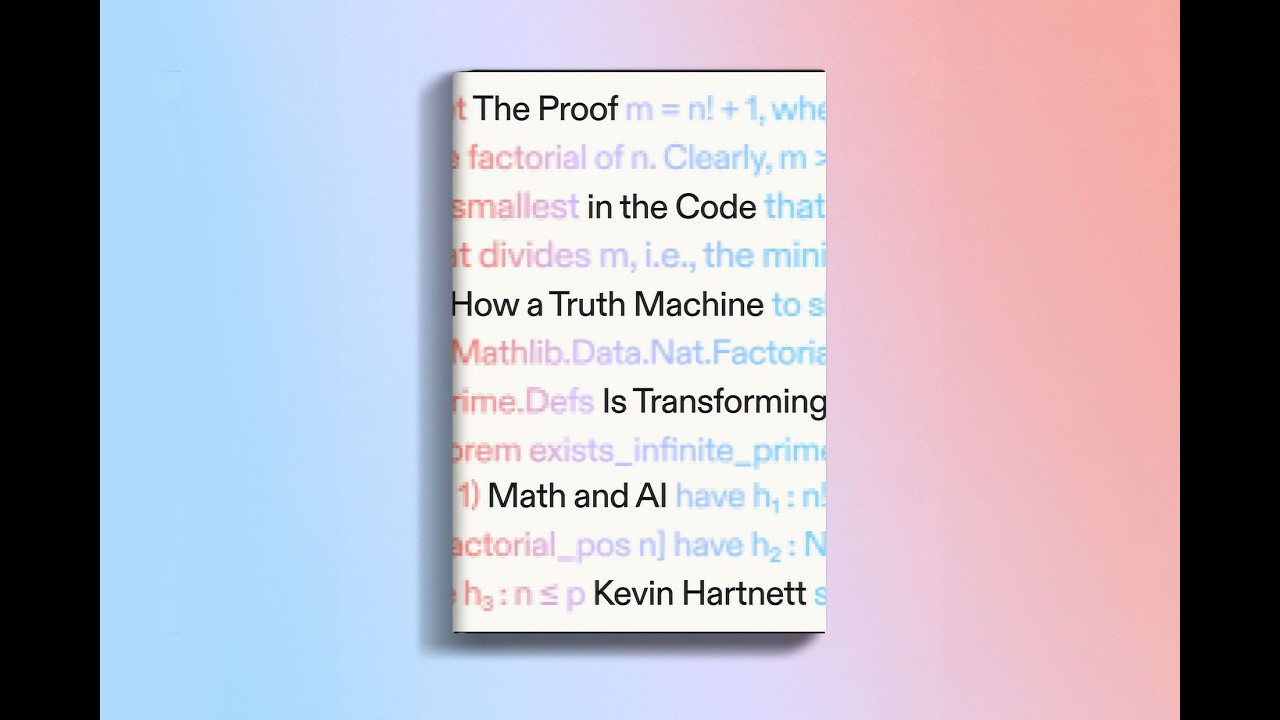
The Proof in the Code: A Conversation with Kevin Hartnett
Keywords
Summary
205 words
Critical Evaluation
Value of the Information & Strength of the Argument
The interview provides valuable insights into the development and significance of Lean, offering a compelling narrative that combines technical explanation with sociological context. Hartnett’s arguments are well-supported by specific examples, such as the liquid tensor experiment and the role of mathlib, and he effectively communicates the potential of Lean to transform mathematical practice and AI. The discussion is balanced, acknowledging both the benefits and challenges of formal verification. However, as an interview, it lacks the depth of a formal analysis and relies on anecdotal evidence and personal perspectives.
97 words
Title / Content Match
The title accurately reflects the content, which focuses on the story and implications of the Lean proof assistant as presented in Hartnett's book.
Quality & Reliability
8/10
The conversation is led by an experienced science journalist (Kevin Hartnett) and the publisher of Quanta Books, providing an authoritative overview of Lean and its impact. The discussion is based on Hartnett's book and includes specific examples and named researchers. However, as an interview, it lacks detailed technical depth and independent verification of claims.
Key Moments
Markers derived by PSI from the transcript: the creator did not define chapters.
- Introduction and definition of a 'truth machine'
- Historical examples of truth verification systems, including Ramon Lull
- Explanation of the Curry-Howard correspondence and the similarity between proofs and programs
- Introduction to Lean and its development at Microsoft Research
- Discussion of the de Bruijn factor and why mathematicians were initially reluctant
- Kevin Buzzard's role as an evangelist and the formalization of perfectoid spaces
- The liquid tensor experiment and verification of Scholze's work
- Use of Lean in software verification and its potential for AI-generated code
- Lean's role in AI training, particularly reinforcement learning for math
- Recent AI achievements in solving math problems, including the unit distance problem
Cited Sources
- The Proof in the Code: How a Truth Machine Is Transforming Math and AI — The book by Kevin Hartnett that this interview is based on.
Concurring Sources
- Lean theorem prover — Official Lean website, confirming its existence and features.
- mathlib — GitHub repository for mathlib, supporting the claims about its development.
Contribution & Novelties
The interview provides a comprehensive overview of Lean’s development and its implications for mathematics and AI, synthesizing historical context, technical details, and personal stories. It highlights the sociological transformation in mathematics and the potential for human-computer collaboration. The discussion of Lean’s role in AI training, particularly in reinforcement learning, is particularly timely and insightful.
Pour aller plus loin :
- Lean theorem prover — Official website for Lean, offering documentation and resources.
- mathlib — The community-maintained library of formalized mathematics for Lean.
- Curry-Howard correspondence — Wikipedia article explaining the link between proofs and programs.
- Interactive theorem proving — Wikipedia article on proof assistants, including Lean.
- Kevin Buzzard’s blog — Blog by Kevin Buzzard, a key advocate for Lean, discussing formalization efforts.
120 words
Radar Profile
The radar profile shows high scores in quantity and quality of information, reflecting the interview's rich content. The technical level is moderate, suitable for a general audience. The reliability is high due to the expertise of the speaker and the consistency with known facts.