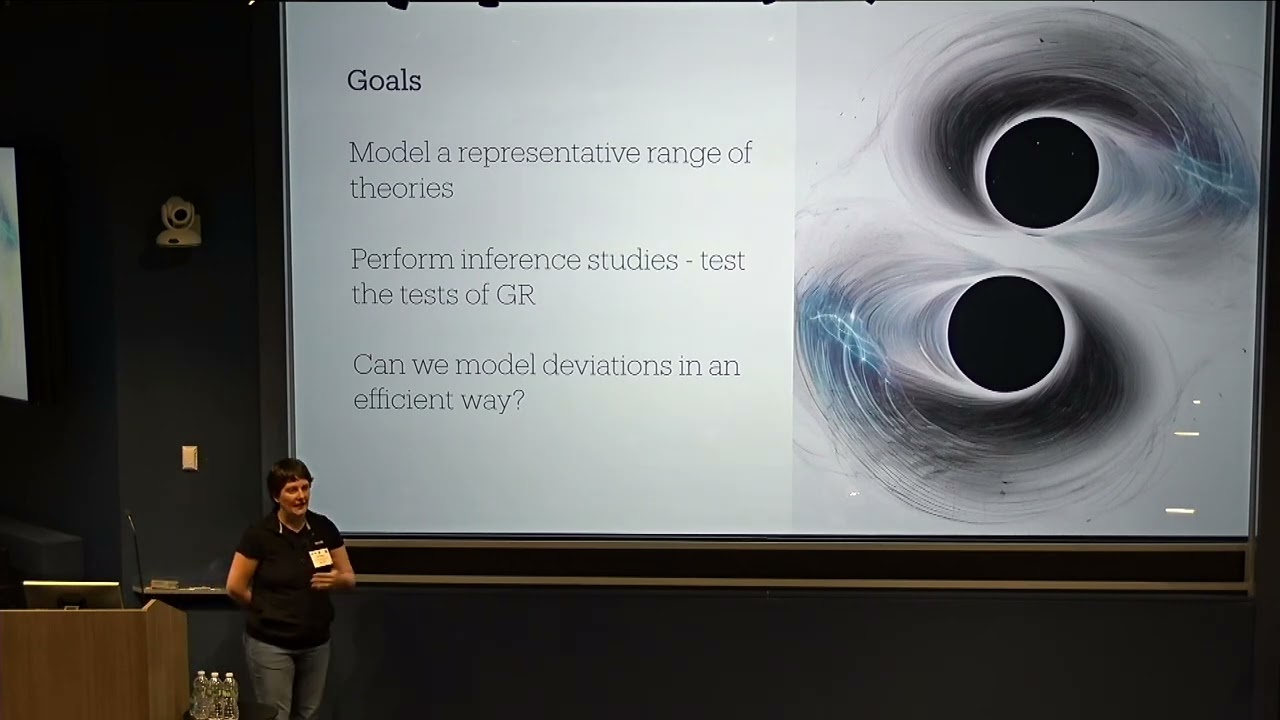
Katy Clough: New Physics in the Strong Field Regime
Keywords
Summary
181 words
Critical Evaluation
Value of the Information & Strength of the Argument
The talk provides valuable insights into the current state of numerical relativity for modified gravity, highlighting both the challenges and recent breakthroughs. The argumentation is well-structured, starting with the motivation for studying new physics, then discussing the modeling landscape, and finally presenting specific results and future directions. Clough effectively communicates the importance of well-posed formulations and code validation, and she acknowledges uncertainties and open questions, such as the disagreement with post-Newtonian results. The presentation is balanced, not overclaiming results, and emphasizes the collaborative nature of the work.
Scientific Rigor, Source Quality, Title Accuracy
The talk is scientifically rigorous, with Clough referencing key works by Kovac, Rial, East, Ripley, and others, though specific citations are not provided in the transcript. The title accurately reflects the content, focusing on new physics in the strong field regime. The talk is part of a Simons Foundation annual meeting, which lends credibility. However, as a conference talk, it does not provide detailed references, and the audience is expected to be familiar with the literature. The adequacy between title and content is high, and the talk does not contain any commercial or promotional content.
197 words
Title / Content Match
The title accurately reflects the content, focusing on new physics in the strong field regime of gravity, particularly in the context of black hole mergers.
Quality & Reliability
8/10
Talk by a leading researcher in numerical relativity, presenting recent results and ongoing work within a collaborative framework. The content is technically accurate and well-motivated, but as a conference talk, it lacks detailed citations and peer-reviewed verification.
Key Moments
Markers derived by PSI from the transcript: the creator did not define chapters.
- Introduction and quiz on which waveform contains new physics
- Discussion of big questions: what new physics looks like, detectability, and EFT deviations
- Motivation for studying new physics with gravitational waves, including future detectors
- Overview of numerical relativity and its role in modeling modified gravity
- Discussion of effective field theories and well-posed formulations
- Presentation of Einstein-scalar-Gauss-Bonnet waveforms and code comparisons
- Introduction of the FHK prescription for generic EFTs
- Discussion of GPU acceleration and its impact on numerical relativity
- Summary and future directions for the collaboration
Cited Sources
- Simons Collaboration on Black Holes and Strong Gravity Annual Meeting 2026 — Event page for the annual meeting where this talk was given.
Concurring Sources
- Simons Foundation Event Page — Official event page confirming the talk's context.
Contribution & Novelties
The talk provides an overview of recent advances in numerical relativity for modified gravity, particularly the ability to simulate Einstein-scalar-Gauss-Bonnet gravity and the development of the FHK prescription for generic EFTs. It highlights the importance of code comparisons and the potential of GPU acceleration. The talk also raises open questions, such as the disagreement with post-Newtonian results, and emphasizes the need for well-posed formulations.
Pour aller plus loin :
- Effective field theory — Provides background on the framework used to parameterize deviations from GR.
- Numerical relativity — Overview of the numerical methods used to solve Einstein’s equations.
- Gravitational wave — Background on gravitational waves and their detection.
- Einstein-scalar-Gauss-Bonnet gravity — Key paper on this modified gravity theory (if URL is uncertain, omit).
122 words
Radar Profile
The radar profile shows high scores in all dimensions, indicating a technically dense and reliable talk. The highest scores are in technical level and information quality, reflecting the expert audience and the depth of content. The lower score in information quantity is relative, but still high, as the talk covers a broad range of topics within the time limit.