Vincenzo Vitelli: Extreme Mechanics of Tissues (October 23, 2025)
Keywords
Summary
106 words
Critical Evaluation
Value of the Information & Strength of the Argument
The talk presents a compelling and original approach to understanding tissue mechanics by bridging scales from subcellular forces to tissue-level flows. The argumentation is solid: the microscopic model is motivated by biological observations, the inference algorithm is rigorously tested on synthetic data, and the coarse-grained theory is derived from the microscopic parameters. The speaker acknowledges limitations and open questions, such as nonlinearities, but the overall logic is clear and convincing.
Scientific Rigor, Source Quality, Title Accuracy
The scientific rigor is high: the research combines theory, experiments, and modern inference techniques, and the methodology is carefully explained. The speaker references prior work on odd elasticity and non-Hermitian metamaterials, but does not provide specific citations in the talk. The title accurately reflects the content, focusing on extreme mechanics of tissues. The talk is a seminar presentation, not a peer-reviewed publication, but the underlying work appears to be rigorous.
155 words
Title / Content Match
The title accurately reflects the content: a presentation on the extreme mechanics of biological tissues, focusing on chiral active mechanics and inference.
Quality & Reliability
8/10
Talk by a leading researcher presenting original research with a clear methodology, combining theory, experiments, and inference. The approach is rigorous and includes validation on synthetic data. However, the presentation is a seminar, not a peer-reviewed publication, and some details are glossed over.
Key Moments
Markers derived by PSI from the transcript: the creator did not define chapters.
- Introduction: from gravitational waves to biological waves, motivation for studying tissues as chiral non-Hermitian metamaterials.
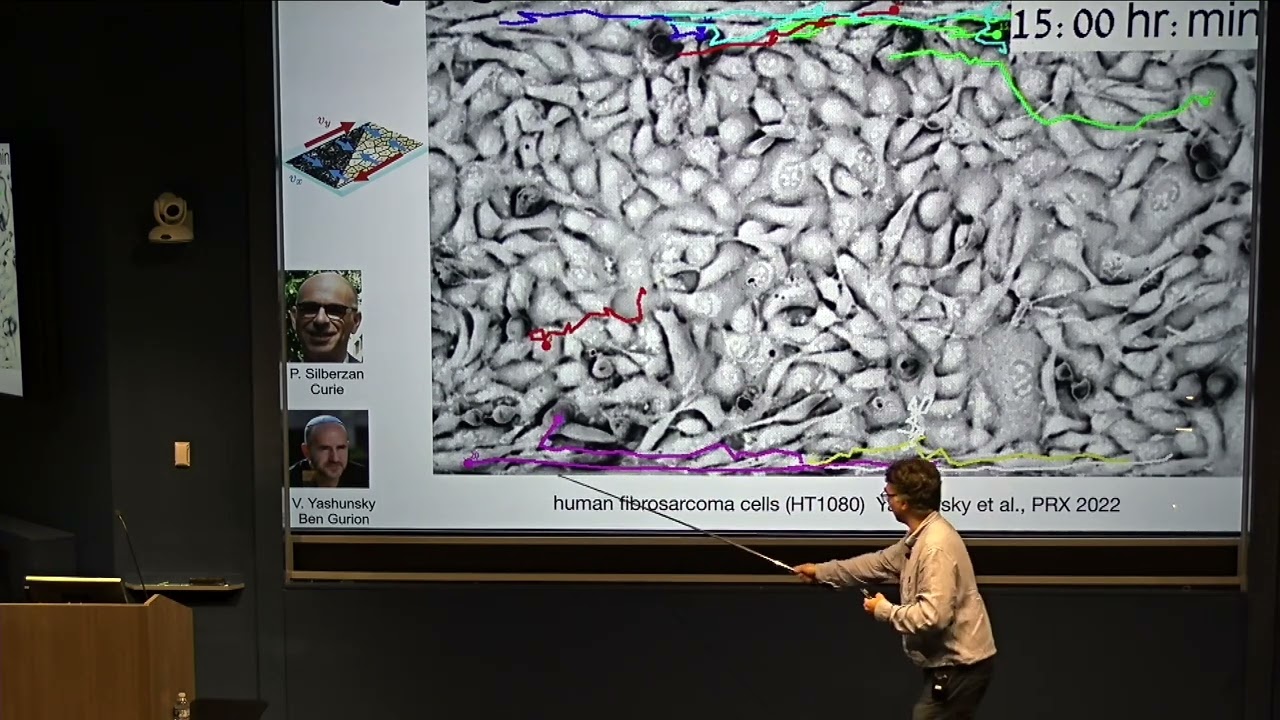
- Experimental setup: tissue in a channel, showing opposite flows at top and bottom edges, indicating chiral behavior.
- Microscopic model: cell as a chiral fiber network, introducing non-conservative forces and the parameter alpha_0.
- Vertex model: non-variational extension, adding a non-conservative force term.
- Inference challenge: noisy data and topological changes (T1 events) hinder gradient-based methods.
- NADA algorithm: nudging data to regularize the loss landscape, inspired by a cat pushing objects off a table.
- Validation on synthetic data: NADA recovers parameters accurately, unlike standard automatic differentiation.
- Application to real data: inferred flow fields match experiments well.
- Coarse-graining: deriving hydrodynamic theory with odd viscoelastic moduli, predicting new terms like K_0 and A.
- Continuity equation: including cell proliferation and death, which are spatially inhomogeneous.
Cited Sources
- Simons Foundation — The talk is hosted by the Simons Foundation, and the description mentions the Simons Collaboration on Extreme Wave Phenomena Based on Symmetries.
Concurring Sources
- Simons Foundation — The talk is hosted by the Simons Foundation, which supports research in mathematics and physical sciences.
Contribution & Novelties
The talk presents a novel framework for understanding chiral active mechanics in biological tissues, combining a microscopic vertex model with a new inference algorithm (NADA) and coarse-graining to predict macroscopic flows. This bridges scales from subcellular forces to tissue-level behavior, offering a parameter-free approach to model complex biological systems.
Pour aller plus loin :
- Odd elasticity — Relevant concept for non-conservative mechanical responses.
- Active matter — Broad field encompassing systems with self-propelled units.
- Vertex model — A computational model for epithelial tissues.
- Automatic differentiation — Technique used in the NADA algorithm.
91 words
Radar Profile
The radar profile shows high scores across all dimensions, with particularly strong performance in technical level and information quality, indicating a dense, expert-level presentation with robust methodology.