Sourav Chatterjee: What Is a Probabilistically Defined Quantum Field Theory? (April 30, 2026)
Keywords
Summary
157 words
Critical Evaluation
Value of the Information & Strength of the Argument
The talk provides valuable insights into the rigorous construction of QFTs using probabilistic methods. Chatterjee clearly explains the connection between Euclidean path integrals and stochastic processes, and demonstrates the power of the Markov process approach with a concrete example. The argumentation is solid, building from classical mechanics to quantum mechanics and then to QFT, and he carefully distinguishes between heuristic and rigorous results. He also highlights the limitations and open problems, which adds to the credibility.
Scientific Rigor, Source Quality, Title Accuracy
The talk is scientifically rigorous, referencing established frameworks (Osterwalder-Schrader, Wightman, Haag-Kastler) and standard theorems (Stone’s theorem, Hille-Yosida). The description provides a link to the Simons Foundation event page, which is a reliable source. The title accurately reflects the content. The talk is an expert overview, not a peer-reviewed publication, but it is presented by a leading researcher in the field.
151 words
Title / Content Match
The title accurately reflects the content: the talk explains probabilistic approaches to defining quantum field theories, with a focus on rigorous construction.
Quality & Reliability
8/10
Talk by a leading mathematician (Sourav Chatterjee) at a Simons Foundation event, presenting rigorous mathematical frameworks (Osterwalder-Schrader, Wightman, Haag-Kastler) and concrete examples (harmonic oscillator, Ornstein-Uhlenbeck). The content is technically accurate and well-structured, though it is an overview talk and not a peer-reviewed publication.
Key Moments
Markers derived by PSI from the transcript: the creator did not define chapters.
- Introduction to classical Lagrangian mechanics and action.
- Path integral formulation and the problem of oscillatory integrals.
- Introduction to Osterwalder-Schrader framework and Hilbert space construction.
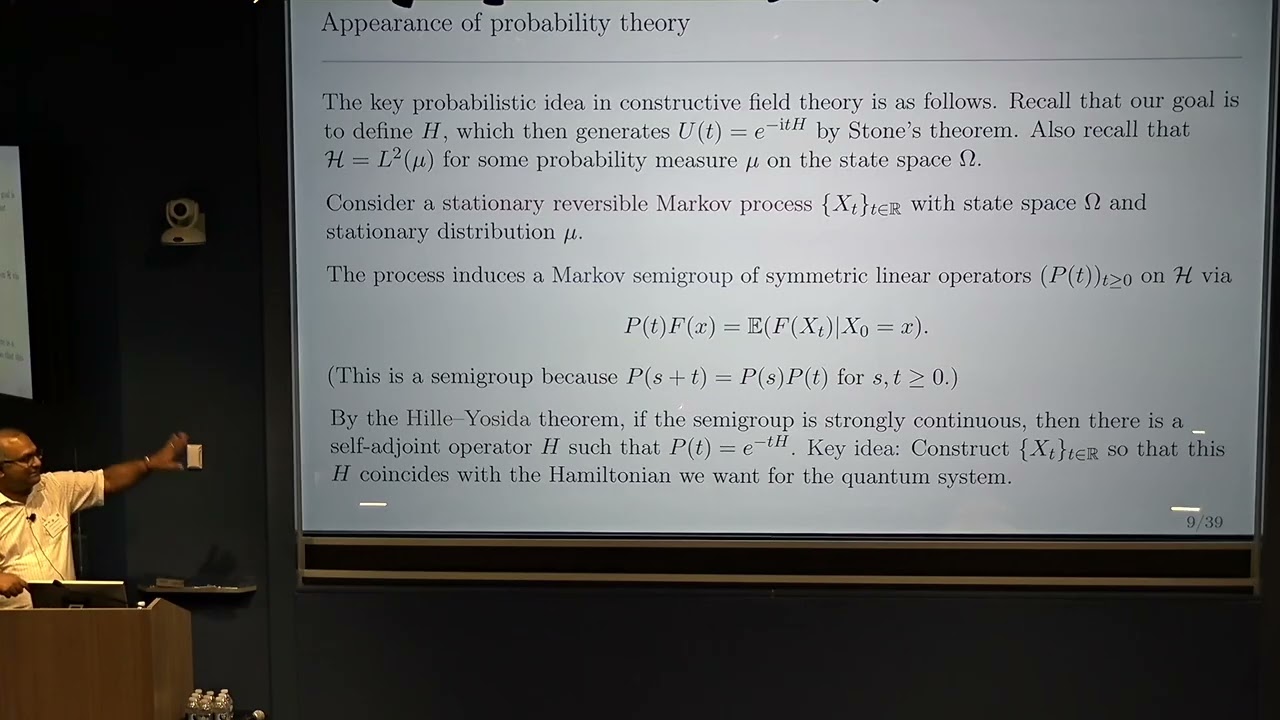
- Key probabilistic idea: stationary reversible Markov processes and Hamiltonian construction.
- Simple harmonic oscillator example and Ornstein-Uhlenbeck process.
- Discussion of Osterwalder-Schrader axioms and reflection positivity.
- Successful constructions in constructive field theory.
- Open problems and the Yang-Mills existence and mass gap Millennium problem.
Cited Sources
- Simons Collaboration on Probabilistic Paths to Quantum Field Theory Annual Meeting 2026 — Event page for the talk, providing context and related information.
Concurring Sources
- Constructive Quantum Field Theory — General overview of constructive QFT, consistent with the talk's content.
Contribution & Novelties
The talk provides a clear and accessible overview of probabilistic methods in constructive quantum field theory, emphasizing the role of Markov processes and reflection positivity. It bridges the gap between physics and probability, making the subject more approachable. The example of the harmonic oscillator illustrates the abstract concepts concretely.
Pour aller plus loin :
- Osterwalder-Schrader axioms — Foundational axioms for Euclidean field theory.
- Ornstein-Uhlenbeck process — The stochastic process arising in the harmonic oscillator example.
- Yang-Mills existence and mass gap — The Millennium Prize problem mentioned in the talk.
89 words
Radar Profile
The radar profile shows high scores across all dimensions, indicating a technically rich and reliable talk. The balance between information quantity, quality, and technical depth is strong, with a slight emphasis on technical level.