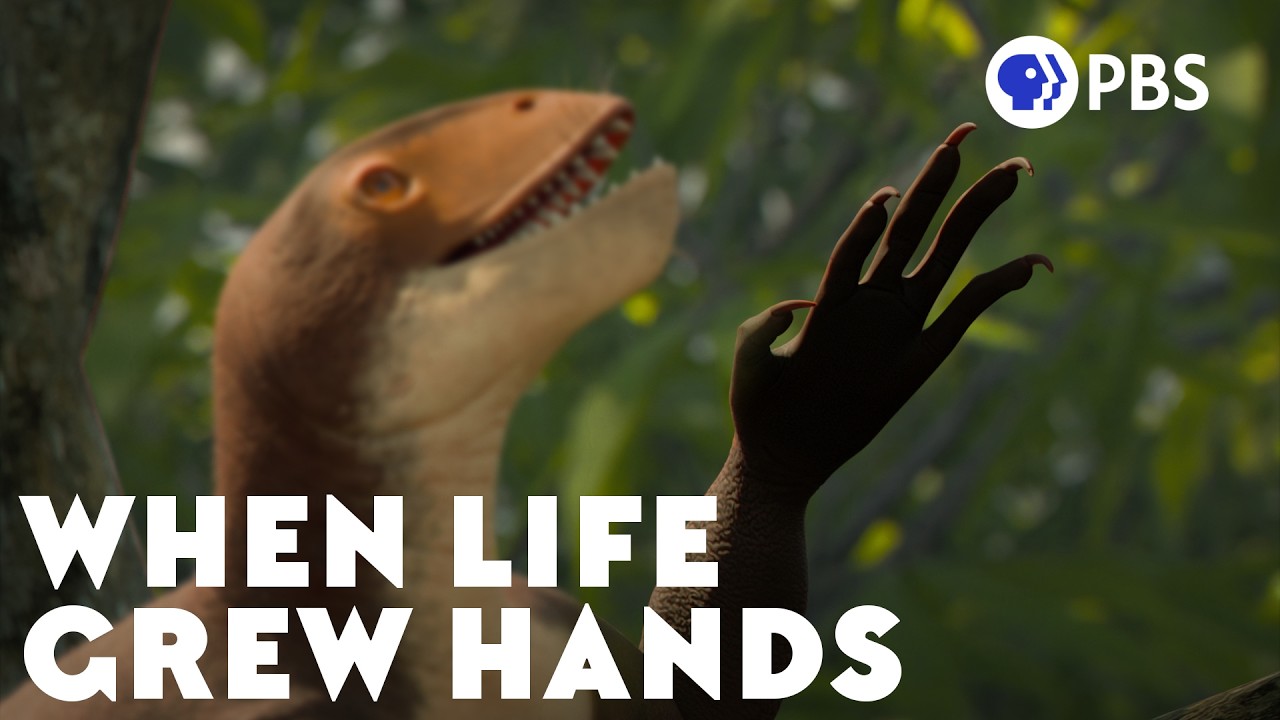
What Drove Life Into The Trees?
Keywords
Summary
178 words
Critical Evaluation
Value of the Information & Strength of the Argument
The video provides valuable insights into a relatively obscure aspect of evolutionary history, synthesizing recent paleontological findings. It effectively argues that the evolution of arboreality was driven by ecological opportunities, particularly the availability of insects and later leaves in the canopy. The argumentation is solid, using specific fossil evidence and anatomical comparisons to support each claim. The video also highlights the importance of convergent evolution and the role of environmental changes, such as the development of denser canopies, in shaping evolutionary trajectories. The presentation is engaging and accessible, making complex scientific concepts understandable without oversimplifying the evidence.
Scientific Rigor, Source Quality, Title Accuracy
The video maintains a high standard of scientific rigor, referencing multiple peer-reviewed studies and consulting with experts. The sources are credible, and the information is presented with appropriate caveats, such as acknowledging uncertainties about the phylogenetic position of varanopids. The title accurately reflects the content, and the video stays on topic throughout. The production quality is excellent, with clear visuals and animations that aid understanding. The comments section shows a generally positive reception, with viewers appreciating the depth of information and the engaging presentation.
196 words
Title / Content Match
The title accurately reflects the content, which explores the evolutionary history of tetrapods moving into trees, focusing on the timing, mechanisms, and ecological drivers.
Quality & Reliability
8/10
The video is produced by PBS Eons, a reputable science communication channel, and presents a well-structured narrative based on peer-reviewed paleontological research. The information is up-to-date and includes specific fossil evidence and scientific interpretations. However, as a popular science video, it simplifies complex topics and does not provide full methodological details, which slightly limits its reliability for a specialist audience.
Key Moments
Markers derived by PSI from the transcript: the creator did not define chapters.
- Introduction to the episode and the discovery of Suminia.
- Discussion of the first trees in the Devonian and the flat world before them.
- Introduction of the first arboreal amniotes: Anthracodromeus and Cephalerpeton.
- Explanation of the difference between scansorial and arboreal adaptations.
- Introduction of the varanopids Eoscansor and Ascendonanus and their climbing adaptations.
- Introduction of the weigeltisaurids, the oldest gliding tetrapods.
- Discussion of Suminia's unique adaptations and its herbivorous diet.
- Explanation of how dense canopies in the Permian facilitated full arboreality.
- Conclusion and promotion of the new PBS series 'Eons: Life and Death on Pangea'.
Cited Sources
- References for this episode — The video description provides a link to a document with references for the episode.
- PBS Eons on Bluesky — Social media link for the channel.
- Support PBS Eons — Donation link for PBS Member Stations.
- Eons: Life and Death on Pangea (PBS App) — Link to the PBS App for watching the new series.
- Eons: Life and Death on Pangea (Web) — Link to watch the series on the web, for viewers outside the U.S.
Concurring Sources
- Suminia getmanovi — Wikipedia article on Suminia, which supports the video's description of its arboreal adaptations.
- Weigeltisauridae — Wikipedia article on the gliding reptiles, consistent with the video's claims.
Contribution & Novelties
The video provides a comprehensive and up-to-date synthesis of the evolutionary history of arboreality in tetrapods, highlighting recent discoveries and interpretations. It offers a novel perspective by linking the evolution of climbing and gliding to the development of dense forest canopies in the Permian, a factor not commonly emphasized. The video also clarifies the distinction between scansorial and arboreal lifestyles, which is crucial for understanding the gradual transition to tree-dwelling.
Pour aller plus loin :
- Arboreal locomotion — Overview of the different modes of tree-dwelling locomotion.
- Permian — Geological period during which many of the discussed adaptations evolved.
- Convergent evolution — Concept explaining the repeated evolution of similar traits in unrelated lineages.
- Suminia — Wikipedia page on the early synapsid featured in the video.
- Weigeltisauridae — Family of gliding reptiles from the Permian.
133 words
Radar Profile
The radar profile shows high scores in quantity and quality of information, indicating a well-researched and informative video. The technical level is moderate, making it accessible to a general audience while still providing depth. The overall reliability is high, reflecting the credibility of the source and the accuracy of the content.
💬 Très positif. Sur les 30 commentaires analysés, les spectateurs expriment un fort enthousiasme pour le contenu, apprécient la qualité de la production et la profondeur des informations, et certains demandent des épisodes supplémentaires sur des sujets connexes.