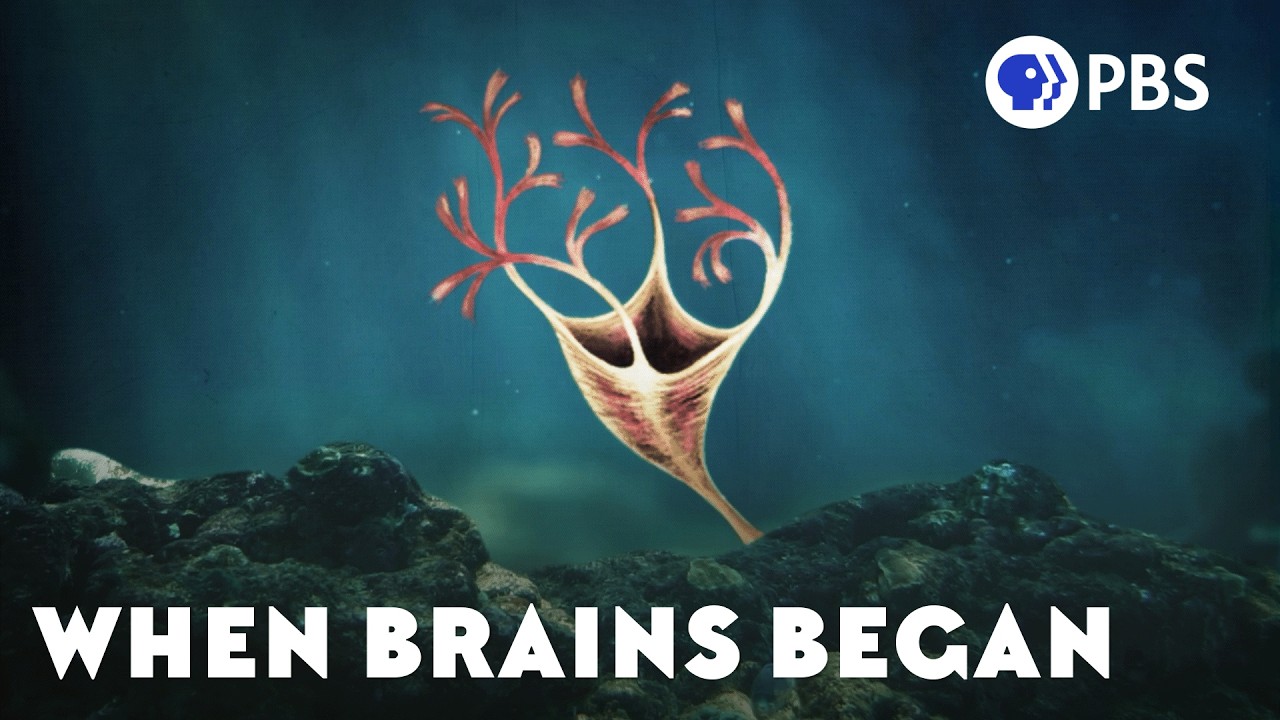
How Brawn Led to Brains
Keywords
Summary
188 words
Critical Evaluation
Value of the Information & Strength of the Argument
The video provides valuable insights into the evolutionary link between muscular and neural systems, synthesizing recent paleontological findings. It presents a compelling argument that brains evolved initially for internal coordination rather than sensory processing, a perspective that adds depth to our understanding of brain origins. The argumentation is logical and well-supported by specific fossil evidence, such as Haootia and Stanleycaris, and molecular clock data. The narrative effectively connects the Ediacaran period’s apparent inactivity with the Cambrian explosion’s burst of complexity, offering a coherent evolutionary story.
Scientific Rigor, Source Quality, Title Accuracy
The video maintains high scientific rigor, referencing specific fossils and studies, and provides a link to a references document in the description. The sources are credible, including peer-reviewed research on early nervous systems. The title accurately reflects the content, which focuses on the role of muscular development in brain evolution. The video also includes a land acknowledgement, showing cultural sensitivity. Overall, the content is reliable and well-sourced, with minor simplifications typical of science communication.
174 words
Title / Content Match
The title accurately reflects the video's central thesis that muscular development preceded and drove brain evolution.
Quality & Reliability
8/10
The video is well-researched, citing specific fossil evidence and molecular clock data, and is produced by PBS Eons, a reputable educational channel. The content aligns with current scientific understanding, though some interpretations are simplified for a general audience.
Key Moments
Markers derived by PSI from the transcript: the creator did not define chapters.
- Introduction: Questioning why animals have brains, using a 560-million-year-old Ediacaran creature as an example.
- Explanation of nervous systems and neurons, and the difficulty of fossilizing them.
- Molecular clock evidence suggests nervous systems appeared ~625 million years ago, but fossil evidence is lacking.
- Cambrian explosion: rapid appearance of complex brains, with examples like Cardiodictyon and Stanleycaris.
- Discussion of the 'information revolution' and how eye evolution drove brain growth.
- Proposal that early brains evolved to coordinate muscles, citing Haootia as evidence.
- Conclusion: Brawn led to brains, and without muscles, brains might not have evolved.
Cited Sources
- References document — List of scientific references used in the video.
Concurring Sources
- References document — The video's references likely include studies supporting the claims made.
External References
Contribution & Novelties
The video offers a novel perspective on brain evolution, suggesting that the primary driver for the emergence of brains was the need to coordinate muscular movement, rather than processing sensory information. This challenges the traditional view that brains evolved for intelligence. It synthesizes recent fossil discoveries and molecular data to support this hypothesis.
Pour aller plus loin :
- Cambrian explosion — Relevant to the rapid diversification of animals with brains.
- Nervous system evolution — Provides background on the origins of neurons and nerve nets.
- Haootia — The fossil organism mentioned as evidence of early muscle tissue.
- Molecular clock — Technique used to estimate evolutionary timelines.
105 words
Radar Profile
The radar profile shows high scores in information quantity, quality, and reliability, with a moderate technical level. This indicates a well-balanced, informative video that is accessible to a general audience while maintaining scientific accuracy.
💬 Très positif. Sur les 30 commentaires analysés, les spectateurs expriment un fort enthousiasme pour la vidéo, saluant la qualité du contenu et la continuité de la chaîne malgré les défis de financement.