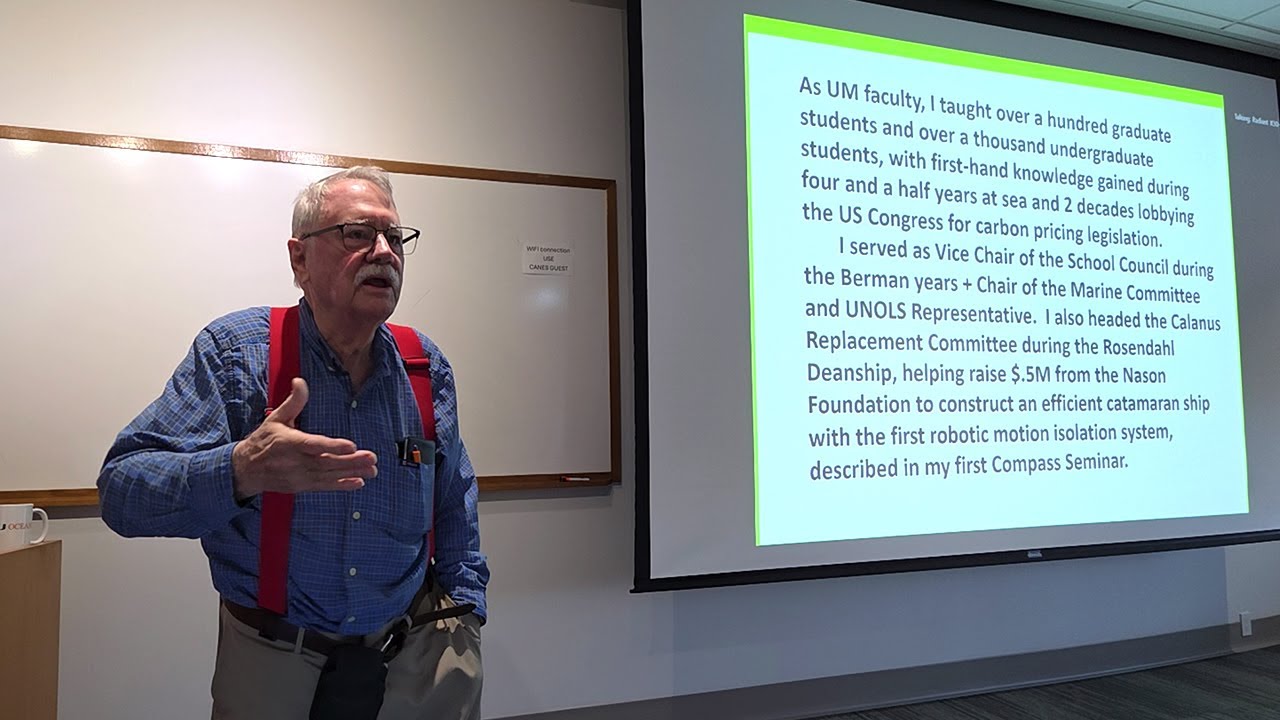
John van Leer, Rosenstiel: My Life - So Far
Keywords
Summary
142 words
Critical Evaluation
Value of the Information & Strength of the Argument
The value of the information lies in the unique first-hand perspective of a long career in oceanography, covering both technical details and personal anecdotes. The argumentation is based on personal experience and is presented as a narrative, not as a scientific argument. The speaker provides specific examples of his work, such as the design of the ‘scissors’ instrument and the use of a CO2 pressure standard, which adds credibility. However, the talk is not structured to prove a point but to share a life story, so the argumentation is more about the coherence of his career choices and the lessons learned.
Scientific Rigor, Source Quality, Title Accuracy
The scientific rigor is moderate: the talk is a personal account, and while the speaker is an expert, he does not provide citations or references. The quality of sources is limited to his own experiences and mentions of institutions like MIT, WHOI, and RSMAS. The title accurately reflects the content, as it is indeed a personal retrospective. No comments were provided, so no analysis of public reception is possible.
185 words
Title / Content Match
The title accurately reflects the content: a personal retrospective of John van Leer's life and career.
Quality & Reliability
8/10
First-hand account by a senior oceanographer with decades of field experience, but relies on personal memory and lacks external verification.
Key Moments
Markers derived by PSI from the transcript: the creator did not define chapters.
- Introduction by Roland, welcoming John van Leer.
- John starts his talk, mentioning his plans for the next 20 years and his electric vehicles.
- Childhood during WWII, early interests in science and engineering.
- Building a homemade SCUBA at 14 and getting air from WHOI.
- Working as an apprentice machinist and Fuller Brush salesman.
- College years, summer jobs, and decision to join MIT Instrumentation Lab.
- PhD at MIT-WHOI, work with Henry Stommel, and development of the 'scissors' instrument.
- Arctic under-ice experiments, including the igloo and the storm event.
- Career at RSMAS, teaching, and advocacy for carbon pricing.
- Recent interest in electric vehicles and robotics, and concluding remarks.
Cited Sources
- No external sources cited — The talk is a personal narrative without citations.
Concurring Sources
- No concordant sources provided — No external sources were mentioned in the video.
Dissenting Sources
- No discordant sources provided — No external sources were mentioned in the video.
Contribution & Novelties
The talk provides a unique personal perspective on the development of oceanographic instrumentation and field research over several decades. It highlights the importance of hands-on engineering and adaptability in scientific careers. The speaker’s experiences with early robotic profilers and under-ice observations offer insights not commonly found in textbooks.
Pour aller plus loin :
- Cyclesonde — A type of oceanographic profiler, relevant to the speaker’s work.
- Henry Stommel — Renowned oceanographer, the speaker’s PhD advisor.
- Marginal Ice Zone Experiment — Context for the Arctic research mentioned.
85 words
Radar Profile
The radar profile shows high scores in quantity and quality of information, reflecting the rich personal narrative, but lower in technical level and reliability due to the lack of external verification. This suggests a talk that is informative and engaging but not rigorously scientific.