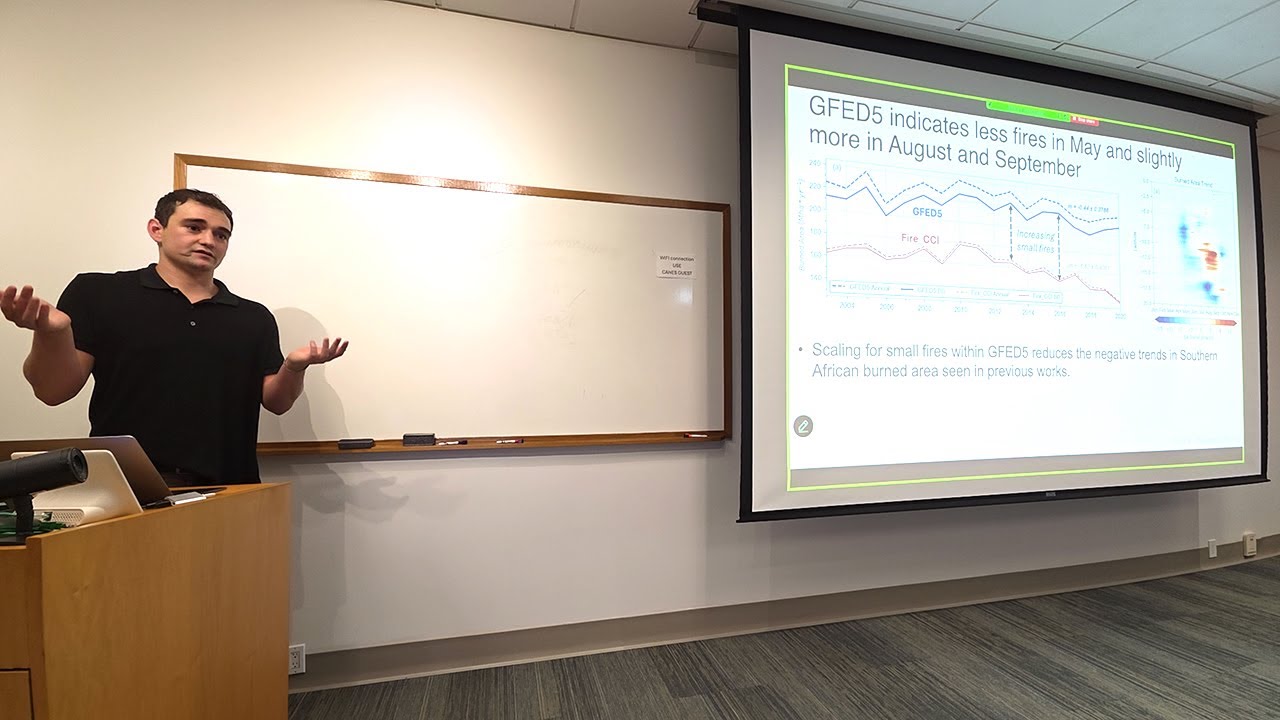
Tyler Tatro, Rosenstiel: Smoke-Cloud Interactions
Keywords
Summary
172 words
Critical Evaluation
Value of the Information & Strength of the Argument
The talk provides valuable insights into the complex interactions between absorbing aerosol and stratocumulus clouds, a critical but understudied area. The argumentation is solid, based on multiple lines of evidence: reanalysis, satellite data, and in-situ observations. The speaker clearly explains the physical mechanisms and supports claims with quantitative analyses, such as correlations and composites. The discussion of implications for marine cloud brightening and shipping tracks adds practical relevance. The presentation is well-structured, with clear transitions between synoptic and decadal scales.
Scientific Rigor, Source Quality, Title Accuracy
The research appears scientifically rigorous, using established datasets (ERA5, CAMS, MODIS, CALIPSO) and comparing with observations. The speaker cites relevant literature (e.g., Ghan and Feingold 2022, Meyer et al.) and acknowledges limitations, such as reanalysis underestimating magnitudes. The title accurately reflects the content. No comments were provided for analysis.
144 words
Title / Content Match
The title accurately reflects the content, focusing on smoke-cloud interactions in the Southeast Atlantic.
Quality & Reliability
8/10
The talk presents original research based on well-established observational and reanalysis datasets (ERA5, CAMS, satellite), with clear methodology and comparisons to observations. The speaker is a PhD candidate, and the content is consistent with current scientific understanding. Minor limitations include reliance on reanalysis and lack of peer-reviewed publication details.
Key Moments
Markers derived by PSI from the transcript: the creator did not define chapters.
- Introduction to smoke-cloud interactions and the importance of stratocumulus clouds.
- Overview of known effects of smoke on stratocumulus: semi-direct and indirect effects.
- Discussion of challenges in observing aerosol in the marine boundary layer and validation of reanalysis.
- Synoptic analysis of the Angolan thermal low and its role in smoke transport.
- Implications for shipping track cloud brightness estimates.
- Decadal trends in circulation and aerosol transport, and their radiative effects.
Cited Sources
- Wood, R. (2012). Stratocumulus Clouds. Monthly Weather Review. — Referenced for the global coverage and importance of stratocumulus clouds.
- Ghan, S., & Feingold, G. (2022). Aerosol-cloud-precipitation interactions. — Referenced for the regimes of cloud albedo response to droplet number concentration.
- Meyer, J. et al. (recent paper on aerosol optical depth trends in Southeast Atlantic) — Referenced for observed trends in aerosol optical depth.
- Atall, R. et al. (2021). High-resolution burned area mapping. — Referenced for underestimation of burned area from MODIS.
Concurring Sources
- Wood, R. (2012). Stratocumulus Clouds. Monthly Weather Review. — Supports the importance and characteristics of stratocumulus clouds.
- Ghan, S., & Feingold, G. (2022). Aerosol-cloud-precipitation interactions. — Supports the regimes of cloud response to aerosol.
Contribution & Novelties
The talk contributes new insights into the synoptic and decadal drivers of smoke-cloud interactions in the Southeast Atlantic, particularly the role of the Angolan thermal low in modulating marine boundary layer aerosol and cloud properties. It also highlights the implications for marine cloud brightening and shipping track studies. The use of reanalysis and satellite data to bridge scales is a methodological strength.
Pour aller plus loin :
- Stratocumulus cloud — Overview of stratocumulus clouds and their role in climate.
- Aerosol-cloud interaction — General concept of aerosol effects on clouds.
- Biomass burning — Context for the source of smoke aerosol.
- ERA5 — Reanalysis dataset used in the study.
- CAMS — Copernicus Atmosphere Monitoring Service for aerosol reanalysis.
116 words
Radar Profile
The radar profile shows high scores across all dimensions, indicating a well-rounded and reliable presentation. The highest score is in quantity of information, reflecting the comprehensive coverage of the topic, while the lowest is in technical level, though still high, suggesting accessibility to a broad scientific audience.