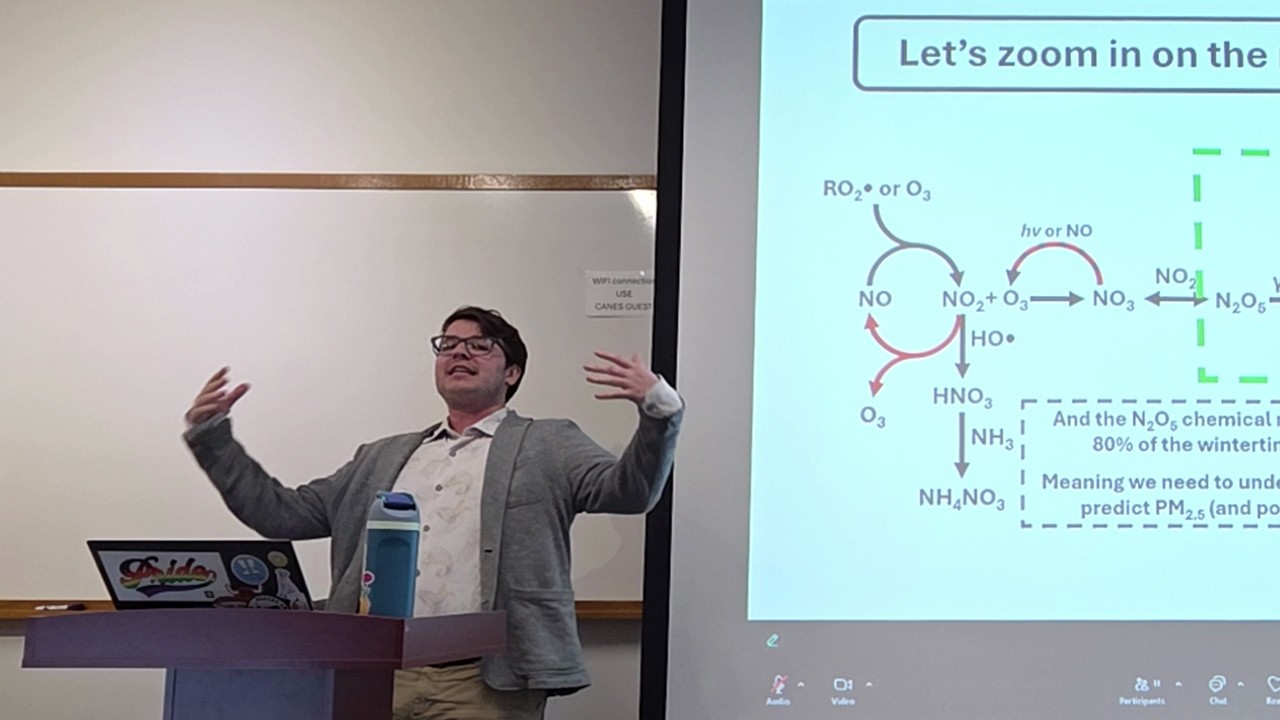
James Christie, Rosenstiel: Atmospheric Chemistry in the Salt Lake Valley
Keywords
Summary
162 words
Critical Evaluation
Value of the Information & Strength of the Argument
The talk provides valuable insights into the mechanisms of wintertime pollution in the Salt Lake Valley, specifically the role of N2O5-aerosol reactions. The argumentation is solid, based on original experimental data and field measurements. The speaker clearly explains the chemical mechanisms and the significance of γN2O5, and supports his claims with data from laboratory and field studies. He also discusses limitations and uncertainties, such as the back-of-the-envelope calculation for playa dust contribution. The presentation is well-structured and logically progresses from background to methods to results and implications.
Scientific Rigor, Source Quality, Title Accuracy
The scientific rigor is high: the research is based on established methods (flow tube, mass spectrometry) and the speaker references prior work (e.g., Drew Mitru’s study). The sources are not explicitly cited in the video, but the description mentions the research context. The title accurately reflects the content, focusing on atmospheric chemistry in the Salt Lake Valley. The talk is a seminar, so it is not peer-reviewed, but it presents original research that is likely part of the speaker’s thesis. The methodology is detailed, and the results are interpreted cautiously.
192 words
Title / Content Match
The title accurately reflects the content: the talk covers both laboratory and field studies of N2O5-aerosol reactions in the Salt Lake Valley.
Quality & Reliability
8/10
The presentation is based on original research, with detailed methodology and data. The speaker is a PhD candidate in atmospheric sciences, and the content is peer-reviewed (as part of his thesis). The talk is technical and specific, with clear explanations of methods and results. However, it is a seminar, not a peer-reviewed publication, and some conclusions are based on limited samples.
Key Moments
Markers derived by PSI from the transcript: the creator did not define chapters.
- Introduction to the Salt Lake Valley pollution problem and overview of the talk.
- Explanation of the PM2.5 pollution recipe: topography, primary pollutants, and inversions.
- Detailed chemical mechanism: NOx cycle, N2O5 formation, and reaction with aerosol to form ammonium nitrate.
- Introduction to the flow tube setup and aerosol generation methods (dry and wet).
- Laboratory studies on playa dust from the Great Salt Lake: spatial variability and reactivity.
- Field campaign in Salt Lake City: ambient measurements of γN2O5 and implications.
- Conclusions and future directions.
Cited Sources
- COMPASS 2026-04-01: James Christie, Rosenstiel School — Video description and presentation.
Concurring Sources
- Drew Mitru's previous study on playa dust — Mentioned in the talk as prior work on playa dust reactivity.
Contribution & Novelties
The talk presents original research on the reactive uptake of N2O5 on aerosol particles relevant to the Salt Lake Valley, providing quantitative data on γN2O5 for playa dust and road salt. It highlights spatial variability in playa dust reactivity and its potential contribution to chlorine chemistry. The field measurements using a custom ambient flow tube are novel. The work improves understanding of wintertime PM2.5 formation and could inform air quality models.
Pour aller plus loin :
- N2O5 hydrolysis — Background on N2O5 chemistry.
- Ammonium nitrate — Key component of PM2.5.
- Salt Lake Valley air quality — Context on pollution issues.
100 words
Radar Profile
The radar profile shows high scores in technical level and information quality, indicating a specialized and detailed presentation. The lower scores in accessibility and entertainment suggest it is aimed at a scientific audience rather than the general public.
💬 No comments were provided for analysis.