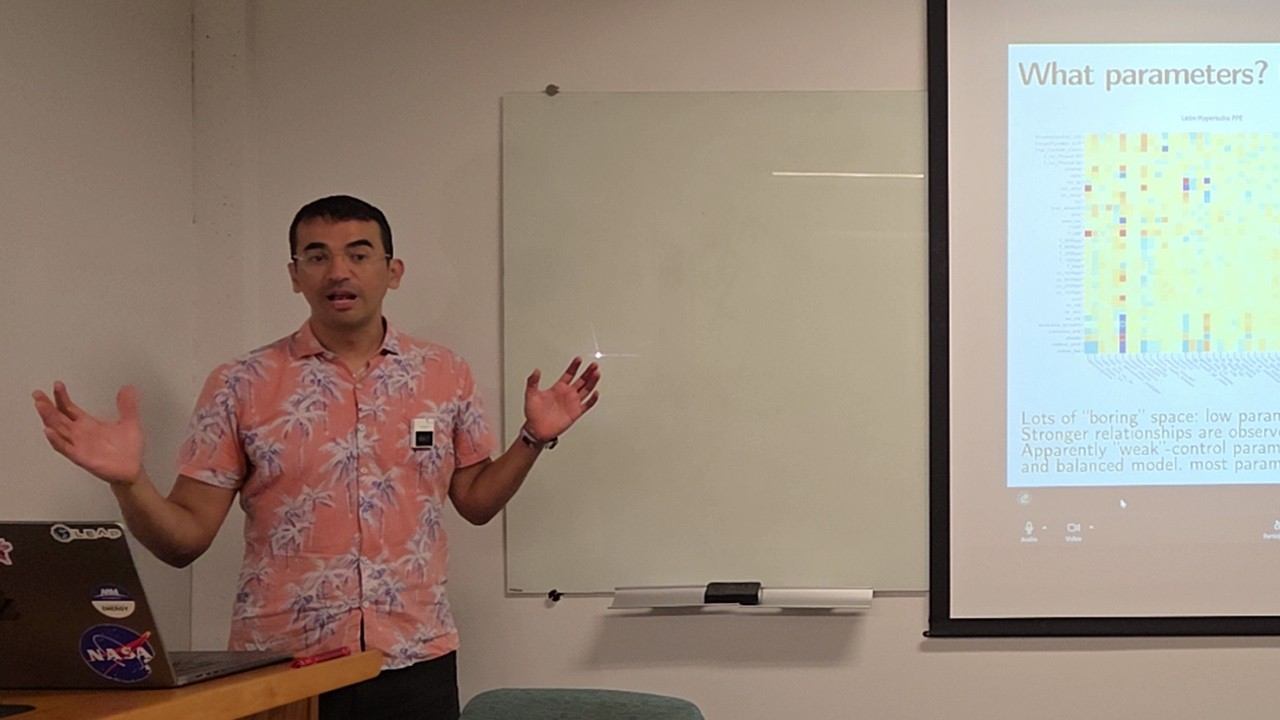
Marcus van Lier-Walqui, NASA: Earth System Modeling
Keywords
Summary
148 words
Critical Evaluation
Value of the Information & Strength of the Argument
The talk provides valuable insights into the practical challenges and methodologies of improving Earth system models. The speaker argues convincingly for the use of calibrated physics ensembles over purely data-driven approaches, emphasizing the importance of uncertainty quantification and physical interpretability. He supports his arguments with examples from his research, such as the comparison of perturbed parameter ensembles and the impact of observational constraints. The argumentation is solid, though some points could benefit from more detailed evidence or references.
87 words
Title / Content Match
The title accurately reflects the content, which focuses on NASA's Earth system modeling efforts.
Quality & Reliability
8/10
The speaker is a NASA scientist presenting ongoing research with methodological rigor, referencing peer-reviewed work and institutional practices. However, the talk is a seminar, not a peer-reviewed publication, and some claims lack detailed evidence.
Key Moments
Markers derived by PSI from the transcript: the creator did not define chapters.
- Introduction to NASA GISS and its history
- Overview of ModelE and its evolution
- Discussion on parameterization and uncertainties
- Introduction to calibrated physics ensemble (CPE)
- Comparison of parameter importance and observational constraints
- Challenges with satellite data uncertainties
- Methodology for training emulator and iterative refinement
- Results: improvement from 0% to 30% allowable simulations
- Ongoing development: accounting for emulator uncertainty
- Observing System Simulation Experiments (OSSEs) concept
Cited Sources
- ModelE documentation — Referenced as the model used in the talk
- GISS Surface Temperature Analysis (GISTEMP) — Mentioned as a key product of NASA GISS
Concurring Sources
- NASA GISS ModelE — Official documentation of the model discussed.
- GISTEMP — Temperature record mentioned as a key product.
Contribution & Novelties
The talk presents an original approach to climate model parameter estimation using machine learning surrogates and Bayesian inference, termed ‘calibrated physics ensembles’. It also proposes a novel application of this methodology to assess the value of future satellite observations. The emphasis on physical interpretability over black-box machine learning is a valuable contribution to the field.
Pour aller plus loin :
- Bayesian inference — Foundation of the parameter estimation method.
- Markov chain Monte Carlo — Computational technique used in the approach.
- Cloud parameterization — Key process discussed in the talk.
- Observing System Simulation Experiment — Concept for evaluating observation value.
99 words
Radar Profile
The radar profile shows high scores in information quantity, quality, and reliability, with a slightly lower technical level, indicating a well-balanced presentation accessible to a broad scientific audience.