Aidan Mahoney, Rosenstiel: Investigating Tropical Cyclones
Keywords
Summary
176 words
Critical Evaluation
Value of the Information & Strength of the Argument
The presentation offers valuable insights into the limitations of current GCMs in simulating tropical cyclone activity and proposes a novel methodological framework to overcome these limitations. The argumentation is solid, grounded in established theory (potential intensity) and supported by reanalysis data and numerical experiments. The speaker clearly explains the rationale behind each step and acknowledges uncertainties, such as the spread in tropopause temperature projections. The use of the MoE to decompose environmental influences is a significant contribution that could improve understanding of TC responses to climate change.
Scientific Rigor, Source Quality, Title Accuracy
The scientific rigor is high: the research is based on peer-reviewed concepts (potential intensity, ventilation) and uses standard datasets (reanalysis) and models (WRF, CHIPS). The speaker transparently discusses model limitations and biases. The title accurately reflects the content, which is a focused investigation of large-scale environmental influences on TCs. No external sources are cited in the presentation, but the methodology is consistent with current literature. The presentation is part of a university seminar series, indicating academic context.
179 words
Title / Content Match
The title accurately reflects the content, which focuses on investigating the influence of the large-scale environment on tropical cyclones.
Quality & Reliability
8/10
Presentation of original research with clear methodology, use of reanalysis data and numerical modeling, and transparent discussion of model limitations. The speaker is a PhD candidate at a reputable institution, and the content is consistent with current scientific understanding.
Key Moments
Markers derived by PSI from the transcript: the creator did not define chapters.
- Introduction and overview of tropical cyclone impacts and the need for improved prediction.
- Discussion of potential intensity and its sensitivity to tropopause temperature.
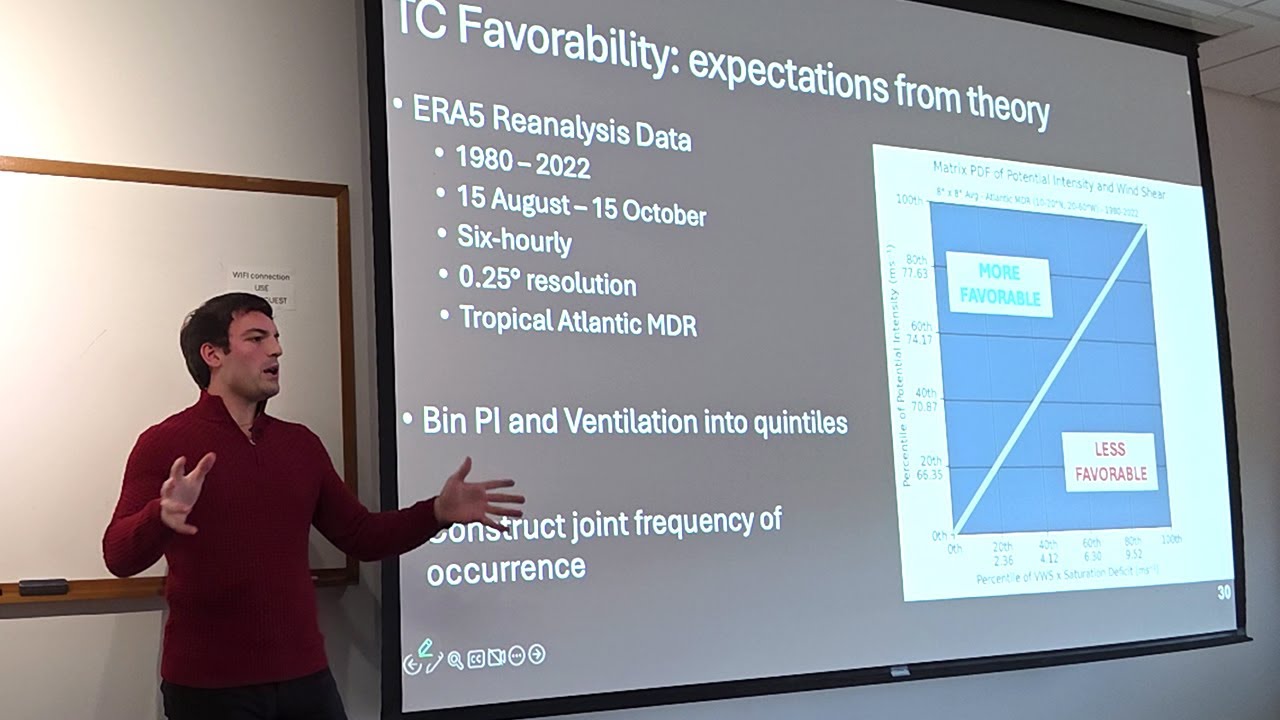
- Introduction of the Matrix-of-Environments (MoE) approach.
- Explanation of the point-downscaling method and WRF model setup.
- Validation of the MoE using ENSO variability in the Atlantic.
- Presentation of results showing the relationship between PI, ventilation, and TC activity.
- Discussion of the implications for future TC activity under climate change.
- Q&A session addressing model limitations and future work.
Contribution & Novelties
The presentation introduces a novel Matrix-of-Environments (MoE) approach that combines reanalysis data and numerical modeling to systematically investigate the influence of the large-scale environment on tropical cyclones. This method allows for a physically-based decomposition of environmental factors and overcomes limitations of direct GCM output. The research provides new insights into the role of tropopause temperature in driving model spread in potential intensity and TC activity.
Pour aller plus loin :
- Potential intensity — Wikipedia article explaining the concept of potential intensity.
- Weather Research and Forecasting model — Wikipedia article on the WRF model used in the study.
- Genesis Potential Index — Wikipedia article on the GPI, an empirical index for TC genesis.
112 words
Radar Profile
The radar profile shows high scores across all dimensions, indicating a technically rigorous and well-presented research talk. The balance between information quantity, quality, and technical depth suggests a comprehensive and reliable source for understanding current research on tropical cyclones and climate.