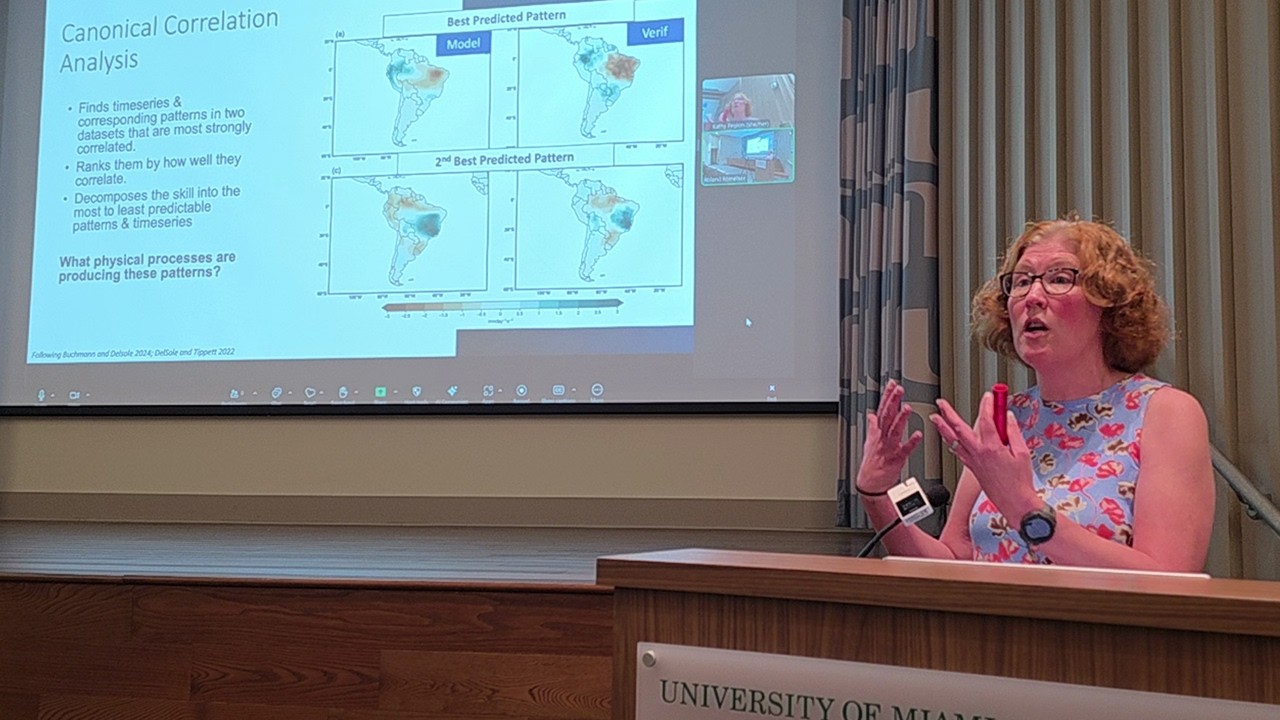
Kathy Pegion, Oklahoma: Precipitation in South America
Keywords
Summary
171 words
Critical Evaluation
Value of the Information & Strength of the Argument
The presentation provides valuable insights into the sources of subseasonal precipitation predictability in South America, a region often overlooked in S2S research. The argumentation is solid, systematically testing hypotheses (interannual vs. subseasonal, role of atmosphere/ocean/land, potential mechanisms) and using a combination of re-forecasts, sensitivity experiments, and idealized modeling. The use of canonical correlation analysis to isolate skillful patterns is rigorous. The conclusion that a Rossby wave train, possibly forced by tropical heating, is a key source of predictability is well-supported by the evidence presented.
Scientific Rigor, Source Quality, Title Accuracy
The study is based on a peer-reviewed research approach, using the NCAR-CESM2 model and re-forecasts from the SubX/SubC project. The speaker references the South American dipole, MJO, and ENSO as known sources of variability, but does not cite specific papers in the talk. The title accurately reflects the content. The presentation is scientifically rigorous, with clear methodology and acknowledgment of limitations.
160 words
Title / Content Match
The title accurately reflects the content, focusing on precipitation predictability in South America.
Quality & Reliability
8/10
The presentation is based on a peer-reviewed study using rigorous methods (re-forecasts, canonical correlation analysis, idealized model experiments). The speaker is an expert in subseasonal-to-seasonal prediction. Limitations are acknowledged (e.g., model errors, difficulty in separating contributions).
Key Moments
Markers derived by PSI from the transcript: the creator did not define chapters.
- Introduction and context of subseasonal prediction
- Overview of subseasonal prediction challenges
- Skill of week-3 precipitation forecasts in South America
- Removing interannual variability and its effect on skill
- Seasonal dependence of skill (DJF and SON)
- Experiments with climatological initial conditions to isolate contributions
- Canonical correlation analysis to identify skillful patterns
- Evidence against MJO and ENSO as sources, identification of Rossby wave train
- Idealized experiments with simplified model to test wave generation
Cited Sources
- SubX (Subseasonal Experiment) project — Mentioned as the source of re-forecasts used for skill calculations.
- NCAR-CESM2 model — The model used for the re-forecasts and experiments.
Concurring Sources
- Subseasonal-to-Seasonal Prediction Project (S2S) — Provides context on the challenges and importance of subseasonal prediction.
Contribution & Novelties
This study provides novel insights into the sources of subseasonal precipitation predictability in South America, identifying a Rossby wave train as a key mechanism independent of ENSO and MJO. The use of idealized experiments to test the wave generation hypothesis is a methodological strength.
Pour aller plus loin :
- Madden-Julian Oscillation (MJO) — Relevant as a potential source of predictability that was ruled out.
- El Niño-Southern Oscillation (ENSO) — Relevant as another potential source that was ruled out.
- Rossby wave — Key mechanism identified in the study.
- Canonical correlation analysis — Statistical method used to identify skillful patterns.
98 words
Radar Profile
The radar profile shows high scores across all dimensions, indicating a well-balanced presentation with strong information content, technical depth, and reliability. The lowest score is in 'quantite_information' (8), but still high, reflecting the focused scope of the study.