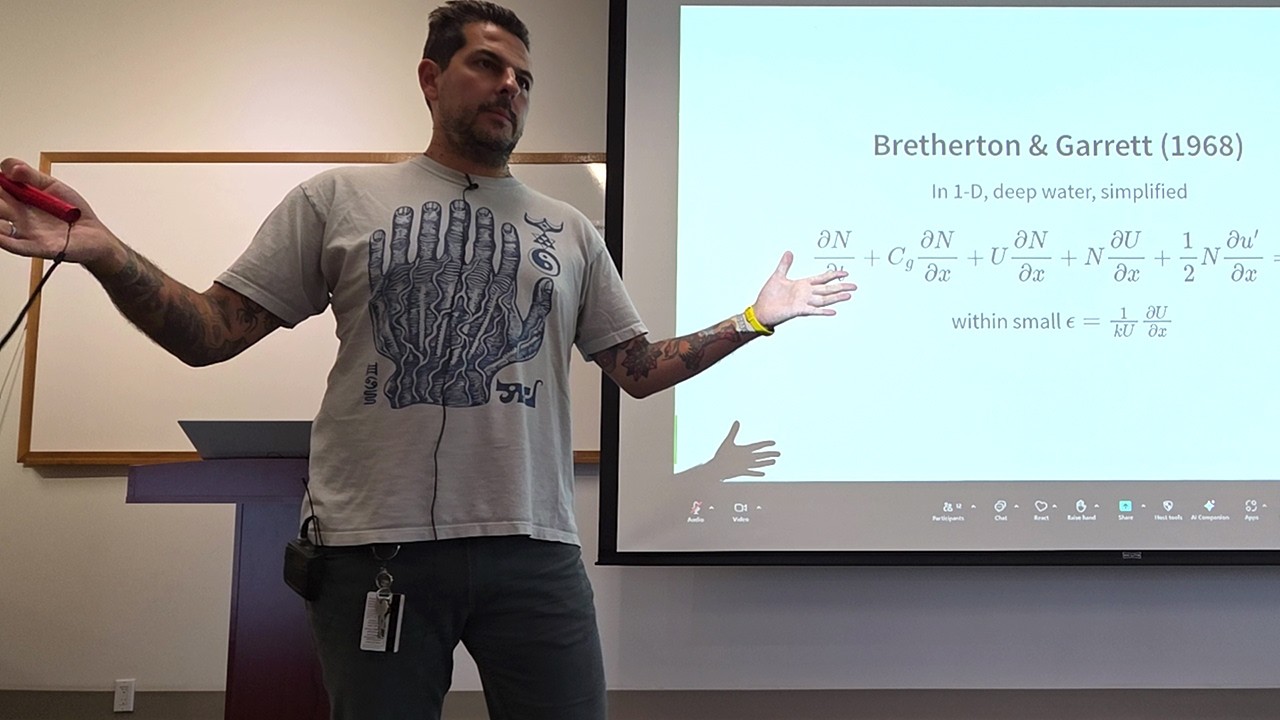
Wave Action Balance in Strongly Varying Currents
Keywords
Summary
159 words
Critical Evaluation
Value of the Information & Strength of the Argument
The presentation provides valuable insights into a critical assumption in wave modeling. The speaker clearly explains the theoretical background and the potential limitations of the standard wave action balance. The argumentation is solid, based on a well-designed numerical experiment with a high-resolution ocean model. The use of an ensemble of simulations over a month reduces bias from specific initial conditions. The quantitative results are compelling, showing that subgrid-scale current gradients can have a significant impact on wave action tendency. The speaker also acknowledges the limitations of the study, such as the specific region and season, which strengthens the credibility of the findings.
Scientific Rigor, Source Quality, Title Accuracy
The presentation demonstrates strong scientific rigor. The speaker references key foundational papers (Whitham 1965, Bretherton & Garrett 1968) and recent work (Ardhuin et al. 2017) to contextualize the research. The methodology is clearly described, and the numerical experiments are well-controlled. The title accurately reflects the content. The speaker does not overstate the conclusions, noting that the results are specific to the case study. The presentation is well-structured and technically detailed, suitable for an expert audience.
192 words
Title / Content Match
The title accurately reflects the content, focusing on the wave action balance equation and its application to strongly varying currents.
Quality & Reliability
8/10
The presentation is based on rigorous numerical simulations and a well-established theoretical framework, with clear methodology and quantitative results. The speaker is a core faculty member with relevant expertise. However, the study is based on a single regional simulation and has not yet been peer-reviewed, limiting its generalizability.
Key Moments
Markers derived by PSI from the transcript: the creator did not define chapters.
- Introduction and background of the speaker
- Overview of global wave forecasting and the role of wave action balance
- Explanation of the wave action balance equation and its assumptions
- Discussion of the limitations of the equation in strongly varying currents
- Description of the high-resolution ocean simulation and experimental setup
- Results of wave propagation experiments with different current resolutions
- Quantitative analysis of the contributions of grid-resolved and subgrid-scale currents
- Summary of findings and implications for wave forecasting
Cited Sources
- Whitham (1965) - A general approach to linear and non-linear dispersive waves using a Lagrangian — Origin of the wave action balance via variational method
- Bretherton & Garrett (1968) - Wavetrains in inhomogeneous moving media — Generalization of wave action conservation to slowly-varying currents
- Ardhuin et al. (2017) - Observing sea states — Demonstration of the impact of currents on wave heights at scales of 10-100 km
Concurring Sources
- Ardhuin et al. (2017) - Observing sea states — Shows that currents significantly affect wave heights, supporting the importance of current gradients.
Contribution & Novelties
This work provides a quantitative assessment of the impact of subgrid-scale current gradients on wave action balance, which has been largely neglected in operational wave models. The finding that these gradients can contribute significantly to the wave action tendency, even exceeding the propagation term, is novel and has important implications for improving swell forecasts. The study also highlights the need to revisit the assumption of slowly varying currents in strongly varying environments.
Pour aller plus loin :
- Wave action — Provides background on the concept of wave action and its conservation.
- Spectral wave models — Overview of spectral wave models and their applications.
- Submesoscale processes — Introduction to submesoscale ocean dynamics and their importance.
114 words
Radar Profile
The radar profile shows high scores in all dimensions, indicating a technically rigorous and well-presented seminar. The high level of technical detail and strong quantitative analysis are balanced by clear explanations, making it accessible to a specialized audience.