Adam Sobel, Columbia: Climate Risk Science
Keywords
Summary
189 words
Critical Evaluation
Value of the Information & Strength of the Argument
The talk provides valuable insights into the gap between climate science and practical adaptation needs. Sobel’s argument is well-structured and grounded in his extensive experience. He effectively uses examples from his research and industry collaborations to illustrate the challenges and potential solutions. The discussion of epistemic uncertainties, particularly regarding tropical cyclone frequency, is honest and highlights the limitations of current knowledge. The proposal for a new organization is thought-provoking, though it is presented as a work in progress.
Scientific Rigor, Source Quality, Title Accuracy
Sobel demonstrates scientific rigor by referencing peer-reviewed research and his own published work. He acknowledges uncertainties and avoids overstating conclusions. The sources cited are primarily his own group’s publications and industry collaborations, which are appropriate for the context. The title accurately reflects the content, which focuses on the concept and practice of climate risk science.
148 words
Title / Content Match
The title accurately reflects the content, which focuses on the concept and practice of climate risk science.
Quality & Reliability
8/10
Talk by a leading climate scientist with extensive experience in both academia and the insurance industry. The content is based on peer-reviewed research and practical engagement, but it is a presentation, not a formal publication, and some claims are presented as opinions or proposals.
Key Moments
Markers derived by PSI from the transcript: the creator did not define chapters.
- Introduction by Amy Clement and start of Adam Sobel's talk.
- Sobel defines climate risk science and its importance for adaptation.
- Discussion of the gap between climate model output and decision-relevant information.
- Overview of catastrophe models used in the insurance industry.
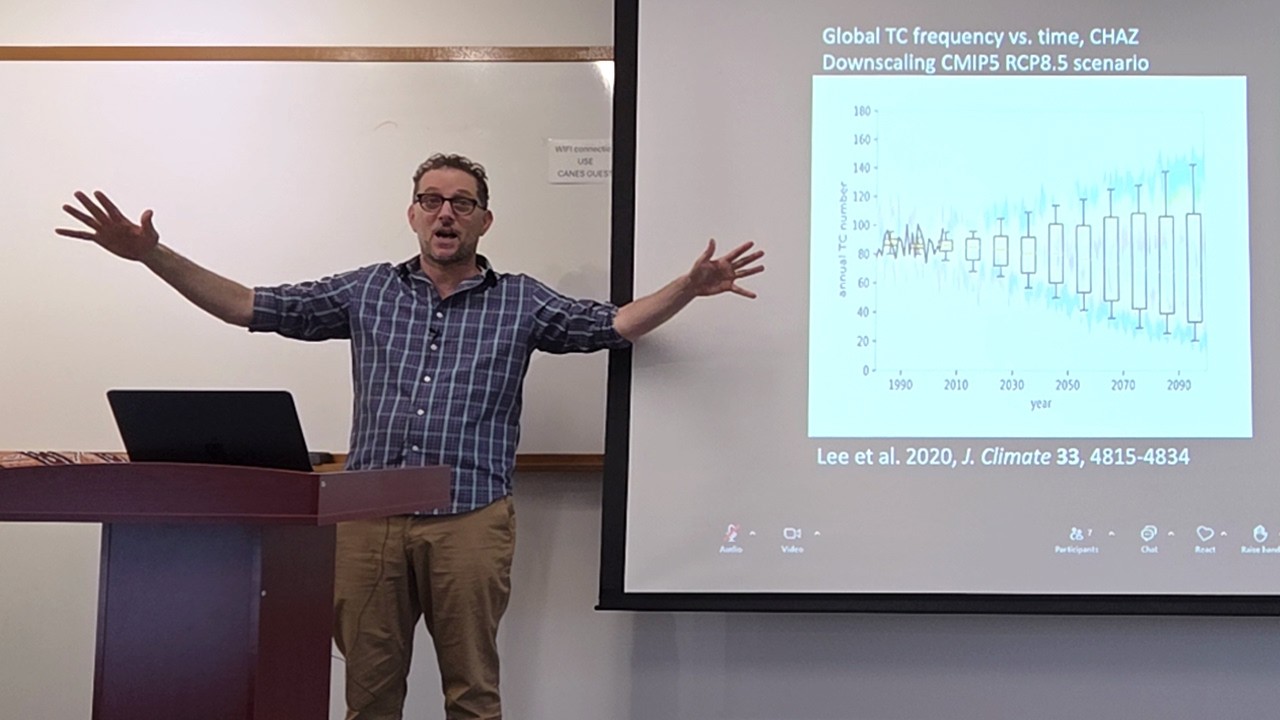
- Introduction of the CHAZ model for synthetic hurricane generation.
- Presentation of results showing uncertainty in future tropical cyclone frequency.
- Discussion of the role of humidity predictors in model uncertainty.
- Results from collaboration with AON on US hurricane wind losses.
- Discussion of the tropical Pacific bias and its implications.
- Proposal for a new organization to provide usable climate risk science.
Cited Sources
- CHAZ model publications — Sobel mentions the CHAZ model developed by his group, but no specific URL is provided in the talk.
- AON collaboration — Sobel discusses work with AON, but no specific URL is given.
Concurring Sources
- IPCC AR6 WG1 — The IPCC reports provide consensus on climate change science, including uncertainties in extreme events.
Dissenting Sources
- Some climate models show increases in tropical cyclone frequency — Sobel notes that while many models project decreases, some show increases, indicating a lack of consensus.
Contribution & Novelties
The talk offers a clear articulation of the concept of ‘climate risk science’ as a distinct discipline bridging climate science and decision-making. It highlights the importance of addressing deep uncertainties and proposes a concrete organizational structure to improve the accessibility and quality of such science for the public sector. The discussion of the tropical Pacific bias and its impact on hurricane projections is a valuable contribution.
Pour aller plus loin :
- Climate Risk Science — Overview of climate risk concepts.
- Catastrophe modeling — Background on the insurance industry’s approach.
- Statistical downscaling — Explanation of downscaling techniques.
96 words
Radar Profile
The radar profile shows high scores in information quantity, quality, and reliability, reflecting the speaker's expertise and the depth of content. The technical level is also high, but the talk remains accessible to a scientifically literate audience. The overall balance indicates a strong, credible presentation.
💬 Sur les 0 commentaires analysés, aucune tendance n'est disponible.