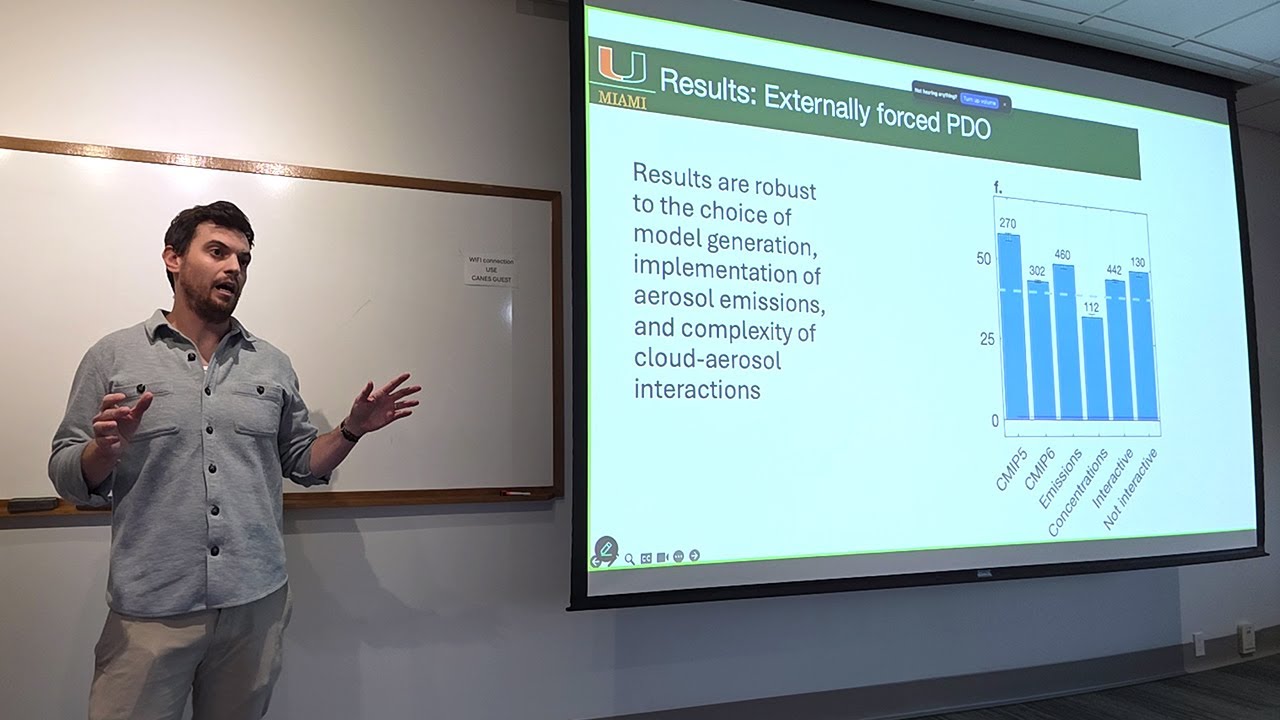
Jeremy Klavans, Rosenstiel: Decadal Regional Climate
Keywords
Summary
209 words
Critical Evaluation
Value of the Information & Strength of the Argument
The talk provides valuable insights into the sources of decadal climate variability, challenging the long-held assumption that it is predominantly internal. The argumentation is solid, based on extensive model ensembles and statistical analysis. The speaker carefully explains the methodology and addresses potential counterarguments, such as the possibility of an unlikely world, but convincingly argues for the role of external forcing. The presentation is well-structured, moving from a specific case (PDO) to a broader perspective, and includes a clear call for improving climate models.
Scientific Rigor, Source Quality, Title Accuracy
The scientific rigor is high, with the research based on state-of-the-art climate models and rigorous statistical tests. The speaker cites relevant literature and acknowledges the work of others. The title accurately reflects the content, and the presentation is well-organized. The talk is a seminar presentation, so it does not include a formal list of references, but the speaker mentions key papers and concepts. The adequacy between title and content is excellent.
169 words
Title / Content Match
The title accurately reflects the content: a presentation on decadal regional climate variability and predictability, with a focus on the signal-to-noise error.
Quality & Reliability
8/10
The talk presents original research based on large ensembles of climate models, with rigorous statistical methods and clear explanations. The speaker is an expert in the field, and the work is likely peer-reviewed or in preparation. However, the presentation is a seminar, not a published paper, and some details are simplified for a general audience.
Key Moments
Markers derived by PSI from the transcript: the creator did not define chapters.
- Introduction: speaker's background and the dominant view of regional decadal climate variability as internal and unpredictable.
- First AGU meeting: maps of North American temperature trends from CESM1 large ensemble, illustrating internal variability.
- Explanation of large ensembles and the concept of forced response vs internal variability.
- Introduction of the three climate modes: AMV, NAO, and PDO, with their typical mechanisms.
- Deep dive into PDO: ensemble mean PDO shows structure matching observations on decadal timescales.
- Statistical significance: forced PDO explains 53% of observed variance, significant at 99% confidence.
- Interpretation: either an unlikely world or a real forced signal; the latter is favored.
- Ensemble size needed: at least 100-200 members to isolate the forced signal.
- Signal-to-noise error: models underestimate forced response relative to observations, related to signal-to-noise paradox.
- Spatial pattern of forced PDO: similar to observed, but weaker horseshoe warming and Aleutian Low response.
Cited Sources
- CESM1 Large Ensemble — Used to illustrate internal variability in the introduction.
- CMIP5 and CMIP6 — Source of the 572 ensemble members used in the analysis.
- HadISST — Observational SST data used for comparison.
- 20th Century Reanalysis — Observational sea level pressure data used for comparison.
Concurring Sources
- Signal-to-noise paradox in climate predictions — Related to the signal-to-noise error discussed in the talk.
- Forced and internal components of decadal variability — Supports the idea that external forcing contributes to decadal variability.
Dissenting Sources
- IPCC AR5
Contribution & Novelties
The talk presents a novel finding that externally forced variability plays a significant role in decadal modes of regional climate, contrary to the prevailing view. This is achieved by using very large ensembles, which allow the isolation of the forced signal. The identification of a signal-to-noise error in climate models, where the forced response is underestimated, is a key contribution. This has implications for improving decadal predictions and understanding climate variability.
Pour aller plus loin :
- Signal-to-noise paradox — Related concept in predictability studies.
- Pacific Decadal Oscillation — Overview of the PDO and its impacts.
- Atlantic Multidecadal Variability — Overview of the AMV and its role in climate.
108 words
Radar Profile
The radar profile shows high scores in information quality and technical level, with slightly lower scores in quantity and reliability. This reflects a focused, in-depth presentation with strong scientific content, but limited breadth and some reliance on unpublished results.
💬 Sur les 0 commentaires analysés, aucune tendance n'est disponible.