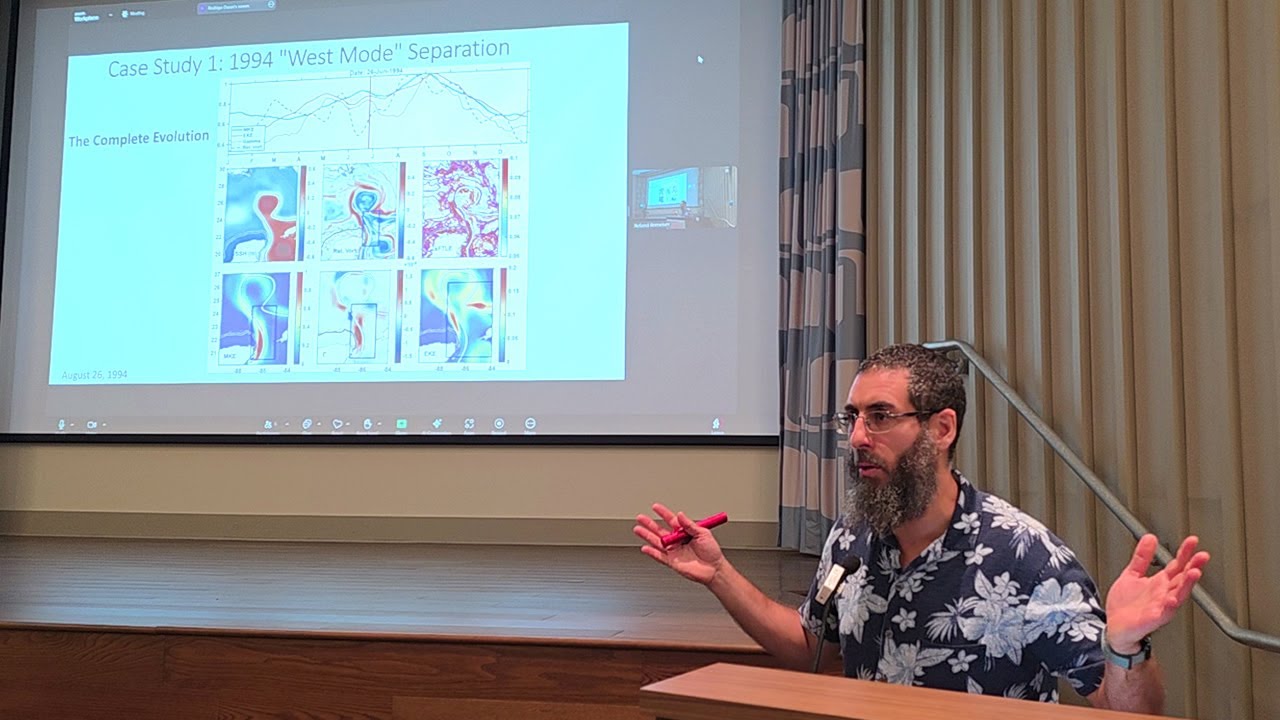
On the Physical Mechanisms Controlling Loop Current Eddy Separations and Their Seasonality
Keywords
Summary
168 words
Critical Evaluation
Value of the Information & Strength of the Argument
The value of the information is high, as it provides a mechanistic explanation for a well-documented but poorly understood phenomenon. The argumentation is solid, built on multiple complementary methodologies: energy transfers, information flow, and vorticity transport barriers. The causal chain is clearly articulated and supported by statistical analysis. The use of both altimetry and reanalysis data strengthens the findings. The presentation is well-structured, with clear explanations of complex concepts.
Scientific Rigor, Source Quality, Title Accuracy
The scientific rigor is high, with the study based on extensive observational and reanalysis data. The methodologies are well-established and appropriately applied. The sources cited are relevant and credible, including peer-reviewed studies and technical reports. The title accurately reflects the content, and the presentation is consistent with the title. The speaker demonstrates expertise and acknowledges uncertainties. Overall, the sources and title are well-aligned.
147 words
Title / Content Match
The title accurately reflects the content, which focuses on the physical mechanisms controlling Loop Current eddy separations and their seasonality.
Quality & Reliability
8/10
The study uses 30 years of altimetry data and a 22-year reanalysis, employs rigorous methodologies (energy transfers, information flow, transport barriers), and is presented by an expert in the field. The results are statistically significant and the causal chain is clearly explained.
Key Moments
Markers derived by PSI from the transcript: the creator did not define chapters.
- Introduction and background on Loop Current and its impacts.
- Discussion of known seasonality of eddy shedding.
- Presentation of the hypothesis and methodologies.
- Spatial patterns of mean kinetic energy and vorticity.
- Temporal analysis showing peaks before August 23.
- Causal chain: Yucatan Current intensification leads to eddy formation.
- Movie of a separation event showing false and true separation.
- Explanation of vorticity transport barriers and permanence.
- Discussion of December rarity and wind damping.
- Conclusions and implications for prediction.
Cited Sources
- Hall & Leben (2016) — Cited for the seasonality of Loop Current eddy shedding.
- Hamilton (2014) — Technical report on Loop Current dynamics.
- Chang et al. (2012) — Analysis of eddy shedding events.
- Oey et al. (2013) — Study on Loop Current frontal eddies and separation.
- Yang et al. (2020, 2023) — Modeling studies on eddy formation and separation.
Concurring Sources
- Hall & Leben (2016) — Supports the seasonality of eddy shedding.
- Oey et al. (2013) — Supports the role of frontal eddies in separation.
- Yang et al. (2020, 2023) — Supports the formation of cyclonic perturbations via instabilities.
Contribution & Novelties
This study provides a novel causal mechanism for the seasonality of Loop Current eddy separations, linking Yucatan Current energy to vorticity production and transport barriers. It integrates multiple methodologies to establish a robust causal chain. The findings have implications for predicting eddy shedding events and their impacts.
Pour aller plus loin :
- Loop Current — Overview of the Loop Current and its dynamics.
- Barotropic instability — Explanation of the instability mechanism.
- Information flow — Concept used for causality detection.
- Finite-time Lyapunov exponent — Related to transport barriers.
87 words
Radar Profile
The radar profile shows high scores in all dimensions, indicating a well-rounded and reliable presentation. The strongest aspects are information quality and reliability, while the weakest is the quantity of information, though still high.