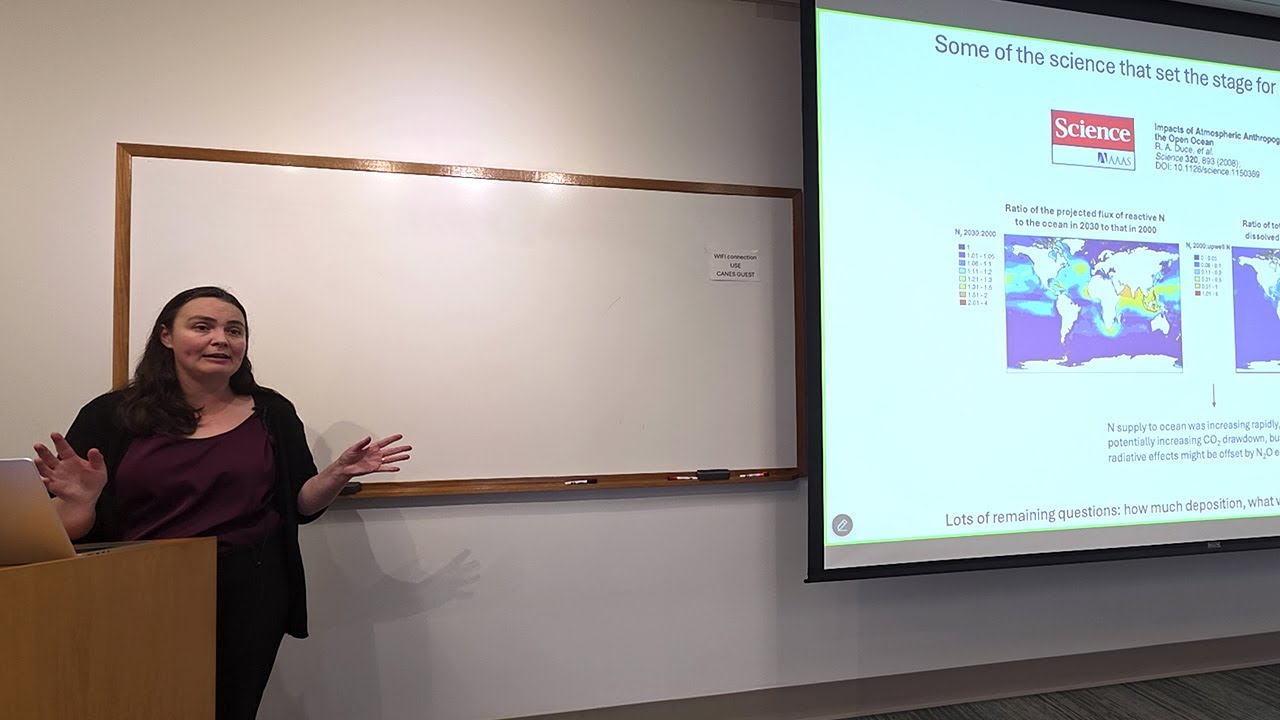
Lauren Zamora, UMD: To Arctic Clouds From Saharan Dust
Keywords
Summary
136 words
Critical Evaluation
Value of the Information & Strength of the Argument
The talk provides valuable insights into the scientific process and career development. Zamora presents her research trajectory with clear explanations of the scientific questions and methods. She supports her arguments with references to specific studies and data, demonstrating a solid foundation. The discussion of uncertainties and limitations in her work adds to the credibility. She also offers practical advice for students, making the talk useful for early-career scientists.
Scientific Rigor, Source Quality, Title Accuracy
Zamora demonstrates scientific rigor by referencing specific papers and datasets. She mentions Duce et al. (2008), Jickells et al., and her own publications. She also discusses community workshops and NASA campaigns. The title accurately reflects the content, as the talk is a retrospective covering both Saharan dust and Arctic clouds. The talk is not a formal scientific review but a personal account, which is appropriate for a seminar.
151 words
Title / Content Match
The title accurately reflects the content: a career retrospective from Saharan dust research to Arctic clouds.
Quality & Reliability
8/10
The talk is a career retrospective by a research scientist with a strong publication record. It presents personal research findings and field knowledge, but is not peer-reviewed. The speaker is credible and the content aligns with established scientific understanding.
Key Moments
Markers derived by PSI from the transcript: the creator did not define chapters.
- Introduction and overview of the talk
- Discussion of excess nitrogen in the subtropical North Atlantic
- Fieldwork and workshops as valuable experiences
- Postdoc in Germany and nitrous oxide modeling
- Transition to NASA and Arctic aerosol-cloud interactions
- Challenges in observing Arctic clouds
- Climate intervention and polar mixed-phase cloud thinning
- Career advice and lessons learned
Cited Sources
- Duce et al. (2008) - Impacts of Atmospheric Anthropogenic Nitrogen on the Open Ocean — Cited as a key paper on nitrogen deposition and its effects on the ocean.
- Jickells et al. (2017) - A reevaluation of the magnitude and impacts of anthropogenic atmospheric nitrogen inputs on the ocean — Cited as a follow-up to Duce et al., updating estimates of CO2 uptake.
- Suntharalingam et al. (2012) - Global and regional evaluation of the marine nitrous oxide budget — Cited as a study that found atmospheric nitrogen deposition does not significantly contribute to marine N2O emissions.
Concurring Sources
- IPCC AR6 - Climate Change 2021: The Physical Science Basis — Provides context on uncertainties in aerosol-cloud interactions and Arctic warming.
Contribution & Novelties
The talk provides a personal perspective on the evolution of research on aerosol-cloud interactions, from Saharan dust to Arctic clouds. It highlights the importance of interdisciplinary training and career flexibility. The speaker shares insights into NASA postdoc opportunities and the challenges of studying the Arctic.
Pour aller plus loin :
- Aerosol-cloud interactions — Overview of the topic.
- Arctic amplification — Explains the rapid warming of the Arctic.
- Mixed-phase clouds — Relevant to the discussion of Arctic clouds.
77 words
Radar Profile
The radar profile shows high scores in quantity and quality of information, reflecting the speaker's expertise and the depth of the talk. The technical level is moderate, suitable for a general scientific audience. The overall reliability is high, given the speaker's credentials and references.