Marybeth Arcodia, Rosenstiel: Harnessing Data Science
Keywords
Summary
142 words
Critical Evaluation
Value of the Information & Strength of the Argument
The talk provides valuable insights into the application of machine learning to climate prediction, highlighting the concept of forecasts of opportunity. The argumentation is solid, supported by peer-reviewed research and ongoing projects. The speaker clearly explains the methodology, including the use of neural networks, explainable AI, and validation against observations. She also addresses limitations, such as the use of climate model data and the need for real-world validation. The presentation is well-structured, with clear examples and visual aids.
87 words
Title / Content Match
The title accurately reflects the content, focusing on the application of data science to climate prediction.
Quality & Reliability
8/10
The talk presents peer-reviewed research and ongoing projects, with clear methodology and validation against observations. The speaker is an expert in the field, and the content is consistent with current scientific understanding. Some limitations are acknowledged, but the overall reliability is high.
Key Moments
Markers derived by PSI from the transcript: the creator did not define chapters.
- Introduction and overview of the talk
- Explanation of forecasts of opportunity and the weather-climate gap
- Introduction to machine learning and explainable AI
- Sea surface salinity as a predictor for Midwest precipitation
- Results and validation of the neural network approach
- Real-time subseasonal precipitation forecasting tool
- Predicting probability distributions for precipitation
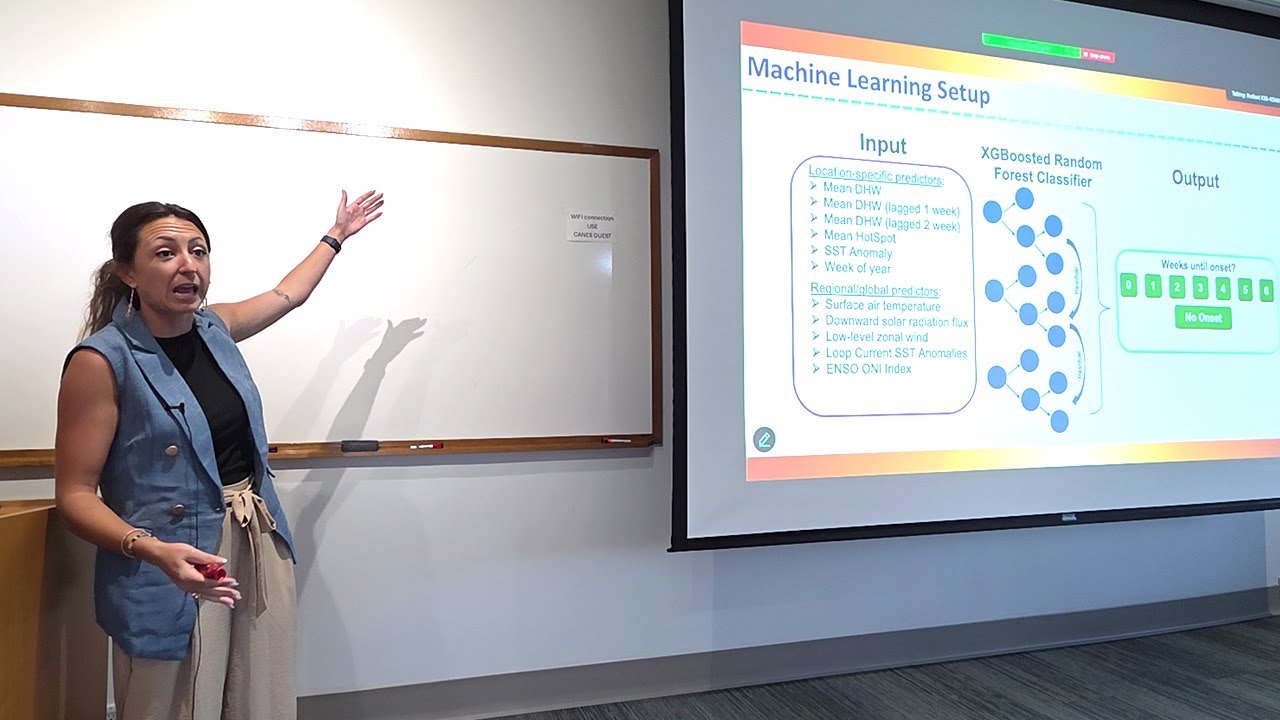
- Coral heat stress prediction using random forests
- Results and implications for coral conservation
- Future research directions and collaboration opportunities
Cited Sources
- Arcodia et al. (2025) - Sea surface salinity as a subseasonal predictor — Mentioned as a paper published earlier this year
- NOAA Coral Reef Watch — Mentioned as the current prediction system for coral heat stress
- WHAM (Water Cycle and Heat Flux Model) — Mentioned as a moisture tracking algorithm used for validation
Concurring Sources
- NOAA Climate Prediction Center — Mentioned as the operational forecasting unit for subseasonal predictions
Contribution & Novelties
The talk presents novel applications of machine learning to climate prediction, particularly the use of sea surface salinity as a predictor and the development of real-time forecasting tools. The emphasis on explainable AI to build trust and uncover physical mechanisms is a valuable contribution.
Pour aller plus loin :
- Forecast of opportunity — Relevant to the core concept.
- Explainable AI — Key methodology discussed.
- Madden-Julian Oscillation — Important climate mode mentioned.
- El Niño-Southern Oscillation — Another key climate mode.
- Random forest — Machine learning method used for coral prediction.
89 words
Radar Profile
The radar profile shows high scores in information quantity, quality, and reliability, with a slightly lower technical level. This indicates a well-balanced presentation that is both informative and credible, though it may require some background knowledge to fully grasp the technical details.
💬 No comments were provided for analysis.