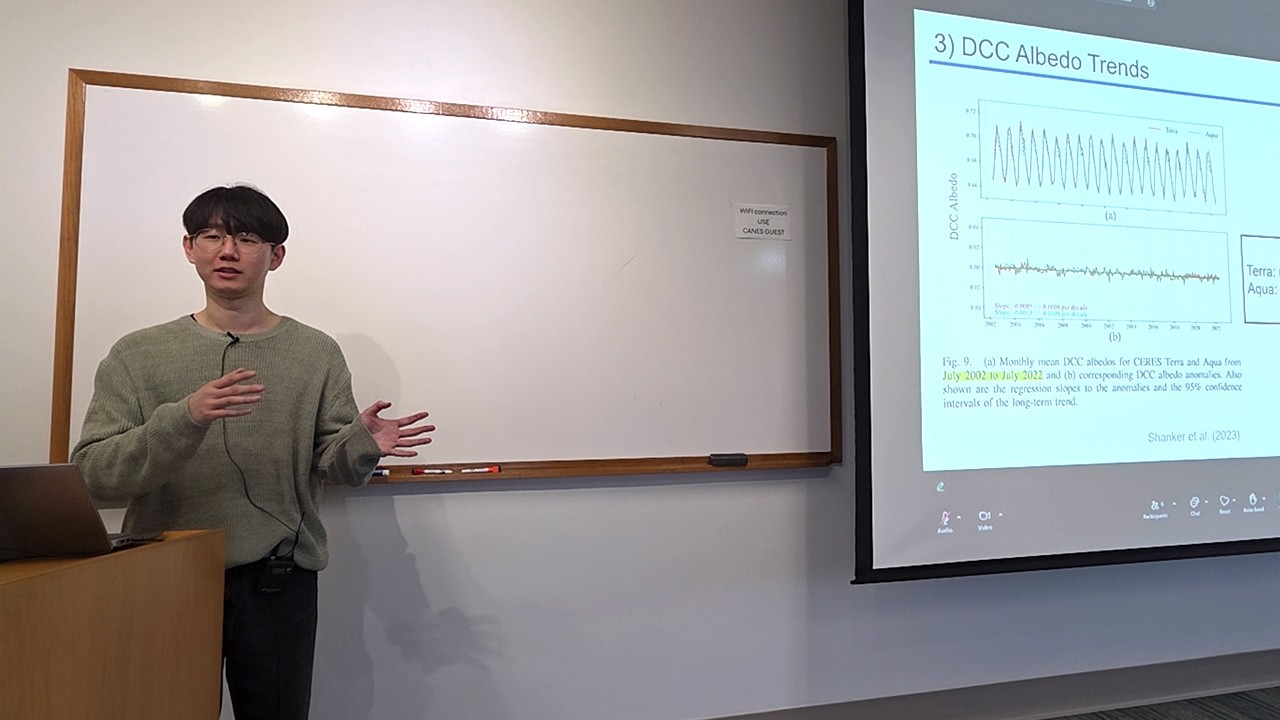
Aerosols, Clouds, and Recent Trends in Earth's Energy Imbalance
Keywords
Summary
211 words
Critical Evaluation
Value of the Information & Strength of the Argument
The presentation provides valuable insights into the attribution of Earth’s energy imbalance trends, offering an observational perspective that challenges model-based conclusions. The argumentation is well-structured, building from foundational concepts to specific analyses. Park carefully explains the radiative kernel method and its limitations, and he supports his claims with multiple lines of evidence. He also acknowledges uncertainties and alternative interpretations, which strengthens the credibility of his argument. The comparison between observational and model-based estimates is particularly valuable, highlighting discrepancies that warrant further investigation.
Scientific Rigor, Source Quality, Title Accuracy
The presentation demonstrates strong scientific rigor, with methods based on peer-reviewed research and data from established satellite datasets (CERES, MODIS, MERRA-2). Park clearly states the sources of his data and the assumptions behind his methods. The title accurately reflects the content, and the talk is well-organized. The speaker does not overstate his findings and explicitly discusses limitations, such as the potential for observational biases. The inclusion of model comparisons and the use of multiple independent methods enhance the reliability of the conclusions.
179 words
Title / Content Match
The title accurately reflects the content, focusing on aerosols, clouds, and trends in Earth's energy imbalance.
Quality & Reliability
8/10
The presentation is based on peer-reviewed research (published in Science Advances and ACP) and uses rigorous observational and modeling methods. The speaker is a PhD candidate with relevant expertise. The talk includes detailed methodology and acknowledges uncertainties, but as a single presentation, it lacks external verification and some claims rely on model comparisons.
Key Moments
Markers derived by PSI from the transcript: the creator did not define chapters.
- Introduction of speaker and topic
- Definition of Earth's energy imbalance and its trend
- Decomposition of EEI trend into shortwave and longwave components
- Introduction of radiative kernel method to isolate cloud contribution
- Discussion of internal variability and exclusion of it as a cause
- Presentation of aerosol trends, including Southern Hemisphere increases
- Estimation of shortwave aerosol-cloud interaction using observations
- Comparison of observational ACI estimates with CMIP6 model simulations
- Introduction of cloud radiative kernel (CRK) method and its results
- Three lines of evidence for observational uncertainties in cloud trends
Cited Sources
- CERES EBAF dataset — Used for Earth's energy imbalance and cloud radiative effect data
- MODIS aerosol products — Used for aerosol index and cloud droplet number concentration
- MERRA-2 reanalysis — Used for surface mass concentration and meteorological variables
- CMIP6 model simulations — Used for comparison of aerosol-cloud interaction trends
Concurring Sources
- Loeb et al. (2021) - Satellite and Ocean Data Reveal Marked Increase in Earth's Heating Rate — Supports the observed increase in Earth's energy imbalance and shortwave absorption.
- Soden et al. (2008) - Quantifying Climate Feedbacks Using Radiative Kernels — Provides the radiative kernel methodology used in the presentation.
Dissenting Sources
- CMIP6 model simulations — Models tend to overestimate the aerosol-cloud interaction contribution to EEI trends compared to observational estimates, as shown in the presentation.
Contribution & Novelties
The presentation offers a novel observational framework to estimate aerosol-cloud interactions and their contribution to Earth’s energy imbalance, challenging model-based attributions. It also highlights potential biases in satellite-derived cloud radiative trends, suggesting that current methods may overestimate cloud contributions. This work underscores the need for improved observational constraints and uncertainty quantification in climate attribution studies.
Pour aller plus loin :
- Aerosol-cloud interactions — Provides background on the physical mechanisms.
- Radiative forcing — Context for understanding forcing and feedbacks.
- Earth’s energy budget — Overview of the energy balance concept.
88 words
Radar Profile
The radar profile shows high scores across all dimensions, indicating a technically rigorous and well-sourced presentation. The lowest score is in 'quantite_information' (8), but this is still high, reflecting the depth of content. The overall balance suggests a comprehensive and reliable scientific talk.
💬 No comments were provided for analysis.