Colloquium du LIRA
Keywords
Summary
199 words
Critical Evaluation
Value of the Information & Strength of the Argument
The talk provides a comprehensive overview of the current state of interstellar dust research, with a strong emphasis on recent 3D mapping efforts. The speaker presents a clear argument for the importance of dust studies, supported by specific examples and references to ongoing work. The argumentation is solid, as it builds on established knowledge and introduces new findings that challenge previous assumptions, such as the non-monotonic behavior of Rv. The speaker also highlights the significance of the local bubble for astronomical observations, adding a practical perspective. Overall, the information is valuable for both specialists and those with a general interest in astrophysics, and the reasoning is well-structured.
Scientific Rigor, Source Quality, Title Accuracy
The talk demonstrates a high level of scientific rigor, with the speaker referencing multiple missions (Gaia, Stardust, IMAP) and recent studies. However, specific sources are not explicitly cited in the talk, and the description does not provide links. The title ‘Colloquium du LIRA’ is generic and does not reflect the specific content, but this is typical for colloquium presentations. The talk is based on the speaker’s expertise and recent research, which adds credibility, but the lack of explicit citations limits the ability to verify all claims. The content is well-organized and technically accurate, though some simplifications are made for a general audience.
224 words
Title / Content Match
The title is generic and does not reflect the specific content, but the talk is a colloquium presentation, so the title is acceptable.
Quality & Reliability
8/10
The speaker is a renowned expert with extensive experience in interstellar medium research, and the talk presents established results and recent developments. However, it is a colloquium presentation, not a peer-reviewed publication, and some details are simplified for a general audience.
Key Moments
Markers derived by PSI from the transcript: the creator did not define chapters.
- Introduction and welcome by Milan, introducing Rosine Lallement and her achievements.
- Start of the talk: outline and introduction to interstellar dust, its importance and properties.
- Discussion on the elemental composition and size distribution of dust grains.
- Direct detection of interstellar dust: missions like Stardust and IMAP, and challenges.
- Introduction to extinction curves and the parameter Rv, and the family of curves.
- 3D mapping techniques: beam-by-beam and full 3D inversion, and the local bubble.
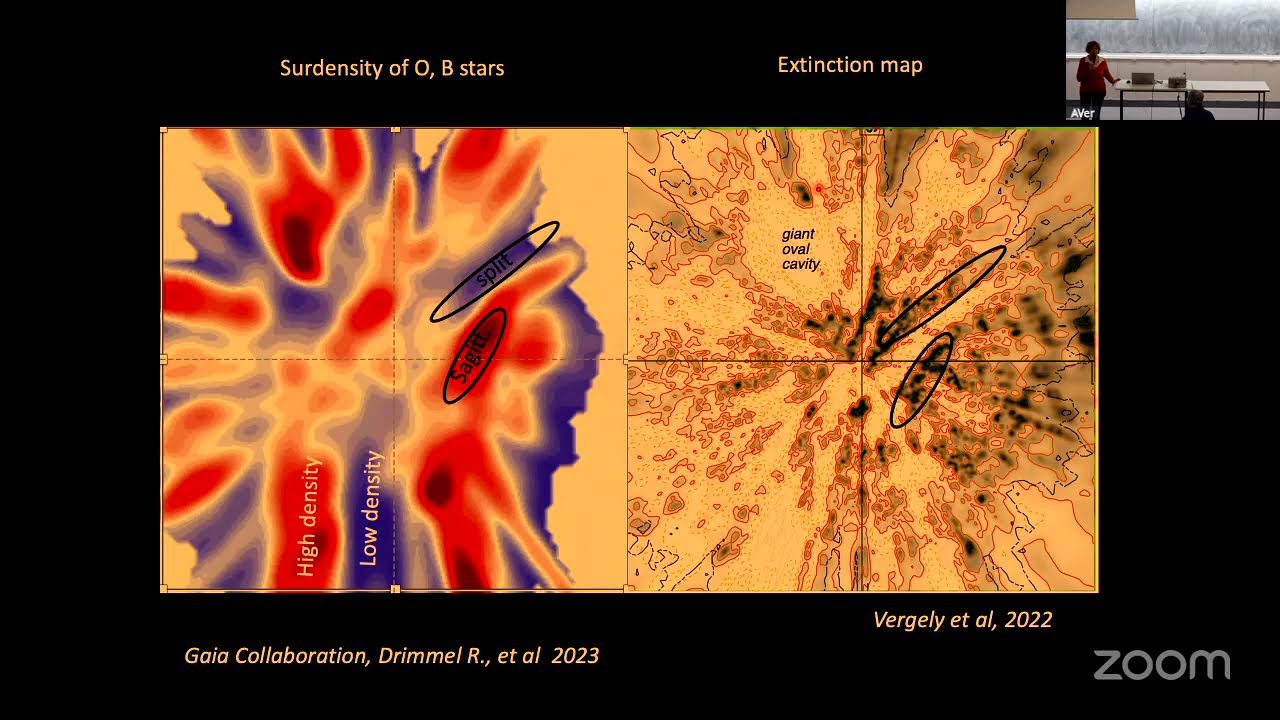
- Large-scale maps: the Split, Sagittarius-Carina arm, and comparison with young stars.
- Recent developments: non-monotonic Rv behavior, UV bump variability, and DIBs.
- Conclusion and prospects with future Gaia data releases.
Cited Sources
- Gaia mission — Mentioned as the source of parallax and photometric data used for 3D dust mapping.
- Stardust mission — Mentioned for its collection of interstellar dust particles.
- IMAP mission — Mentioned as a future mission expected to detect interstellar dust particles.
Concurring Sources
- Gaia Data Release 3 — The talk references Gaia DR3 as the basis for current 3D dust maps.
- Local Bubble — The talk discusses the local bubble and its importance; this source provides additional context.
Dissenting Sources
- No discordant sources — No conflicting sources were mentioned in the talk.
Contribution & Novelties
The talk provides an up-to-date overview of 3D mapping of interstellar dust, highlighting recent surprising findings such as the non-monotonic behavior of Rv and the variability of the UV bump. It also emphasizes the importance of the local bubble for astronomical observations. The speaker presents her own group’s work on full 3D inversion, which offers a more detailed view of the local interstellar medium compared to other methods.
Pour aller plus loin :
- Interstellar dust — General overview of interstellar dust properties and importance.
- Gaia (spacecraft) — Details on the Gaia mission and its data releases.
- Diffuse interstellar band — Explanation of DIBs and their significance.
106 words
Radar Profile
The radar profile shows high scores in quantity and quality of information, reflecting the comprehensive and expert-level content. The technical level is also high, indicating the talk is suitable for an audience with some background in astrophysics. The overall reliability is strong, given the speaker's expertise and the use of established data.
💬 No comments were provided for analysis.