From Near Earth to the Fabric of Spacetime
Keywords
Summary
111 words
Critical Evaluation
Value of the Information & Strength of the Argument
The presentation offers valuable insights into ESA’s strategic priorities and the scientific rationale behind its missions. The argumentation is coherent, supported by concrete examples of mission achievements and challenges. Mundle effectively communicates the importance of long-term planning and international cooperation in space science. However, the talk is more of a high-level overview than a deep dive into specific scientific results, and some claims are presented without detailed evidence.
Scientific Rigor, Source Quality, Title Accuracy
The presentation is scientifically rigorous, with information based on official ESA mission statuses and recent publications. The speaker cites specific missions and results, but does not provide detailed references or URLs. The title accurately reflects the content, which spans from solar system exploration to fundamental physics. No comments were provided for analysis.
135 words
Title / Content Match
The title accurately reflects the broad scope of the talk, covering missions from solar system exploration to fundamental physics and cosmology.
Quality & Reliability
8/10
The presentation is given by the ESA Director of Science, providing authoritative and up-to-date information on ESA's space science missions. The content is factual, based on official mission statuses and recent results, with no apparent bias or misinformation. However, it is a high-level overview without detailed technical depth, and some claims (e.g., 'over 200 papers') are not individually verified.
Key Moments
Markers derived by PSI from the transcript: the creator did not define chapters.
- Introduction and welcome of Carol Mundle, ESA Director of Science.
- Mundle begins her talk, highlighting ESA's 50th anniversary and the mandatory science program.
- Discussion of ESA's science program structure and the importance of international collaboration.
- Overview of key missions: Rosetta, Mars Express, Planck, and James Webb.
- Introduction of upcoming missions: Smile, Plato, Ariel, and Comet Interceptor.
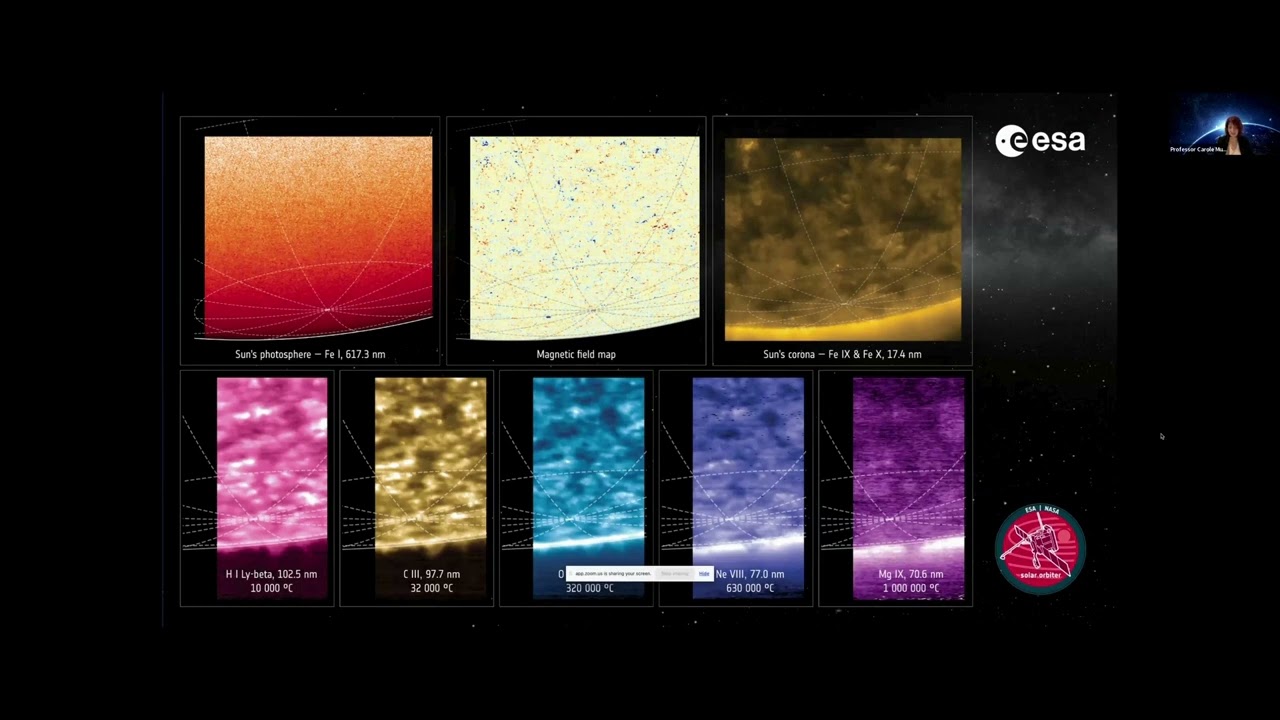
- Discussion of Solar Orbiter and its recent first maps of the sun's poles.
- Details on BepiColombo's challenges and recent flyby results.
- Juice mission update, including the lunar-Earth gravity assist and instrument calibration.
- ESA's archives and the serendipitous science from missions like Gaia.
- Conclusion: future missions and the importance of sustainable funding.
Contribution & Novelties
The presentation provides a comprehensive overview of ESA’s current and future space science missions, highlighting recent achievements and upcoming milestones. It emphasizes the strategic importance of the mandatory science program and international collaboration. The talk offers a unique perspective from ESA’s Director of Science, giving insight into the agency’s priorities and challenges.
Pour aller plus loin :
- ESA Science Programme — Official ESA page detailing the science programme and missions.
- Solar Orbiter — ESA mission page for Solar Orbiter, including recent results.
- BepiColombo — ESA mission page for BepiColombo, with updates on the mission’s status.
95 words
Radar Profile
The radar profile shows high scores in information quality and reliability, reflecting the authoritative source and factual content. The moderate scores in information quantity and technical level indicate a broad overview rather than an in-depth technical analysis.