Activities of the Titan atmospheric working group up to the Huygens descent
Keywords
Summary
162 words
Critical Evaluation
Value of the Information & Strength of the Argument
The talk provides valuable insights into the scientific and engineering processes behind a major planetary mission. Yelle’s argumentation is based on his direct experience and references to specific papers and data. He clearly explains the uncertainties and how they were addressed, demonstrating a rigorous approach. The value lies in the historical perspective and the lessons learned for future missions.
68 words
Title / Content Match
The title accurately reflects the content: the speaker discusses the activities of the Titan atmospheric working group leading up to the Huygens descent.
Quality & Reliability
7/10
Talk by a leading expert in planetary science, based on direct involvement in the Cassini-Huygens mission. The content is retrospective and relies on personal experience and published results. Some statements are not fully detailed, but the speaker's authority and the historical context lend credibility.
Key Moments
Markers derived by PSI from the transcript: the creator did not define chapters.
- Introduction: challenge of designing a mission to an unknown atmosphere.
- Voyager UVS occultation data and their limitations.
- Uncertainties in argon and methane abundances.
- Importance of atmospheric knowledge for probe trajectory.
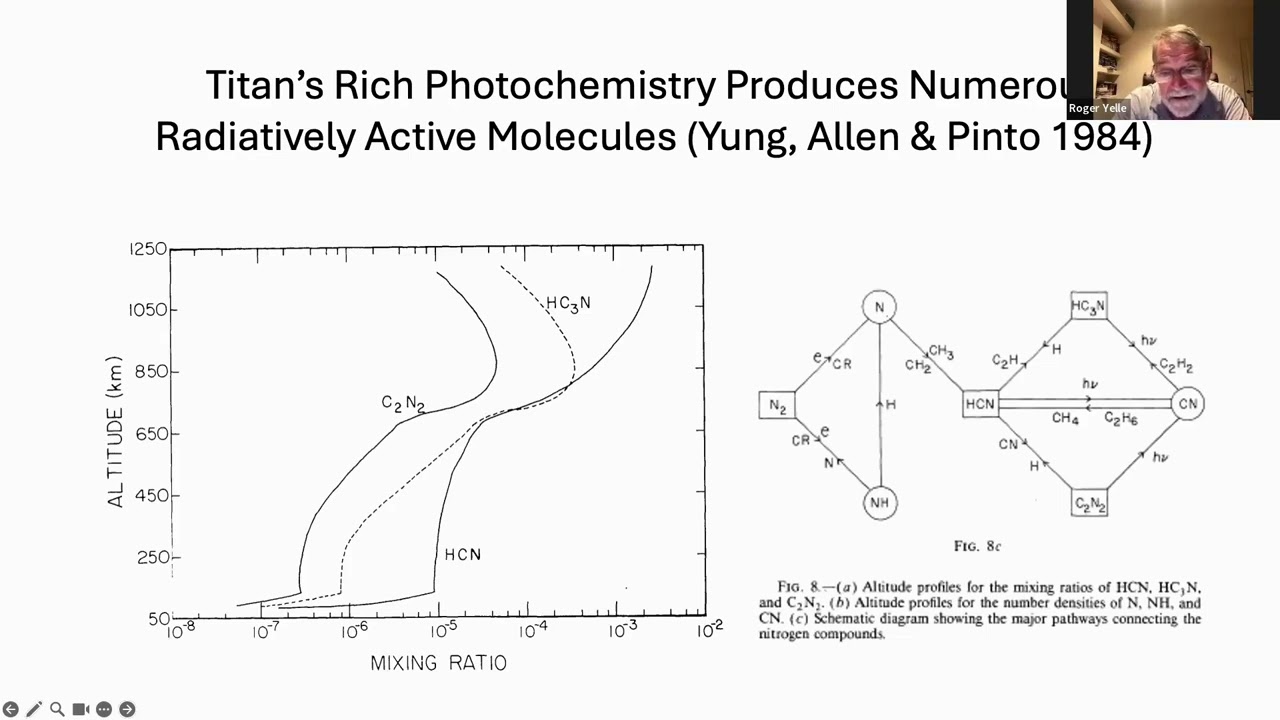
- Yung et al. 1984 chemistry paper and HCN abundance prediction.
- Yelle's 1991 paper on HCN cooling and temperature balance.
- Engineering models for the atmosphere and their range.
- Other concerns: shock radiation and gravity waves.
- Comparison of models with Huygens HASI measurements.
- Cassini INMS results showing large temperature variations.
Cited Sources
- Voyager UVS occultation data — Used for initial temperature and composition estimates.
- Yung et al. 1984 paper on Titan's atmospheric chemistry — Predicted high HCN abundance.
- Yelle 1991 paper on HCN cooling — Explained temperature balance in Titan's upper atmosphere.
- Snowden et al. paper on INMS temperature retrievals — Showed large temperature variability.
Concurring Sources
- Voyager 1 and 2 UVS results — Initial measurements of Titan's atmosphere.
- Huygens HASI measurements — In situ temperature and density profiles.
- Cassini INMS data — Mass spectrometer measurements of atmospheric composition and temperature.
Contribution & Novelties
This talk provides a unique insider perspective on the scientific and engineering challenges of preparing the Huygens mission. It highlights the iterative process of using limited data to build models and the importance of understanding atmospheric uncertainties. The speaker also emphasizes the unresolved questions about Titan’s upper atmosphere, suggesting directions for future research.
Pour aller plus loin :
- Titan (moon) - Wikipedia — Overview of Titan and its exploration.
- Huygens (spacecraft) - Wikipedia — Details on the Huygens probe.
- Cassini-Huygens - NASA Science — Official mission page.
- Atmosphere of Titan - Wikipedia — In-depth information on Titan’s atmosphere.
98 words
Radar Profile
The radar profile shows a balanced performance with moderate scores across all dimensions. The talk is informative and technically sound, but not exceptionally detailed or novel. The speaker's expertise is evident, but the content is somewhat retrospective and lacks deep analysis of the data.