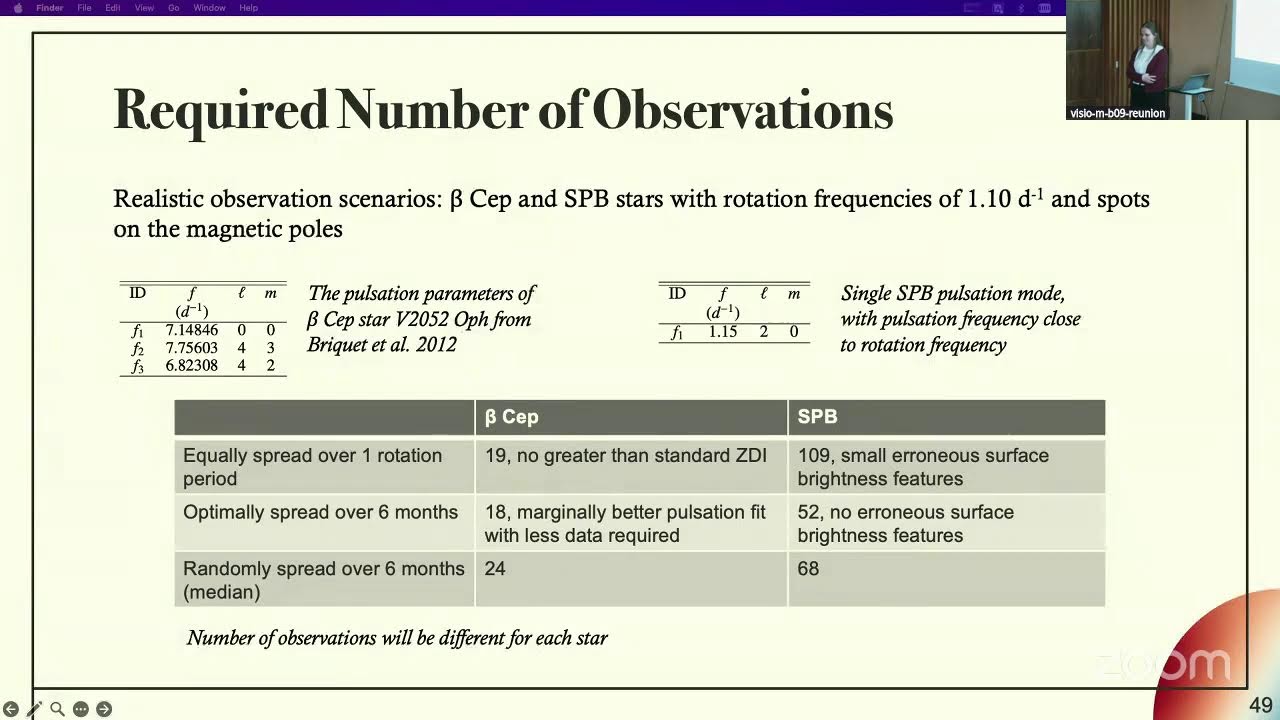
Soutenance de thèse - Chloe Gutteridge
Keywords
Summary
146 words
Critical Evaluation
Value of the Information & Strength of the Argument
The value of the information is high, as it presents original research on a niche topic. The argumentation is solid, with clear methodology and results. The speaker acknowledges limitations and uncertainties, such as small sample sizes and potential instrumental issues. The presentation is well-structured, moving from background to methods to results and implications.
Scientific Rigor, Source Quality, Title Accuracy
The scientific rigor is high, typical of a PhD defense. The speaker references previous work and collaborations, but specific citations are not explicitly mentioned in the transcription. The title is generic but accurate. The content is consistent with the title.
108 words
Title / Content Match
The title is generic but accurately reflects the content: a PhD defense presentation.
Quality & Reliability
8/10
The presentation is a PhD defense, based on original research, with detailed methodology and results. It is peer-reviewed by a jury. The speaker is transparent about limitations and uncertainties. The scientific content is rigorous, though the transcription may contain errors.
Key Moments
Markers derived by PSI from the transcript: the creator did not define chapters.
- Introduction and jury presentation
- Introduction to hot stars and pulsations
- Overview of pulsation regions and asteroseismology
- Magnetic fields in stars and detection methods
- Magneto-asteroseismology and previous studies
- Description of three observational campaigns
- Data reduction and LSD method
- Results from sample 1 and sample 2
- Results from sample 3 and context of known magnetic pulsators
- Challenges in ZDI and new code development
Contribution & Novelties
The presentation introduces a new code for magnetic mapping of pulsating stars that accounts for pulsational velocity variations, addressing a gap in existing ZDI codes. It also provides new magnetic field detections in several pulsating stars, contributing to the small sample of known magnetic pulsators.
Pour aller plus loin :
- Asteroseismology — Relevant for understanding the use of pulsations to probe stellar interiors.
- Zeeman-Doppler imaging — Technique used to map magnetic fields on stellar surfaces.
- Least-squares deconvolution — Method used to increase signal-to-noise in spectropolarimetry.
- TESS — Space telescope used for photometric observations.
- PLATO — Upcoming space mission for which the research prepares.
103 words
Radar Profile
The radar profile shows high scores across all dimensions, indicating a well-rounded and rigorous scientific presentation. The balance between quantity, quality, technical depth, and reliability suggests a comprehensive and trustworthy source.