Titan's deep ocean evolution and evidences or not for its presence
Keywords
Summary
155 words
Critical Evaluation
Value of the Information & Strength of the Argument
The talk provides a valuable synthesis of the current state of knowledge on Titan’s subsurface ocean, highlighting the evolution of evidence and the ongoing debates. The argumentation is solid, systematically presenting each piece of evidence, its initial interpretation, and subsequent re-evaluations. The speaker is careful to distinguish between confirmed findings and those that remain uncertain, and he openly discusses contradictions and unresolved issues. The presentation is well-structured, guiding the audience through the chronological development of understanding and the implications of different measurements. The value lies in its critical assessment of the evidence, which is essential for advancing scientific understanding.
Scientific Rigor, Source Quality, Title Accuracy
The talk demonstrates scientific rigor by referencing specific studies and data, and by acknowledging the limitations and uncertainties of each piece of evidence. The speaker cites multiple peer-reviewed papers and discusses the methods used, such as gravity measurements and radar data analysis. The title accurately reflects the content, which is a balanced examination of evidence for and against the ocean. The presentation is appropriate for a scientific audience, and the speaker does not overstate conclusions, instead emphasizing what is known and what remains uncertain. The quality of sources is high, as they are primarily from the Cassini mission and associated scientific literature.
216 words
Title / Content Match
The title accurately reflects the content, which discusses the evolution of Titan's deep ocean and the evidence for or against its presence.
Quality & Reliability
8/10
Talk by a recognized expert in planetary science, presenting a balanced overview of evidence for Titan's subsurface ocean, including conflicting results and uncertainties. The content is scientifically rigorous, but as a conference presentation, it lacks detailed methodological descriptions and peer-review context.
Key Moments
Markers derived by PSI from the transcript: the creator did not define chapters.
- Introduction to the talk and the topic of Titan's deep ocean.
- Pre-Cassini models proposing the possibility of a subsurface ocean on Titan.
- Discussion of the eccentricity problem and its implications for an ocean.
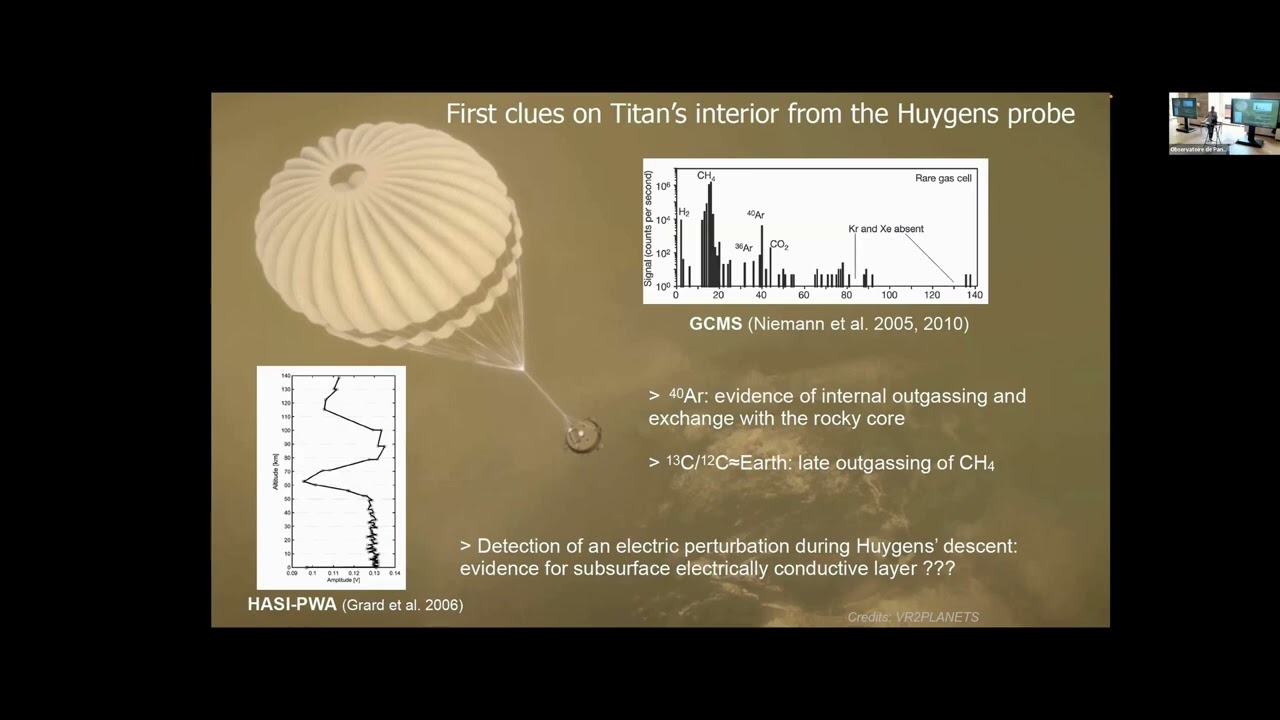
- First evidence from Huygens: argon-40 detection and electric field perturbations.
- Reanalysis of electric field data questioning the ocean interpretation.
- Radar measurements of rotation and obliquity suggesting a decoupled ice shell.
- Gravity measurements and the Love number k2, initial evidence for an ocean.
- Reanalysis of gravity data yielding a lower k2, consistent with a less dense ocean.
- New constraints from spin state indicating high dissipation and rapid eccentricity damping.
- Future measurements from Dragonfly and implications for understanding Titan's interior.
Cited Sources
- Cassini-Huygens mission data — Mentioned as the primary source of data for the talk.
- Huygens probe measurements — Referenced for argon-40 detection and electric field perturbations.
- Titan's gravity field and Love number — Discussed in the context of k2 measurements.
Concurring Sources
- Iess et al. (2012) - Gravity field and interior of Titan — Initial determination of k2 indicating an ocean.
- Durante et al. (2019) - Titan's gravity field and interior — Reanalysis of gravity data yielding a lower k2.
Dissenting Sources
- Béghin et al. (2012) - Electric field perturbations
Contribution & Novelties
The talk provides an up-to-date synthesis of the evidence for Titan’s subsurface ocean, highlighting the dynamic nature of scientific interpretation and the importance of reanalysis. It emphasizes the current debates and uncertainties, particularly regarding the Love number and dissipation, which are crucial for understanding Titan’s evolution. The speaker also outlines future measurement strategies, including those from the Dragonfly mission.
Pour aller plus loin :
- Titan’s subsurface ocean — Overview of the evidence and models.
- Cassini mission — Context for the data discussed.
- Tidal heating — Relevant to the dissipation and eccentricity discussion.
92 words
Radar Profile
The radar profile shows high scores in quantity and quality of information, with a slightly lower technical level, reflecting the presentation's balance between depth and accessibility. The overall reliability is high, consistent with the speaker's expertise and the use of established data.