Titan's gravity field and interior structure after Cassini
Keywords
Summary
159 words
Critical Evaluation
Value of the Information & Strength of the Argument
The presentation provides valuable original data and analysis from the Cassini mission, offering quantitative results on Titan’s gravity field and interior. The argumentation is solid, based on rigorous data processing and modeling, with clear explanations of the methodology. The speaker acknowledges uncertainties and limitations, such as the inability to determine internal dissipation from the time lag. The comparison with the Kaula rule is appropriately cautious, and the discussion of future missions adds perspective.
Scientific Rigor, Source Quality, Title Accuracy
The scientific rigor is high, with detailed descriptions of data acquisition, processing, and error analysis. The sources are primarily the Cassini mission data and the speaker’s own published work (e.g., Durante et al., 2019). The title accurately reflects the content. No public comments were provided, so no analysis of audience reception is possible.
141 words
Title / Content Match
The title accurately reflects the content, which focuses on the gravity field and interior structure of Titan as derived from Cassini data.
Quality & Reliability
8/10
Presentation of original research based on Cassini data, with detailed methodology and quantitative results. The speaker is an expert from Sapienza University, and the content is consistent with peer-reviewed findings.
Key Moments
Markers derived by PSI from the transcript: the creator did not define chapters.
- Introduction and overview of the presentation
- Cassini flybys and gravity data collection
- Data analysis methodology and software (MONTE)
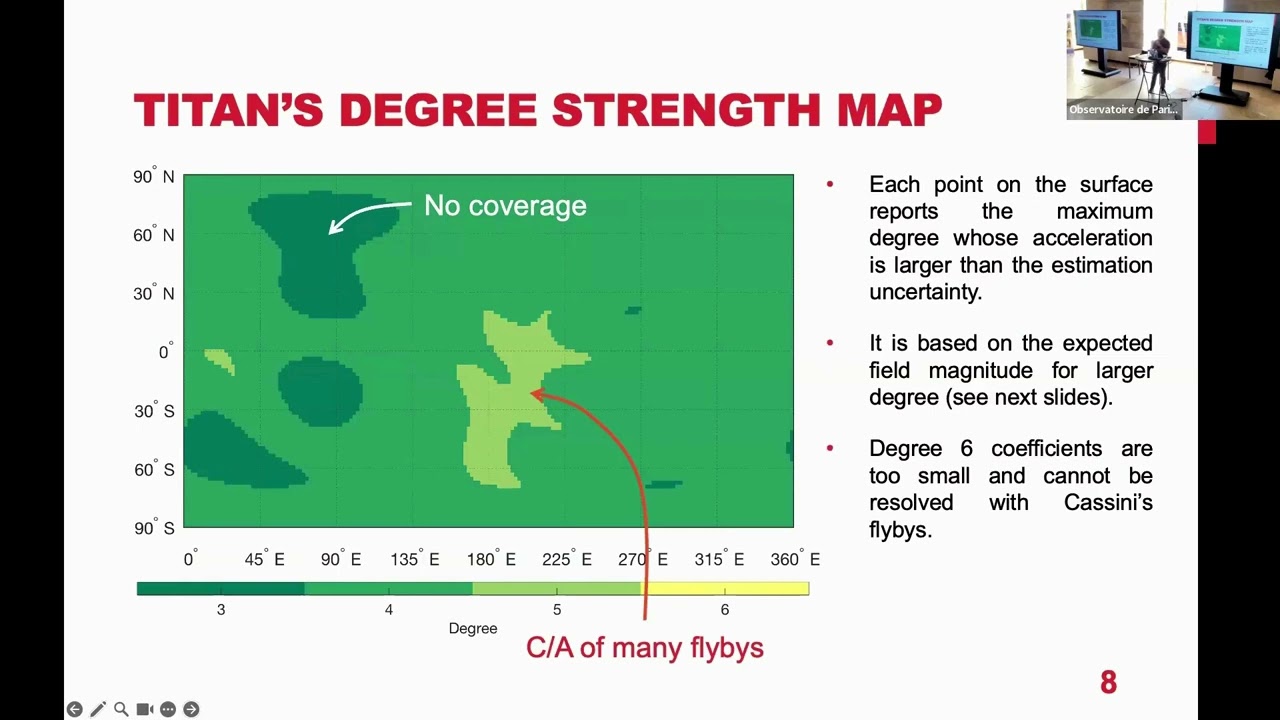
- Results for gravity field coefficients and degree strength map
- Love number determination and time lag
- Implications for Titan's interior structure
- Discussion of Kaula rule and comparison with terrestrial planets
- Conclusion and Q&A
Cited Sources
- Durante et al. (2019) Titan's gravity field and interior structure after Cassini — Referenced as the update on Titan's gravity field based on all nine gravity passes.
Concurring Sources
- Iess et al. (2012) The Tides of Titan — Earlier determination of Titan's tidal response, consistent with the Love number presented.
Contribution & Novelties
This presentation provides the latest results on Titan’s gravity field from Cassini, including the determination of the Love number and moment of inertia, which are crucial for understanding its interior structure. The analysis highlights the lack of correlation between gravity and topography, suggesting internal heterogeneities. The comparison with the Kaula rule offers insights into the mechanical properties of icy moons.
Pour aller plus loin :
- Cassini mission — Background on the mission that collected the data.
- Love number — Explanation of the tidal response parameter.
- Kaula rule — Empirical power law for gravity spectra.
94 words
Radar Profile
The radar profile shows high scores across all dimensions, indicating a technically detailed and reliable presentation. The balance between quantity and quality of information is strong, with a high level of technical depth suitable for an expert audience.