Observations of Titan after Cassini Huygens with Ground and Space Observatories
Keywords
Summary
106 words
Critical Evaluation
Value of the Information & Strength of the Argument
The talk provides valuable updates on recent and ongoing observations of Titan, including new detections and upper limits that constrain atmospheric models. The argumentation is solid, based on peer-reviewed or in-preparation papers, and the speaker clearly explains the scientific significance of each result. However, some claims are preliminary and not yet published, which slightly reduces the overall strength.
67 words
Title / Content Match
The title accurately reflects the content, which focuses on post-Cassini observations of Titan using ground and space observatories.
Quality & Reliability
8/10
Talk by a NASA scientist presenting recent peer-reviewed and in-preparation results, with references to specific instruments and publications. Some claims are not yet published, but the overall methodology is sound.
Key Moments
Markers derived by PSI from the transcript: the creator did not define chapters.
- Introduction and overview of the talk
- TEXES observations and detection of propadiene
- HNC detection and implications for photochemistry
- SOFIA observations of C4H2 and C3H4
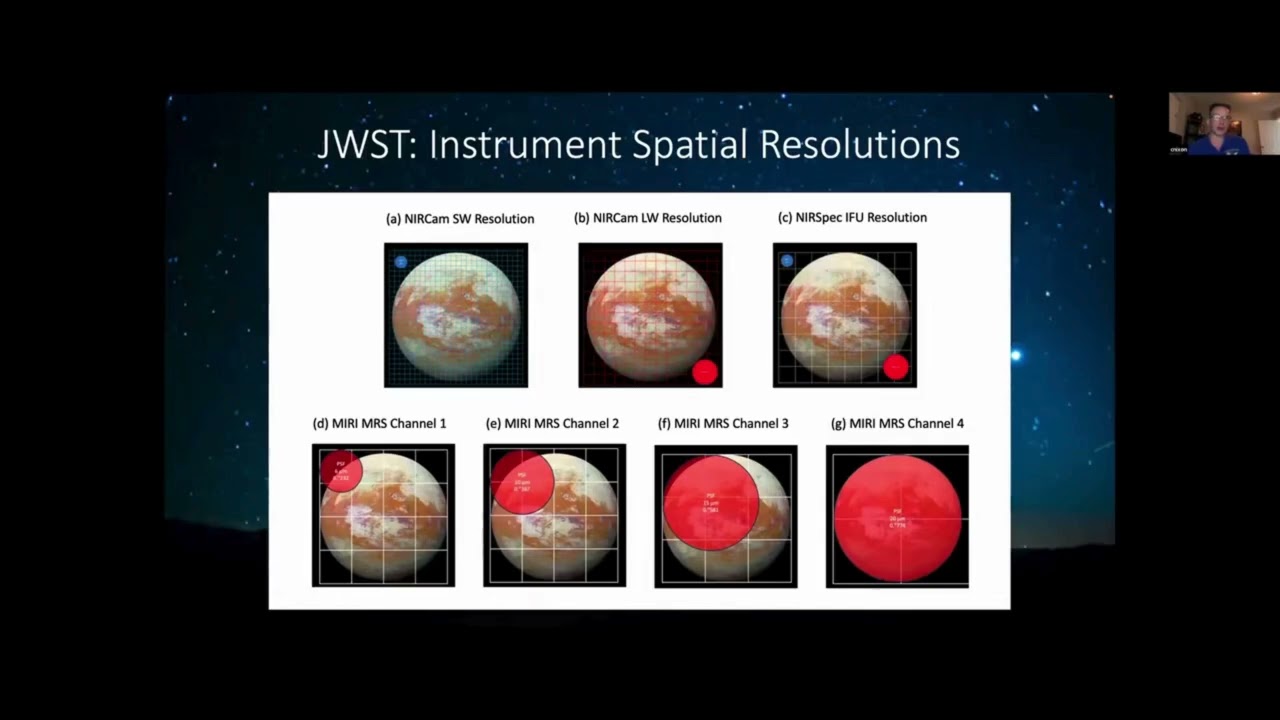
- JWST observations: NIRCam, NIRSpec, MIRI
- First detection of CH3 radical on Titan
- Stellar occultation campaign and wind profile
- Future JWST observations and upcoming telescopes
Cited Sources
- Propadiene detection paper (2019) — Detection of propadiene on Titan using TEXES
- JWST Titan paper (2025) — JWST observations of Titan with NIRCam, NIRSpec, MIRI
- Theresa Marlin's occultation paper (in press) — Stellar occultation campaign to measure winds
Concurring Sources
- ALMA observations of Titan — Complementary observations of Titan's atmosphere
Dissenting Sources
- Photochemical models — Some observed abundances differ from model predictions, indicating need for model updates.
Contribution & Novelties
The talk presents recent detections and upper limits that refine our understanding of Titan’s atmospheric chemistry, including the first infrared detection of HNC and the first remote detection of CH3. It also highlights discrepancies with photochemical models, prompting model revisions.
Pour aller plus loin :
- Titan’s atmosphere — Overview of Titan’s atmosphere.
- JWST — Space telescope used for observations.
- ALMA — Array used for complementary observations.
66 words
Radar Profile
The radar profile shows high scores across all dimensions, indicating a technically detailed and reliable presentation. The talk is rich in information and well-supported by sources, though some results are preliminary.