The ESA JUICE and NASA Europa Clipper missions
Keywords
Summary
178 words
Critical Evaluation
Value of the Information & Strength of the Argument
The talk provides valuable, up-to-date information on the JUICE and Europa Clipper missions, including their payloads, trajectories, and coordination efforts. The argumentation is solid, based on the speaker’s direct involvement in mission planning and the existence of a formal steering group. The presentation is well-structured, clearly explaining the complementary nature of the two missions and the scientific benefits of joint observations. The speaker also addresses challenges, such as the lack of a dust instrument on JUICE, and acknowledges uncertainties in end-of-mission scenarios. Overall, the information is highly relevant for researchers in planetary science and mission planning.
Scientific Rigor, Source Quality, Title Accuracy
The talk is scientifically rigorous, with the speaker citing specific mission details and referencing a Europlanet webinar for further information. The sources are primarily the mission teams and their planning documents, which are authoritative. The title accurately reflects the content, focusing on the two missions and their coordination. The presentation is well-organized and technically detailed, suitable for an expert audience. No external sources are cited beyond the webinar, but the speaker’s expertise and the official nature of the information lend credibility.
192 words
Title / Content Match
The title accurately reflects the content, which focuses on the JUICE and Europa Clipper missions and their coordination.
Quality & Reliability
8/10
The talk is given by leading scientists directly involved in the JUICE and Europa Clipper missions, providing authoritative and up-to-date information on mission status, coordination, and scientific plans. The content is technical and specific, reflecting deep expertise. However, it is a conference presentation without formal peer review, and some details (e.g., exact flyby timings) may evolve.
Key Moments
Markers derived by PSI from the transcript: the creator did not define chapters.
- Introduction and overview of JUICE and Europa Clipper missions
- Comparison of payloads and complementarity
- First joint observation opportunity: interstellar object
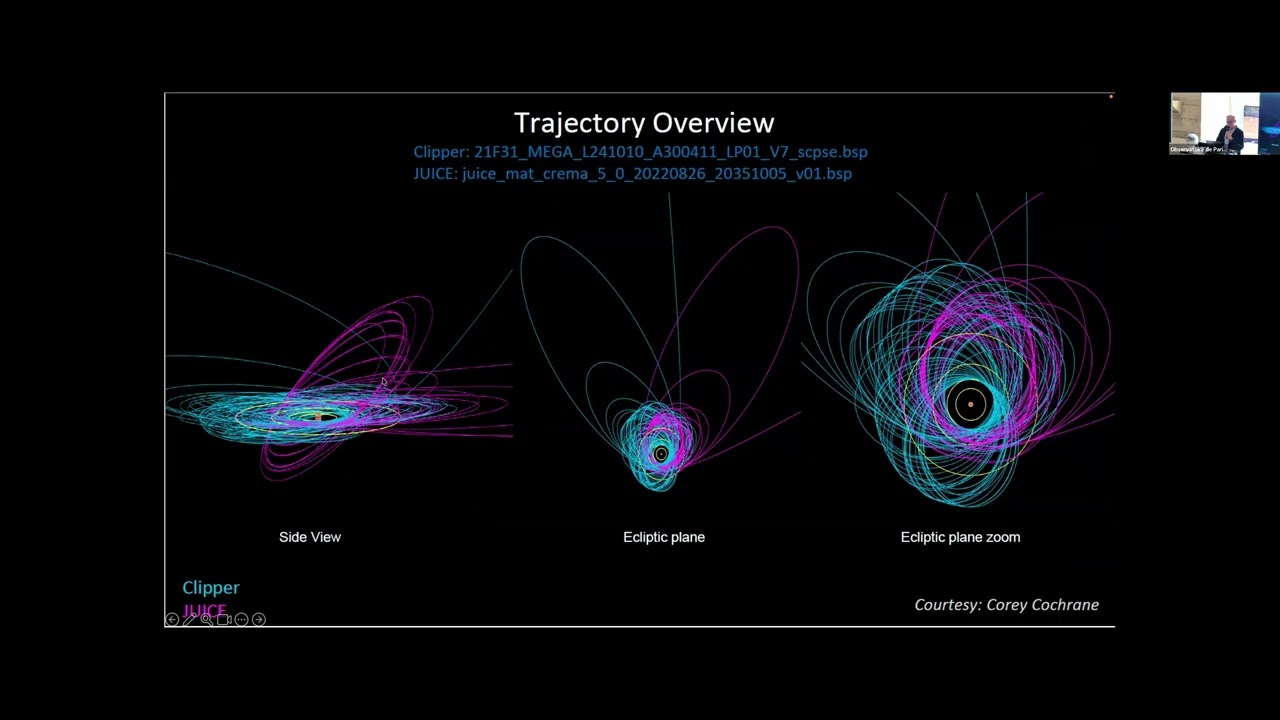
- Mission timelines and trajectories
- Synergistic observations for plasma science and plume detection
- End-of-mission scenarios and potential impact observations
- Q&A session and discussion on dust instrument and end-of-mission
Cited Sources
- Europlanet webinar on JUICE and Europa Clipper collaboration — Referenced by the speaker as a resource for more details on mission capabilities and collaboration.
Concurring Sources
- JUICE mission page — Official ESA page confirming mission details and objectives.
- Europa Clipper mission page — Official NASA page confirming mission details and objectives.
Contribution & Novelties
This talk provides a unique insight into the ongoing coordination between the JUICE and Europa Clipper missions, highlighting specific opportunities for joint observations that have not been widely publicized. The emphasis on the first joint observation of an interstellar object and the detailed discussion of plasma science synergies are particularly novel. The talk also addresses end-of-mission scenarios, which are rarely discussed in public forums.
Pour aller plus loin :
- JUICE mission page — Official ESA page for the JUICE mission, providing detailed mission information.
- Europa Clipper mission page — NASA’s official page for the Europa Clipper mission, with mission updates and science details.
- Ganymede — Wikipedia article on Ganymede, the target moon for JUICE’s final orbit.
- Europa (moon) — Wikipedia article on Europa, the primary target for Europa Clipper.
- Interstellar object — Wikipedia article on interstellar objects, relevant to the first joint observation discussed.
144 words
Radar Profile
The radar profile shows high scores in information quantity, quality, and technical level, indicating a dense and expert-level presentation. The reliability score is also high, reflecting the authoritative source. The overall profile suggests a highly informative and credible talk, with minor limitations in accessibility for non-experts.
💬 No comments were provided for analysis.