Some science results from CassiniMIMI Magnetospheric IMaging Investigation
Keywords
Summary
163 words
Critical Evaluation
Value of the Information & Strength of the Argument
The talk provides valuable insights into the Cassini mission’s magnetospheric results, emphasizing the novelty of ENA imaging and its impact on our understanding of Saturn’s magnetosphere. The argumentation is solid, grounded in data from multiple instruments and published studies. Krimigis effectively explains complex phenomena and supports his claims with observational evidence, such as images and spectra. The discussion of the heliosphere’s shape is particularly compelling, as it challenges long-held assumptions. However, the talk is a summary and lacks detailed methodological explanations, which is typical for a conference presentation.
Scientific Rigor, Source Quality, Title Accuracy
The talk is scientifically rigorous, referencing peer-reviewed publications and data from the Cassini mission. The speaker is a principal investigator with extensive experience, enhancing credibility. The title accurately reflects the content. The presentation includes technical details and references to specific instruments and measurements, indicating a high level of expertise. However, as a talk, it does not provide full citations for all claims, but the context suggests they are based on established research.
175 words
Title / Content Match
The title accurately reflects the content: the talk presents scientific results from the Cassini MIMI investigation, focusing on magnetospheric imaging and related discoveries.
Quality & Reliability
8/10
The talk is given by a leading expert in space physics, with decades of experience on NASA missions. The content is based on peer-reviewed results from the Cassini mission, published in journals like Nature and Space Science Reviews. The presentation includes detailed technical descriptions of instruments and data, indicating high reliability. However, as a conference talk, it lacks full methodological detail and is not a formal publication.
Key Moments
Markers derived by PSI from the transcript: the creator did not define chapters.
- Introduction to the MIMI instrument suite and team.
- Explanation of energetic neutral atom (ENA) imaging principle.
- Presentation of ion composition spectra, highlighting low nitrogen abundance.
- Discussion of the ring current and its dynamics.
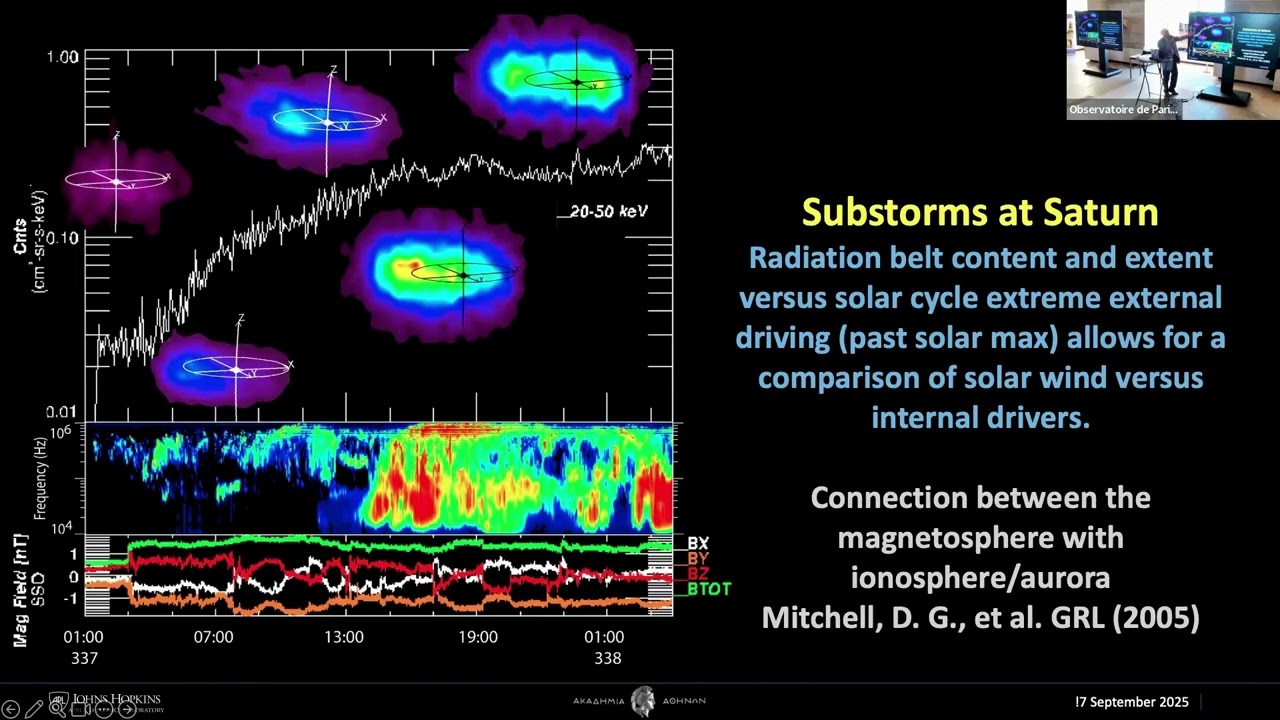
- Detection of a substorm and associated auroral activity.
- Discovery of a new radiation belt inside the rings.
- Unexpected detection of dust particles and their effects on the instrument.
- Imaging of the heliosphere and comparison with Voyager data.
- Conclusion and tribute to colleagues.
Cited Sources
- Space Science Reviews (2004) paper on Cassini MIMI — Referenced as the source of the magnetospheric schematic and initial results.
- Nature paper on ring current dynamics — Mentioned in the context of the ring current video.
Concurring Sources
- NASA Cassini mission page — Official mission information and results.
- Space Science Reviews article on MIMI — Peer-reviewed description of the MIMI instrument and initial results.
Dissenting Sources
- Alternative models of the heliosphere — The talk challenges the long-held comet-like model of the heliosphere; some models still propose a long tail, though Voyager data support the new view.
Contribution & Novelties
The talk presents several novel findings from the Cassini MIMI investigation, including the first ENA images of a planetary magnetosphere, the discovery of a new radiation belt inside Saturn’s rings, and the unexpected detection of dust. It also provides ground truth for the heliosphere’s shape, challenging previous models. The use of ENA imaging is a significant advancement in space physics.
Pour aller plus loin :
- Energetic neutral atom imaging — Provides background on the technique used in the talk.
- Cassini–Huygens — Overview of the mission and its instruments.
- Heliosphere — Discusses the structure and the Voyager crossings.
97 words
Radar Profile
The radar profile shows high scores across all dimensions, indicating a technically rich and reliable presentation. The lowest score is in quantity of information, but it is still high, reflecting the concise nature of a conference talk.