Soutenance de thèse - Mireia Leon-Dasi
Keywords
Summary
115 words
Critical Evaluation
Value of the Information & Strength of the Argument
The value of the information is high, as it presents original research with novel applications of deep learning to planetary spectroscopy. The argumentation is solid, systematically addressing each research question with clear methodology and results. The use of unsupervised deep learning to define deposit extents is innovative and addresses limitations of previous methods. The integration of laboratory spectroscopy to interpret remote sensing data strengthens the conclusions. The presentation is well-structured, with logical progression from context to methods to results and implications.
Scientific Rigor, Source Quality, Title Accuracy
The scientific rigor is high, with a clear methodology and reliance on data from the MESSENGER mission, a well-established source. The quality of sources is good, as the work builds on previous studies and is part of a PhD thesis. The title accurately reflects the content, though it is generic. The presentation includes references to published work, though specific citations are not fully detailed in the transcription. The adequacy between title and content is good, as the defense covers the thesis topic comprehensively.
179 words
Title / Content Match
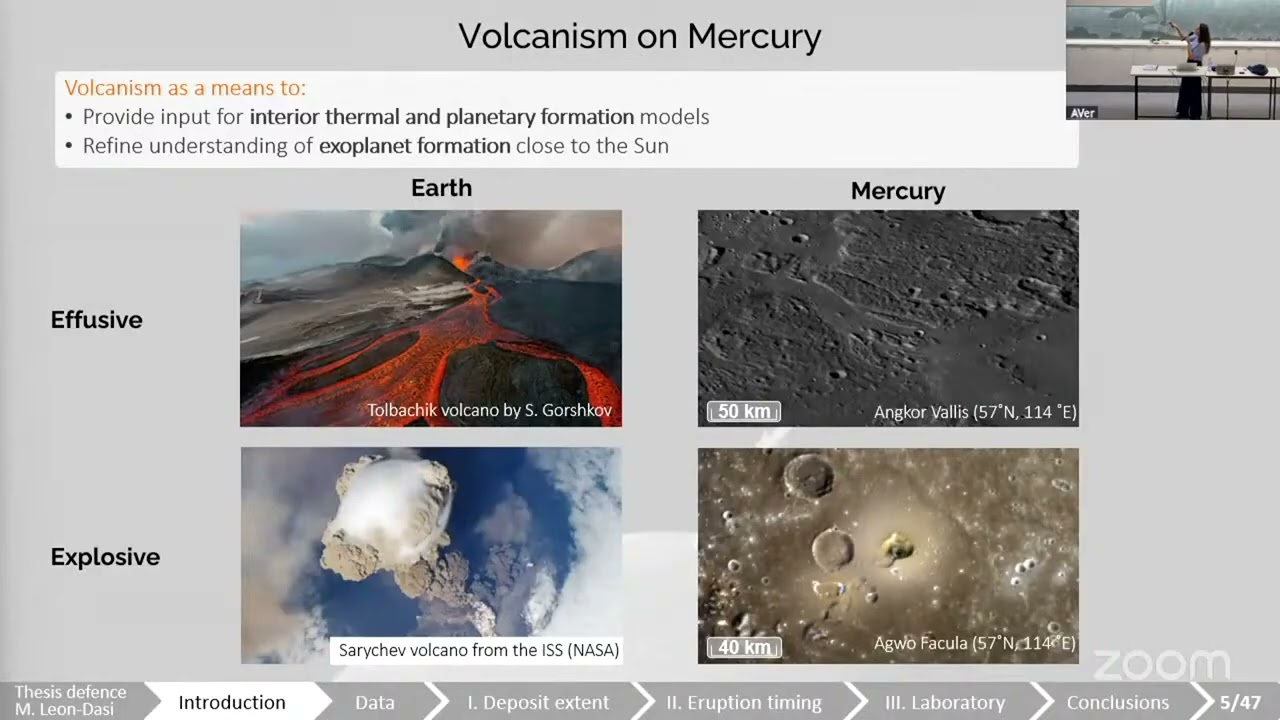
The title accurately reflects the content: a PhD defense presentation on explosive volcanism on Mercury.
Quality & Reliability
8/10
The thesis defense presents original research with a clear methodology, using data from the MESSENGER mission and laboratory spectroscopy. The work is part of a PhD, indicating rigorous scientific process. The presentation is detailed and includes references to published work, though the video itself is a recording of a defense, not a peer-reviewed publication.
Key Moments
Markers derived by PSI from the transcript: the creator did not define chapters.
- Introduction and context of Mercury exploration
- Overview of Mercury's interior and surface
- Discussion of volatile-rich nature and volcanic expectations
- Introduction to explosive volcanism and pyroclastic deposits
- Research questions and methodology overview
- Use of deep learning for deposit detection
- Results: defining extents of 55 deposits
- Spectral diversity and timing of eruptions
- Laboratory spectroscopy and space weathering
- Conclusions and implications for BepiColombo
Cited Sources
- MESSENGER mission — NASA mission to Mercury, source of remote sensing data.
- BepiColombo mission — ESA/JAXA mission to Mercury, future context for the research.
- MASCS instrument — Spectrometer on MESSENGER used for remote sensing data.
Concurring Sources
- MESSENGER mission — Provides data used in the research.
- BepiColombo mission — Future mission that will build on this work.
Contribution & Novelties
The thesis presents a novel application of deep learning (3D convolutional autoencoder) to define the extent of pyroclastic deposits on Mercury, overcoming limitations of previous methods. It provides a new catalog of 55 deposits, including new detections, and explores the spectral diversity of deposits, linking it to eruption timing. The laboratory spectroscopy work prepares for BepiColombo and helps interpret remote sensing data.
Pour aller plus loin :
- MESSENGER mission — Provides context on the mission that collected the data.
- BepiColombo mission — Future mission that will provide higher-resolution data.
- Pyroclastic deposit — Background on pyroclastic materials.
- Autoencoder — Explanation of the deep learning technique used.
105 words
Radar Profile
The radar profile shows high scores across all dimensions, indicating a well-rounded and reliable scientific presentation. The slightly lower score in 'quantite_information' relative to others suggests a focused scope, but overall the content is dense and informative.