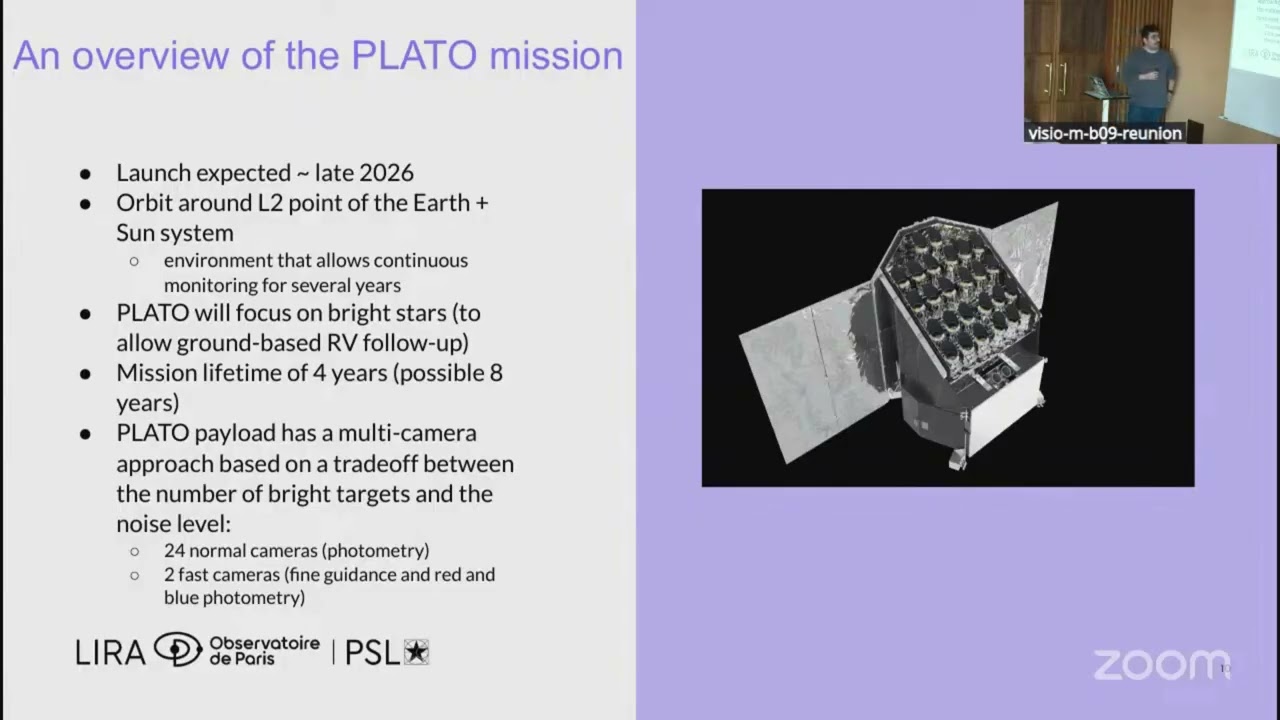
Soutenance de thèse Fernando Gutiérrez
Keywords
Summary
172 words
Critical Evaluation
Value of the Information & Strength of the Argument
The value of the information is high, as it presents original research on a critical problem for the PLATO mission. The argumentation is solid: Gutiérrez systematically builds from the mission’s constraints to the need for onboard photometry, then to the specific issue of false positives, and finally to the proposed solution. He clearly explains the theoretical basis of both methods and provides quantitative comparisons of their efficiency. The reasoning is logical and well-supported by references to prior work (e.g., Jenkins, Bryson, Natalie Matala). The presentation is technically detailed, making it valuable for specialists in exoplanet photometry.
Scientific Rigor, Source Quality, Title Accuracy
The scientific rigor is high: the work is based on established methods and published papers, and the speaker is careful to define terms and equations. The sources cited are relevant and credible (e.g., papers on binary masks, center-shift method). The title accurately reflects the content, as it is a formal PhD defense. The presentation is well-structured and the methodology is transparent. However, as a live defense, some details might be omitted, and the results are not yet peer-reviewed in this format.
192 words
Title / Content Match
The title accurately reflects the content: it is a PhD defense presentation by Fernando Gutiérrez.
Quality & Reliability
8/10
The presentation is a PhD defense, based on original research, with a clear methodology and quantitative results. The speaker demonstrates deep knowledge of the subject and references established methods and papers. However, the video is a recording of a live defense, and the scientific content is not peer-reviewed in this format.
Key Moments
Markers derived by PSI from the transcript: the creator did not define chapters.
- Introduction and committee presentation
- Motivation for studying exoplanets
- Introduction to the PLATO mission and its goals
- PLATO mission design and constraints
- Onboard photometry and binary masks
- Definition of false positives and the problem of eclipsing binaries
- Traditional center-shift method for detecting false positives
- Proposal of double aperture photometry
- Methodology for computing efficiency
- Results and comparison of methods
- Conclusions and perspectives
- Question and answer session
Cited Sources
- PLATO mission official website — Mentioned as the mission context
- Jenkins (2002) paper on detection threshold — Cited for the 7.1 sigma threshold
- Bryson et al. paper on centroid shift — Cited for the traditional method
- Natalie Matala (2010) paper — Cited as first use of centroid for eclipsing binaries
Concurring Sources
- PLATO mission official website — Provides mission details and goals.
Contribution & Novelties
The main novelty is the proposal and rigorous evaluation of double aperture photometry for detecting false positives in PLATO’s onboard photometry. This method is shown to be more efficient than the traditional center-shift method. The work also provides a formal definition and efficiency computation for this approach, which had not been done before.
Pour aller plus loin :
- PLATO mission — Official mission page for context.
- Exoplanet detection methods — Overview of transit method and false positives.
- Transit photometry — Background on the technique used.
85 words
Radar Profile
The radar profile shows high scores across all dimensions, indicating a well-balanced and rigorous presentation. The high level of technical detail and solid methodology are reflected in the scores for information quality and reliability.