Science Results from the Cassini Imaging Science Subsystem
Keywords
Summary
133 words
Critical Evaluation
Value of the Information & Strength of the Argument
The talk provides a high-level overview of significant scientific contributions from the Cassini ISS, emphasizing the instrument’s unique capabilities. West presents findings from peer-reviewed studies, such as those by Del Genio and Barbara on eddy-jet dynamics and cluster analysis, and by Goldreich on Enceladus’s libration. The argumentation is based on observational data and references to published research, lending credibility. However, the presentation is concise and lacks detailed explanations, making it more of a summary than an in-depth analysis.
Scientific Rigor, Source Quality, Title Accuracy
The talk is scientifically rigorous, with references to specific studies and researchers. The sources cited are credible, including peer-reviewed publications and mission data. The title accurately reflects the content, which is a summary of scientific results. The presentation is well-structured and delivered by an expert, ensuring reliability. No comments were provided for analysis.
146 words
Title / Content Match
The title accurately reflects the content, which is a summary of scientific results from the Cassini Imaging Science Subsystem.
Quality & Reliability
8/10
Presentation by a leading expert in planetary science, based on decades of Cassini mission data, with references to peer-reviewed studies. However, it is a conference talk with limited depth and no formal peer review.
Key Moments
Markers derived by PSI from the transcript: the creator did not define chapters.
Cited Sources
- Del Genio, A. D., & Barbara, J. M. (2016). Cluster analysis of Cassini ISS images of Saturn's clouds. — Referenced for eddy-jet interactions and cluster analysis
- Goldreich, P. et al. (2025). Limit cycle model for Enceladus's libration. — Referenced for Enceladus's libration and ice shell evolution
- Lopez, R. (2025). Geomorphology of Titan's surface. — Referenced for Titan's surface geomorphology
- Krookshank, et al. (2025). Organic composition of Iapetus's dark material. — Referenced for Iapetus's dark material composition
Concurring Sources
- Cassini Imaging Science Subsystem (ISS) official page — Provides details on the ISS instrument and its capabilities.
Contribution & Novelties
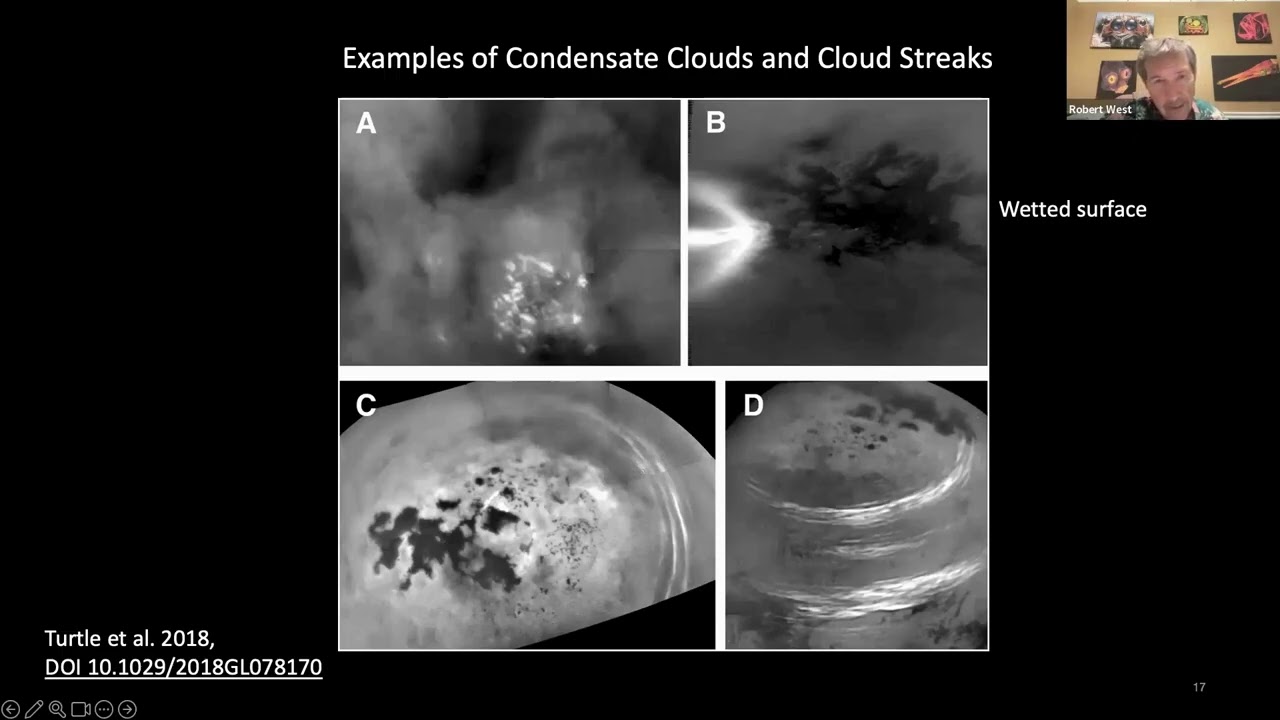
The talk provides a concise overview of key scientific results from the Cassini ISS, highlighting the instrument’s contributions to our understanding of Saturn’s atmosphere, rings, and moons. It emphasizes novel findings such as the use of cluster analysis to study cloud dynamics and the recent discovery of Enceladus’s limit cycle. The presentation also showcases the long-term monitoring of Titan’s detached haze and its seasonal variability.
Pour aller plus loin :
- Cassini–Huygens — Overview of the Cassini mission and its discoveries.
- Enceladus — Detailed information about Enceladus, including its plumes and internal structure.
- Titan (moon) — Comprehensive article on Titan’s atmosphere and surface features.
- Saturn’s rings — Information on the structure and dynamics of Saturn’s rings.
115 words
Radar Profile
The radar profile shows high scores in information quantity, quality, and reliability, with a slightly lower technical level, indicating a presentation that is informative and credible but not overly technical. The overall balance suggests a well-rounded scientific talk suitable for an informed audience.