Titan's deep ocean evolution and evidences or not for its presence
Keywords
Summary
212 words
Critical Evaluation
Value of the Information & Strength of the Argument
The talk provides a comprehensive and up-to-date review of the evidence for Titan’s subsurface ocean, critically evaluating each piece of evidence and highlighting the current debates. The argumentation is solid, based on peer-reviewed studies and mission data, and the speaker clearly distinguishes between established facts and interpretations. The presentation of conflicting results, such as the different k2 values, demonstrates scientific rigor. The speaker also discusses the implications of high dissipation, which challenges existing models, and suggests possible explanations. Overall, the value of the information is high, and the argumentation is well-structured and balanced.
Scientific Rigor, Source Quality, Title Accuracy
The talk is scientifically rigorous, referencing multiple peer-reviewed papers and mission data. The speaker is a recognized expert, and the content aligns with current scientific consensus. The title accurately reflects the content, which focuses on the evolution and evidence for Titan’s ocean. The talk does not oversimplify the subject, and it acknowledges uncertainties. The sources are credible, and the speaker clearly indicates when results are debated. The title is appropriate and not misleading.
181 words
Title / Content Match
The title accurately reflects the content, which focuses on the evolution of Titan's subsurface ocean and the evidence for its existence.
Quality & Reliability
8/10
The talk is given by a leading expert in planetary science, based on peer-reviewed research and mission data. It presents a balanced view of evidence and uncertainties, citing multiple studies. However, it is a conference presentation, not a peer-reviewed publication, and some claims are not fully detailed.
Key Moments
Markers derived by PSI from the transcript: the creator did not define chapters.
- Introduction: Overview of the talk on Titan's deep ocean evolution and evidence.
- Early theoretical predictions of subsurface oceans on large moons, including Titan.
- Discussion of the eccentricity problem and its implications for an ocean.
- First evidence from Huygens: electric field perturbations interpreted as a conducting layer.
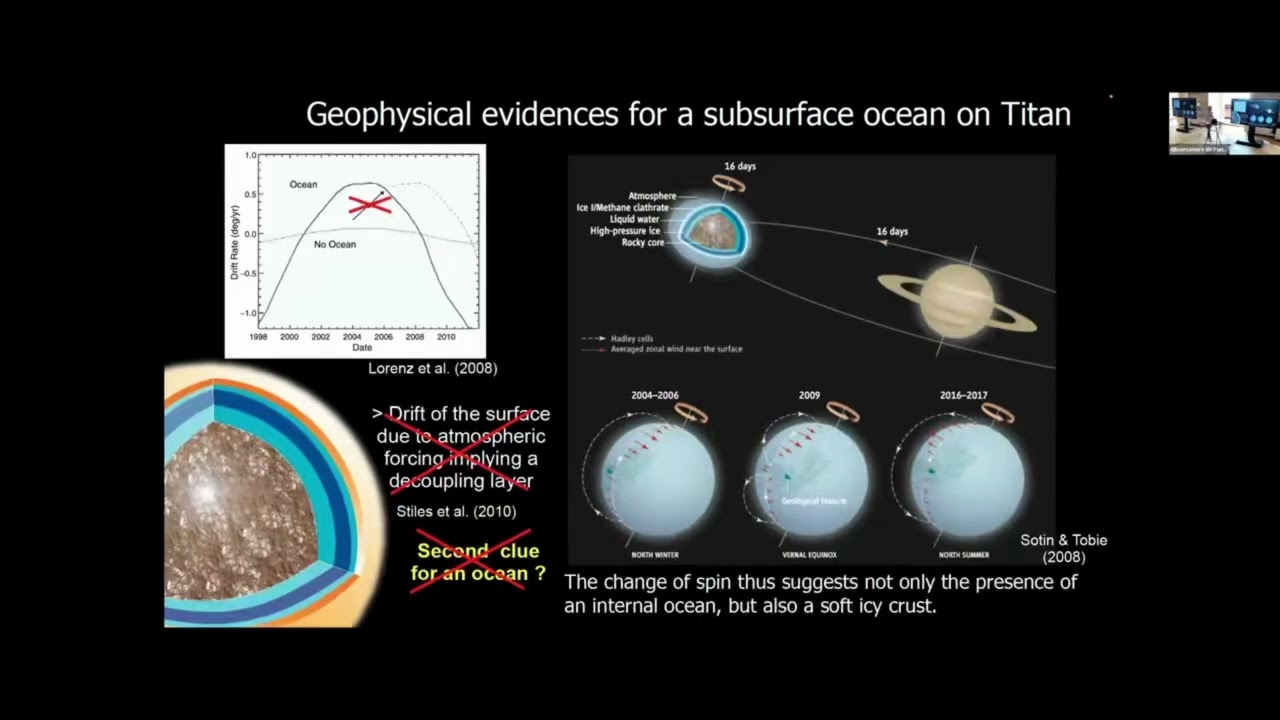
- Radar measurements of length-of-day variations and their retraction.
- Obliquity measurement and its implications for a decoupled ice shell.
- Tidal deformation measurements and the Love number k2.
- Recent reanalysis of gravity data giving a lower k2 value.
- New constraints from spin state analysis indicating high dissipation.
- Future prospects: Dragonfly mission and potential return to Saturn system.
Cited Sources
- Lunine & Stevenson (1985) — Early model proposing methane release via clathrate destabilization.
- Sotin et al. (2002) — Model showing long-term survival of subsurface ocean.
- Dermott & Sagan (1981) — Highlighted the eccentricity problem for Titan.
- Frolov & Sagan (1985) — Showed that present eccentricity implies either rigid interior or unknown mechanism.
- Tobie et al. (2005) — First model reconciling ocean survival and eccentricity.
- Béghin et al. (2012) — Interpretation of Huygens electric field as evidence for ocean.
- Rappaport et al. (2008) — Predicted obliquity and decoupling of ice shell.
- Iess et al. (2012) — First determination of k2 from Cassini gravity data.
- Durante et al. (2019) — Improved analysis of gravity data confirming k2.
- Goossens et al. (2024) — Reanalysis of gravity data giving lower k2.
- Dionne & Noyelles (2024) — Constraints on dissipation from spin state.
- Lainey et al. (2020) — Astrometric measurements indicating high dissipation in Saturn.
Concurring Sources
- Iess et al. (2012) — First k2 measurement indicating ocean.
- Durante et al. (2019) — Confirmation of k2.
- Rappaport et al. (2008) — Obliquity prediction supporting ocean.
Dissenting Sources
- Goossens et al. (2024) — Reanalysis of gravity data gives lower k2, suggesting less dense ocean.
- Dionne & Noyelles (2024) — High dissipation may be explained without an ocean.
Contribution & Novelties
The talk provides a critical synthesis of the current state of knowledge on Titan’s subsurface ocean, highlighting the evolution of evidence and the ongoing debates. It emphasizes the importance of reconciling different observations and the need for future measurements. The speaker also discusses the implications of high dissipation for Titan’s thermal and orbital evolution, which is a relatively new and challenging aspect.
Pour aller plus loin :
- Titan (moon) - Wikipedia — General overview of Titan.
- Cassini-Huygens - Wikipedia — Mission context.
- Dragonfly (spacecraft) - Wikipedia — Future mission to Titan.
- Love number - Wikipedia — Explanation of tidal Love numbers.
- Tidal heating - Wikipedia — Relevant to dissipation and orbital evolution.
112 words
Radar Profile
The radar profile shows high scores in information quantity, quality, and reliability, with a slightly lower technical level, indicating a well-balanced and accessible presentation for an expert audience.