Continuing Cassini's legacy for detailed atmospheric science on Titan using ALMA - Martin Cordiner
Keywords
Summary
130 words
Critical Evaluation
Value of the Information & Strength of the Argument
The talk provides valuable insights into Titan’s atmospheric science, showcasing ALMA’s unique contributions. The argumentation is solid, based on observational data and comparisons with previous missions. The speaker effectively demonstrates the complementarity of ALMA and Cassini, and the importance of long-term monitoring. The presentation is well-structured, moving from technical capabilities to specific results and future prospects.
Scientific Rigor, Source Quality, Title Accuracy
The scientific rigor is high, with references to peer-reviewed publications and data from ALMA and Cassini. The speaker acknowledges uncertainties and limitations, such as spatial resolution trade-offs. The title accurately reflects the content, focusing on continuing Cassini’s legacy with ALMA. No comments were provided for analysis.
117 words
Title / Content Match
The title accurately reflects the content, which focuses on using ALMA to continue and extend atmospheric studies of Titan initiated by Cassini.
Quality & Reliability
8/10
Presentation by a NASA Goddard researcher with extensive use of ALMA data, peer-reviewed results, and cross-comparison with Cassini data. The talk is technical and grounded in observational evidence, though it is a conference presentation rather than a peer-reviewed publication.
Key Moments
Markers derived by PSI from the transcript: the creator did not define chapters.
- Introduction to ALMA and its capabilities for Titan observations.
- Discussion of ALMA's high spectral resolution and its use for molecular identification.
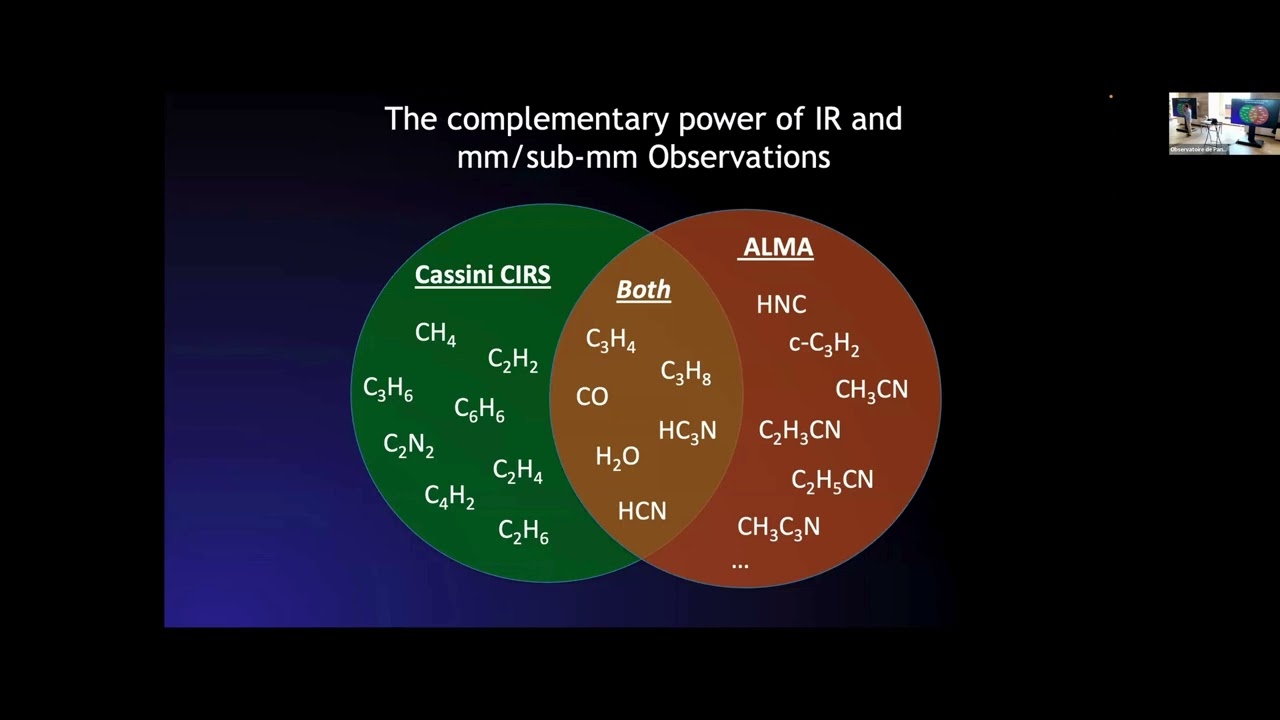
- Comparison of ALMA and Cassini CIRS data for mapping Titan's atmosphere.
- Time series of HC3N abundance showing seasonal changes and polar enhancements.
- Detection of new organic molecules, including vinyl cyanide, and implications for astrobiology.
- Isotopic studies and the enrichment of nitrogen-15 in Titan's photochemical products.
- Discovery of a fast equatorial jet in the thermosphere and its variability.
- Current status of the jet and future plans for monitoring.
- Conclusion summarizing ALMA's contributions and the importance of continuing observations.
Cited Sources
- ALMA Observatory — Mentioned as the telescope used for the observations.
- Cassini-Huygens mission — Referenced as the previous mission providing complementary data.
- Stevenson & Lunine (2017) paper on membrane candidates — Cited in relation to vinyl cyanide and membrane-like structures.
- Louch et al. (2019) paper on equatorial jet — Referenced for the discovery of the fast equatorial jet.
Concurring Sources
- Cassini CIRS data — Used for comparison with ALMA maps, showing consistency in molecular distributions.
Dissenting Sources
- Louch et al. (2019) vs. Cordiner et al. (2017) wind measurements — The speaker noted a factor of two difference in thermospheric wind speeds between the two datasets, which was resolved by reanalysis but highlights potential variability.
Contribution & Novelties
The talk presents recent ALMA observations that extend the timeline of Titan atmospheric studies beyond Cassini, providing new insights into seasonal variations, molecular complexity, and atmospheric dynamics. The detection of new molecules and isotopic ratios contributes to understanding Titan’s photochemistry and potential prebiotic chemistry.
Pour aller plus loin :
- Titan’s atmosphere - Wikipedia — Overview of Titan’s atmospheric composition and processes.
- ALMA - Wikipedia — Information on the ALMA telescope and its capabilities.
- Vinyl cyanide - Wikipedia — Background on vinyl cyanide and its relevance to astrobiology.
87 words
Radar Profile
The radar profile shows high scores across all dimensions, indicating a well-balanced and reliable presentation with strong technical depth and scientific rigor.