Scientific Achievements from the Cassini Titan Radar Mapper
Keywords
Summary
158 words
Critical Evaluation
Value of the Information & Strength of the Argument
The talk provides a comprehensive overview of the scientific results from the Cassini radar, emphasizing the value of multiple datasets in planetary exploration. Lopes argues convincingly that radar data, combined with other instruments, allowed for a global geological map of Titan despite limited SAR coverage. She illustrates the importance of topography in interpreting surface features, as seen in the case of Ganesha Macula, initially mistaken for a volcanic dome. The argumentation is solid, based on peer-reviewed research and direct mission experience. However, the talk is a summary and does not delve into technical details or alternative interpretations.
Scientific Rigor, Source Quality, Title Accuracy
The talk is scientifically rigorous, given the speaker’s expertise and the use of data from a well-documented mission. However, specific sources are not cited in the talk, and the description only provides the speaker’s affiliation. The title accurately reflects the content. The talk is an expert opinion based on original research, but without explicit references, the audience cannot easily verify the claims. The speaker mentions several colleagues and their contributions, but no URLs are provided.
187 words
Title / Content Match
The title accurately reflects the content, which focuses on the scientific achievements of the Cassini Titan Radar Mapper.
Quality & Reliability
8/10
Talk by a leading expert in planetary geology, presenting results from a well-established space mission (Cassini). The content is based on peer-reviewed research and direct involvement in the mission, but it is a conference presentation without detailed citations or verification of all claims.
Key Moments
Markers derived by PSI from the transcript: the creator did not define chapters.
- Introduction and historical context: Charles Elachi's vision for Titan as a radar target.
- Overview of radar modes: SAR, high-SAR, SARtopo, and radiometry, and their uses.
- Global maps from radiometry and topography, and the first SAR image showing channels and fans.
- Geological mapping of Titan using multiple datasets, leading to a global geologic map.
- Dunes: their morphology, distribution, and comparison with Earth's longitudinal dunes.
- Impact craters and their implications for surface age; astrobiology potential.
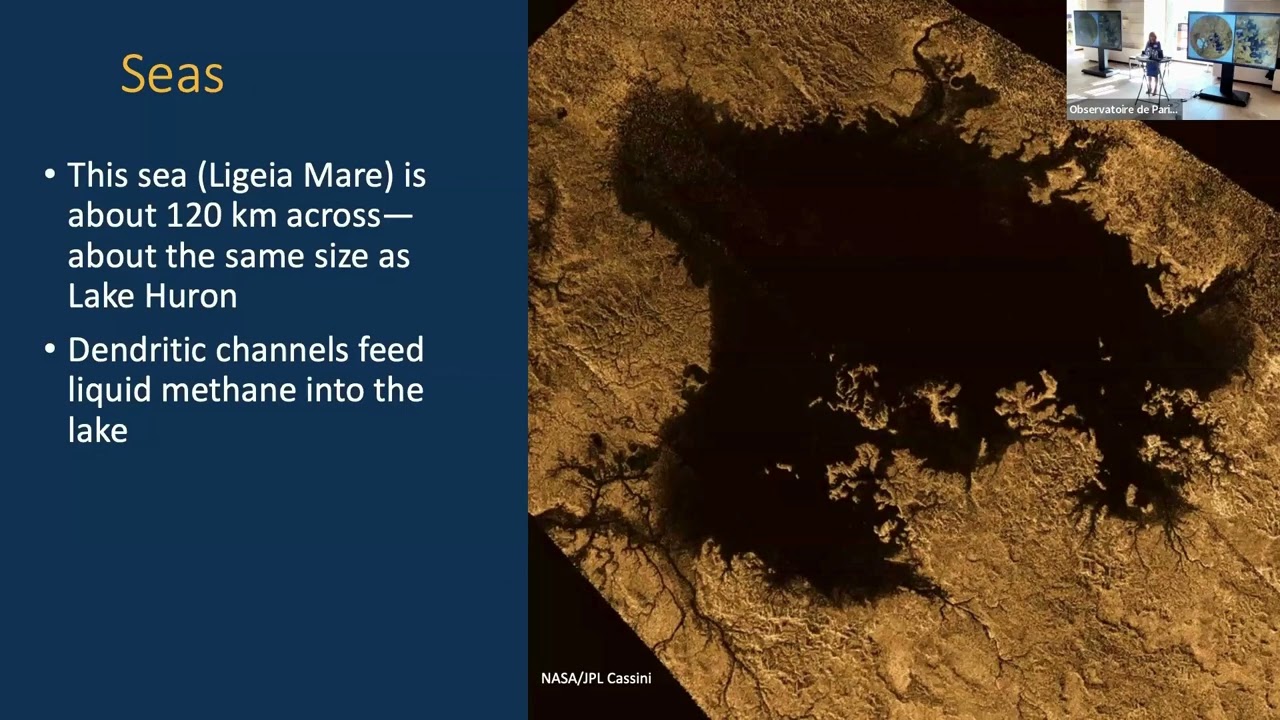
- Rivers, mountains, and evidence of tectonics; lakes and seas at the poles.
- Bathymetry of Ligeia Mare and the 'magic island' mystery.
- Cryovolcanism: Sotra Facula as a collapse feature, not an impact crater.
- Conclusion: Titan as 'Earth of the outer solar system'; promotion of COSPAR book.
Cited Sources
- Cassini-Huygens mission — Mentioned as the mission that carried the radar instrument.
- Titan (moon) — The subject of the talk.
Concurring Sources
- Cassini-Huygens mission — The mission's official page confirms the radar's achievements.
Contribution & Novelties
The talk provides a personal account of the scientific achievements of the Cassini radar, offering insights into the process of geological mapping and the importance of multiple datasets. It highlights specific discoveries such as the lakes, dunes, and potential cryovolcanism, and discusses the challenges of radar data interpretation. The speaker’s expertise adds value, but the content is a summary of previously published results rather than new findings.
Pour aller plus loin :
- Cassini Radar Mapper — Overview of the radar instrument and its modes.
- Titan’s Lakes and Seas — Detailed information on the lakes and seas discovered by Cassini.
- Sotra Facula — The cryovolcanic candidate discussed in the talk.
109 words
Radar Profile
The radar profile shows high scores in information quantity, quality, and reliability, with a slightly lower technical level, reflecting the talk's focus on geological interpretation rather than technical radar details.