Soutenance de thèse - Garance Bras
Keywords
Summary
196 words
Critical Evaluation
Value of the Information & Strength of the Argument
The value of the information is high, as it presents novel methods for improving distance measurements to pulsating stars, which are fundamental for cosmology. The argumentation is solid, based on rigorous statistical methods (PCA) and careful observational data. The presentation clearly explains the motivation, methodology, and results, with appropriate caveats. The use of homogeneous data sets and the investigation of systematic biases demonstrate scientific rigor.
Scientific Rigor, Source Quality, Title Accuracy
The scientific rigor is evident in the use of established techniques (SPIPS, PCA, cross-correlation) and the careful consideration of systematic effects. The sources cited include the SPIPS algorithm (Mérand et al.), the SH0ES program, and previous p-factor calibrations. The title accurately reflects the content. The defense is well-structured and the methodology is transparent.
133 words
Title / Content Match
The title accurately reflects the content, focusing on optimized modeling of pulsating stars for distance measurements.
Quality & Reliability
8/10
The presentation is a PhD defense, based on original research, with a clear methodology and references to established techniques. The work is presented by the researcher herself, ensuring accuracy of the content. However, as a live presentation, some details may be simplified, and the final results are not yet peer-reviewed in a journal.
Key Moments
Markers derived by PSI from the transcript: the creator did not define chapters.
- Introduction and committee presentation
- Context: distance scale and Hubble tension
- Introduction to pulsating stars and period-luminosity relation
- SPIPS modeling tool explained
- First contribution: light curve templates using PCA
- Application of templates to extragalactic Cepheids
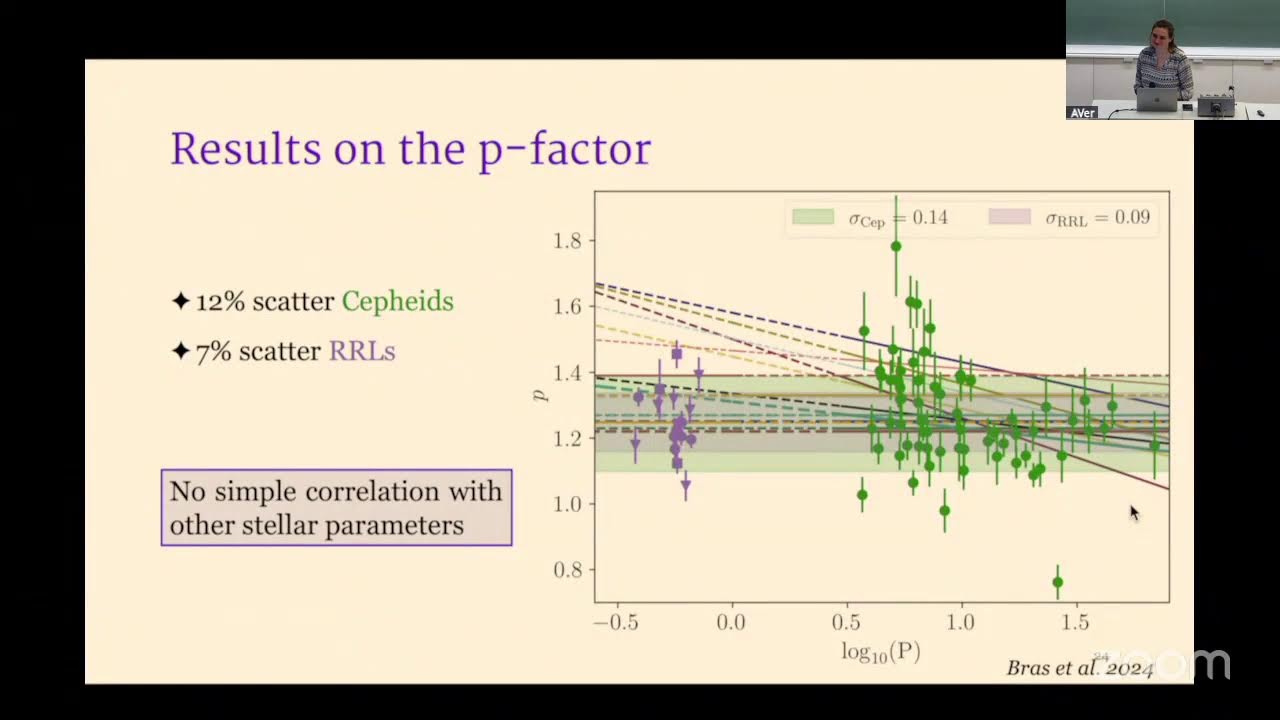
- Second contribution: p-factor calibration for RR Lyrae
- Radial velocity measurements and biases
- Third contribution: limb darkening study with CHARA
- Conclusions and prospects
Cited Sources
- SPIPS: spectro-photometric modeling of pulsating stars — The SPIPS algorithm, developed by Antoine Mérand, is used for modeling pulsating stars.
- SH0ES project — The SH0ES program provides observations of Cepheids in nearby galaxies for distance scale calibration.
- Gaia parallaxes — Gaia parallaxes are used to calibrate the p-factor observationally.
- Leavitt's period-luminosity relation — Discovered by Henrietta Leavitt, this relation is fundamental for Cepheid distances.
Concurring Sources
- SPIPS: spectro-photometric modeling of pulsating stars — The SPIPS algorithm is used and validated in this work.
- SH0ES project — The SH0ES program provides data and context for distance scale measurements.
Dissenting Sources
- Previous p-factor relations — Some previous p-factor relations for Cepheids diverge for RR Lyrae, but this work finds a constant p-factor, contradicting those relations.
Contribution & Novelties
The main novelty is the development of multi-wavelength light curve templates using PCA, which significantly reduce the number of free parameters in fitting Cepheid photometry. This improves the precision of distance measurements. Additionally, the calibration of the p-factor for RR Lyrae stars provides new constraints on this crucial parameter, suggesting a constant value across different pulsating star types. The ongoing study of limb darkening variations with interferometry is also innovative.
Pour aller plus loin :
- Period-luminosity relation — Foundational concept for Cepheid distances.
- Hubble tension — The discrepancy between local and early universe measurements of the Hubble constant.
- Parallax of pulsation — Technique for measuring distances to pulsating stars.
109 words
Radar Profile
The radar profile shows high scores across all dimensions, indicating a well-rounded and reliable scientific presentation. The strengths are in the quantity and quality of information, as well as the technical level and global reliability.