Observations of Titan after Cassini Huygens with Ground and Space Observatories
Keywords
Summary
141 words
Critical Evaluation
Value of the Information & Strength of the Argument
The talk provides valuable updates on Titan research, including new detections and constraints that refine photochemical models. The argumentation is solid, based on peer-reviewed publications and ongoing analyses. The speaker clearly distinguishes between published results and work in preparation, and acknowledges limitations such as spatial resolution. The presentation is well-structured, moving from specific detections to broader implications for Titan’s atmospheric chemistry.
Scientific Rigor, Source Quality, Title Accuracy
The speaker is a recognized expert, and the content is grounded in peer-reviewed research. He references specific instruments (TEXES, SOFIA, JWST, Keck) and papers (e.g., the JWST paper published in May 2025). The title accurately reflects the content, which focuses on post-Cassini observations. The talk is scientifically rigorous, with clear methodology and acknowledgment of uncertainties.
131 words
Title / Content Match
The title accurately reflects the content, which focuses on recent ground- and space-based observations of Titan post-Cassini.
Quality & Reliability
8/10
Presentation by a leading expert in Titan science, based on peer-reviewed research and ongoing projects. Claims are supported by specific observations and references to published papers. Some results are unpublished or in preparation, but clearly identified as such.
Key Moments
Markers derived by PSI from the transcript: the creator did not define chapters.
- Introduction to the talk and overview of topics.
- Discussion of TEXES observations and detection of propadiene.
- First infrared detection of HNC and implications for photochemistry.
- SOFIA observations of heavy molecules and upper limits.
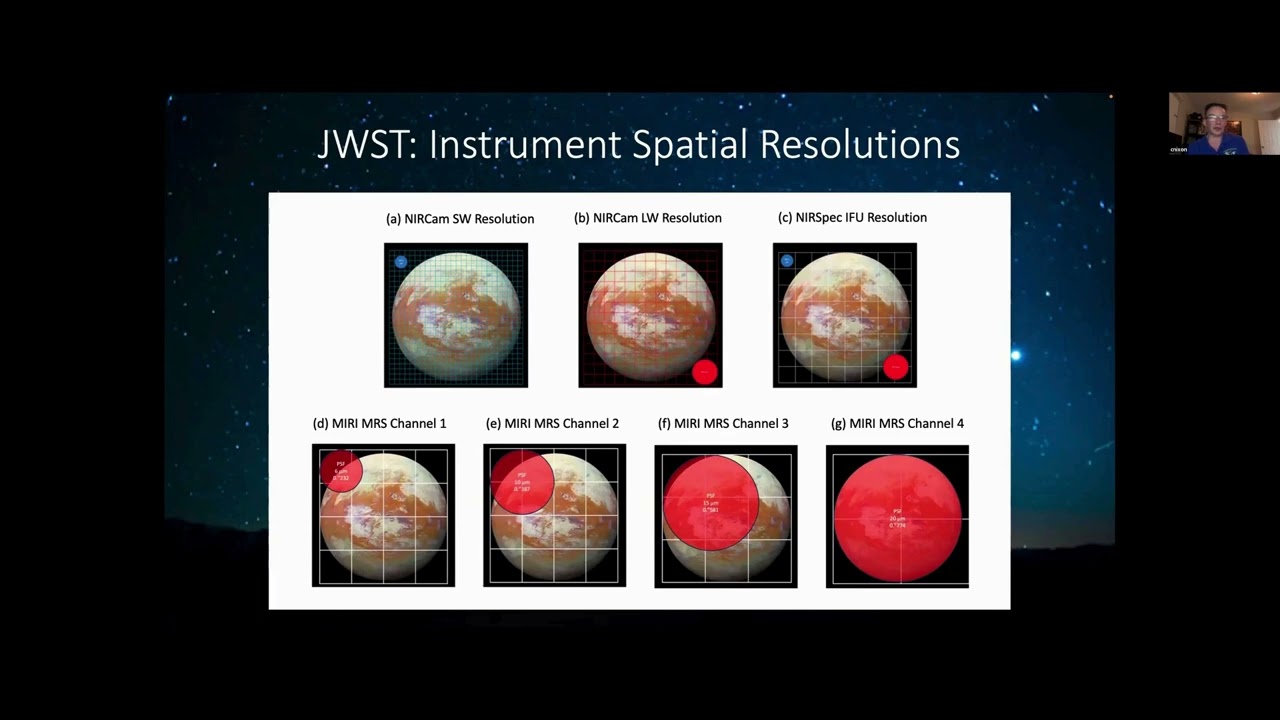
- JWST observations: NIRSpec and MIRI detections, including CH3 radical.
- Cloud monitoring with Keck and comparison with models.
- Stellar occultation campaign and wind profile retrieval.
- Future JWST observations and upcoming ELT-class telescopes.
Cited Sources
- Detection of propadiene on Titan — Mentioned as a detection made with TEXES, published in 2019.
- JWST observations of Titan — Paper published in May 2025, covering NIRSpec and MIRI observations.
- Stellar occultation paper by Theresa Marlin — Accepted paper on the occultation campaign, in press.
Concurring Sources
- ALMA observations of Titan — Mentioned as complementary to the presented work, providing detections of HNC and other molecules.
Contribution & Novelties
The talk presents recent detections and constraints that advance Titan science, such as the first infrared detection of HNC and the first remote sensing detection of CH3. It also provides updated upper limits for molecules like C4N2, which inform photochemical models. The speaker highlights the value of continued ground-based and space-based observations in the post-Cassini era.
Pour aller plus loin :
- Titan (moon) - Wikipedia — Overview of Titan’s atmosphere and surface.
- Cassini-Huygens - NASA — Mission context and findings.
- James Webb Space Telescope - NASA — Instrument capabilities and recent observations.
92 words
Radar Profile
The radar profile shows high scores across all dimensions, indicating a well-balanced and reliable presentation. The talk is rich in information, technically sound, and based on credible sources, with a slight emphasis on quantitative information and technical depth.