Dragonfly In Situ Exploration of Titan's Prebiotic Chemistry, Habitability, Meteorology, Geology, an
Keywords
Summary
170 words
Critical Evaluation
Value of the Information & Strength of the Argument
The presentation provides valuable, up-to-date information on the Dragonfly mission, including its scientific objectives, instrument suite, and engineering design. The speakers, who are directly involved in the mission, offer authoritative insights into the mission’s status and challenges. The argumentation is solid, with clear explanations of how the mission’s design is driven by scientific goals and environmental constraints. The historical context provided by Ralph Lorenz adds depth, illustrating the evolution of Titan exploration concepts. The talk is well-structured and informative, making a strong case for the mission’s scientific value.
97 words
Title / Content Match
The title accurately reflects the content, which covers Dragonfly's science goals and engineering aspects.
Quality & Reliability
8/10
The talk is given by mission leads from APL, providing authoritative and up-to-date information on the Dragonfly mission. The content is technical and detailed, with references to mission milestones and engineering tests. The information is reliable, though it is a presentation rather than a peer-reviewed publication.
Key Moments
Markers derived by PSI from the transcript: the creator did not define chapters.
- Introduction and mission overview by Elizabeth Turtle
- Timeline and mission milestones
- Science goals: prebiotic chemistry and habitability
- Mission elements: cruise stage, entry vehicle, lander
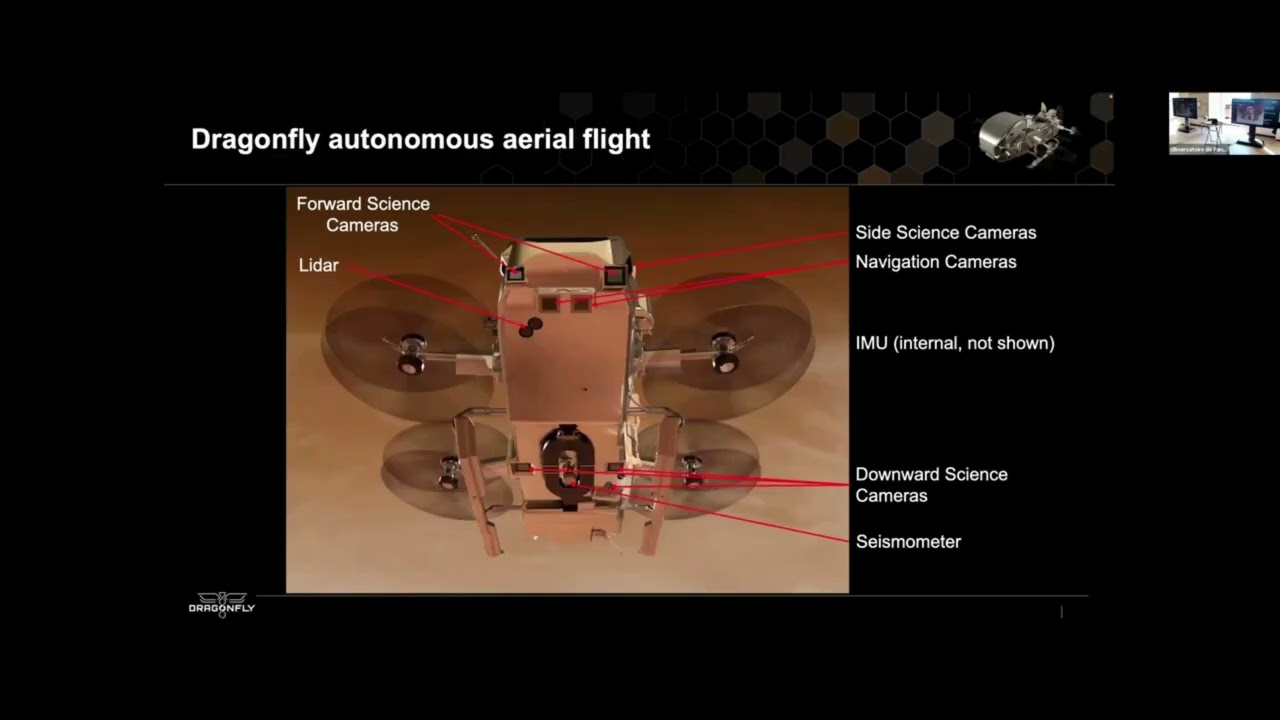
- Lander design and instrumentation
- Science instruments: mass spectrometer, gamma-ray spectrometer, cameras
- Testing facilities and flight testing
- Historical context and rotorcraft design rationale by Ralph Lorenz
- Landing site selection and mission operations
Contribution & Novelties
This presentation provides a current status update on the Dragonfly mission, including recent milestones such as the successful critical design review and the delivery of flight instruments. It offers insights into the engineering challenges and solutions, particularly in thermal design and autonomous navigation. The talk also places the mission in historical context, showing how rotorcraft concepts have evolved for Titan exploration.
Pour aller plus loin :
- Dragonfly mission page — Official mission website with detailed information.
- Titan (moon) — Overview of Titan’s characteristics and exploration.
- New Frontiers program — Program under which Dragonfly was selected.
95 words
Radar Profile
The radar profile shows high scores in information quantity, quality, and reliability, with a slightly lower technical level. This indicates a well-balanced presentation that is both informative and accessible, with a strong foundation in mission data and engineering.