The Deep Synoptic Array : Revolutionizing Access to the Radio Sky
Keywords
Summary
161 words
Critical Evaluation
Value of the Information & Strength of the Argument
The talk provides a comprehensive overview of the DSA’s design, capabilities, and scientific potential. The argumentation is solid, grounded in technical details and comparisons with existing facilities like MeerKAT and the future SKA. The speaker effectively explains the rationale behind the design choices, such as uncooled receivers and the radio camera concept, and supports claims with quantitative figures (e.g., 1.5 microJy sensitivity, 1.4 million baselines). The discussion of commensal observing and data products adds depth, showing the telescope’s versatility. The speaker also addresses potential challenges, such as data management and open access policies, demonstrating a balanced perspective.
Scientific Rigor, Source Quality, Title Accuracy
The presentation is scientifically rigorous, with clear technical specifications and realistic projections. However, no external sources are cited, and the talk relies on the speaker’s expertise and project internal data. The title accurately reflects the content, focusing on the DSA’s revolutionary approach to radio surveys. The speaker mentions collaborations and public data policies, but without specific references. The adéquation between title and content is strong, as the talk indeed emphasizes how the DSA will transform access to the radio sky.
192 words
Title / Content Match
The title accurately reflects the content, focusing on the DSA's capabilities and its potential to transform radio astronomy.
Quality & Reliability
8/10
Presentation by a leading scientist involved in the project, with detailed technical specifications and clear context. No external sources cited, but the content is coherent and aligns with known astronomical survey concepts.
Key Moments
Markers derived by PSI from the transcript: the creator did not define chapters.
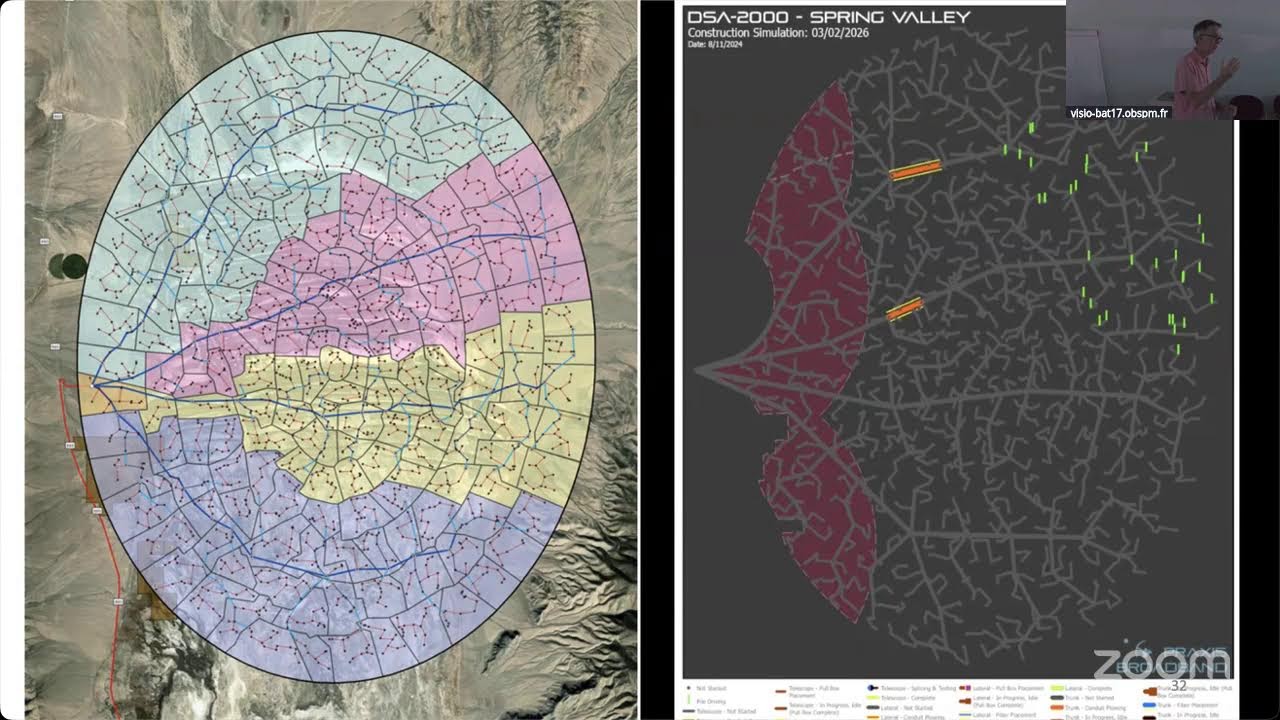
- Introduction to the DSA: 1650 dishes, 20 km array, 0.7-2 GHz, 3 arcsec resolution, 5 sq deg field.
- Key technologies: uncooled receivers and radio camera concept.
- Radio camera architecture: GPU-based correlator-imager, scaling to full bandwidth.
- Comparison with traditional correlators: data rate and cost issues.
- Funding and partnerships: Schmidt Sciences, DZentrum Astrophysics, private funding.
- Survey strategy: 60% surveys, 40% targeted, priority fields like Euclid.
- Data products: continuum images, spectral cubes, transient searches, pulsar timing.
- Science goals: neutral hydrogen census, deep continuum, transients.
- Rotation curve diversity and dark matter studies.
- Open data policy and community engagement.
Contribution & Novelties
The talk presents the DSA as a novel instrument combining a large number of small dishes with uncooled receivers and a GPU-based radio camera, enabling a survey speed that is unique for at least a decade. The emphasis on commensal observing and open data is a significant contribution to the field.
Pour aller plus loin :
- Deep Synoptic Array official site — Official project page with technical details and updates.
- Square Kilometre Array — The SKA is a complementary facility; understanding its capabilities helps contextualize DSA’s role.
- Fast Radio Bursts — DSA will detect many FRBs; this article provides background.
- Neutral hydrogen — The 21-cm line is key for DSA’s HI science.
112 words
Radar Profile
The radar profile shows high scores across all dimensions, with particularly strong performance in information quantity and quality, reflecting the speaker's expertise and the project's maturity. The technical level is high but accessible, and the overall reliability is solid, though the lack of cited sources slightly reduces the score.