Individualized Treatment Effects of Oxygen Targets in Mechanically Ventilated Critically Ill Adults
Keywords
Summary
102 words
Critical Evaluation
Value of the Information & Strength of the Argument
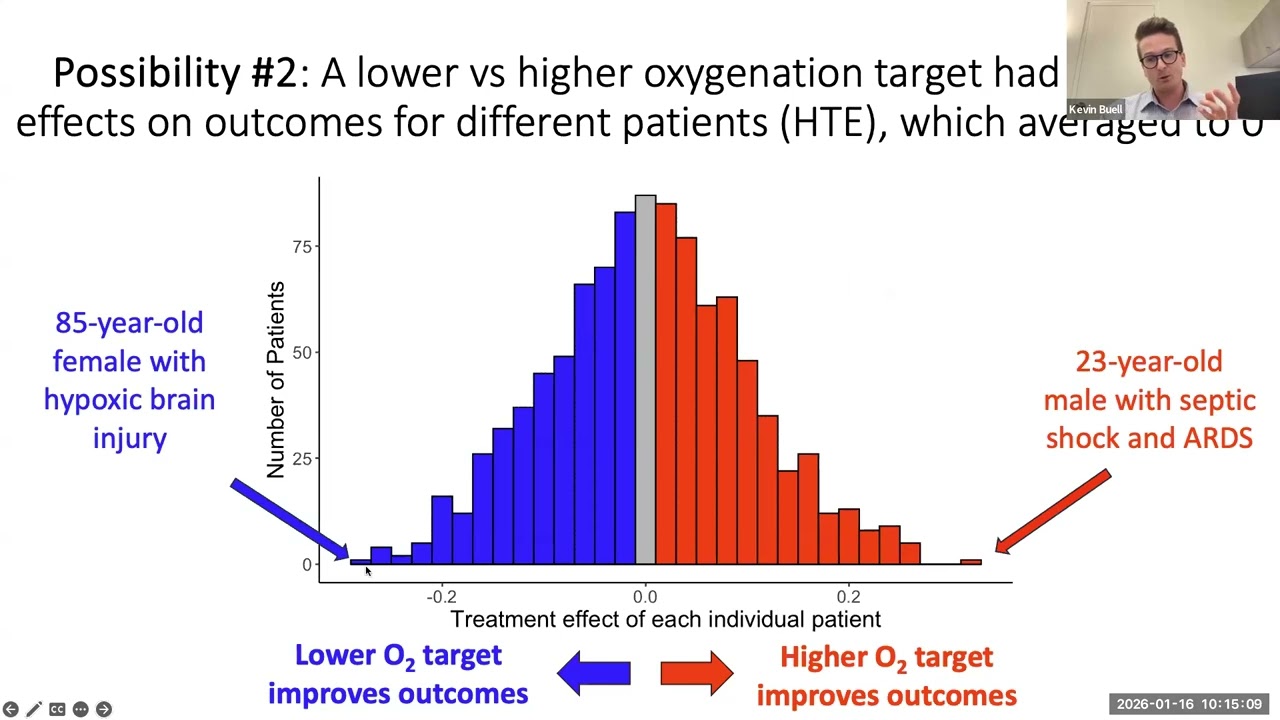
The talk provides substantial value by introducing a novel approach to individualizing oxygen targets, moving beyond average treatment effects. The argumentation is solid, built on a clear progression from observational data to randomized trials, then to the limitations of subgroup analyses, and finally to the application of machine learning for ITEs. The speaker effectively uses examples (e.g., COVID anticoagulation) to illustrate concepts. The methodology is well-explained, including the use of RBoost and the Qini coefficient for model selection. The presentation is persuasive, highlighting the potential clinical impact of personalized oxygen therapy.
Scientific Rigor, Source Quality, Title Accuracy
The scientific rigor is high, with the study published in JAMA and based on two randomized trials (PILOT and ICU-ROX). The speaker transparently discusses limitations, such as the unobservability of true ITEs and the need for external validation. The sources cited are credible, including the JAMA publication and landmark trials. The title accurately reflects the content, focusing on individualized treatment effects. The talk is well-structured and evidence-based, with appropriate caveats.
176 words
Title / Content Match
The title accurately reflects the content, focusing on individualized treatment effects of oxygen targets in mechanically ventilated critically ill adults.
Quality & Reliability
8/10
Presentation of a peer-reviewed study published in JAMA, with rigorous methodology (derivation/validation cohorts, machine learning) and transparent discussion of limitations.
Key Moments
Markers derived by PSI from the transcript: the creator did not define chapters.
- Introduction and aims of the talk
- Review of oxygenation target literature and U-shaped relationship
- Limitations of average treatment effects and subgroup analyses
- Introduction to risk-based analyses and individualized treatment effects
- Machine learning methods for ITE estimation (S-learner, T-learner)
- Study design: derivation and validation cohorts from PILOT and ICU-ROX
- Model development using RBoost and Qini coefficient
- Results and potential clinical implications
- Discussion of limitations and future directions
Cited Sources
- Individualized Treatment Effects of Oxygen Targets in Mechanically Ventilated Critically Ill Adults — The study presented in the talk, published in JAMA.
Concurring Sources
- ICU-ROX trial — One of the trials used for validation, showing neutral average effect.
- PILOT trial — The trial used for model derivation.
Dissenting Sources
- Oxygen therapy in critically ill adults — The LOCO2 trial suggested potential harm from lower oxygen targets, contrasting with the study's findings.
Contribution & Novelties
This talk presents a novel application of individualized treatment effect estimation to oxygen targets in mechanically ventilated patients, using a machine learning model derived from one trial and validated in another. It demonstrates the potential for personalized oxygen therapy in critical care, moving beyond average treatment effects.
Pour aller plus loin :
- Heterogeneous treatment effects — Overview of concepts related to treatment effect heterogeneity.
- Causal inference — Foundational concepts for estimating treatment effects.
- Machine learning in medicine — Applications of ML in clinical settings.
84 words
Radar Profile
The radar profile shows high scores in quality of information and technical level, indicating a rigorous and advanced presentation. The quantity of information is moderate, and the global reliability is strong, reflecting the peer-reviewed nature of the work.
💬 Sur les 0 commentaires analysés, aucune tendance n'est disponible.