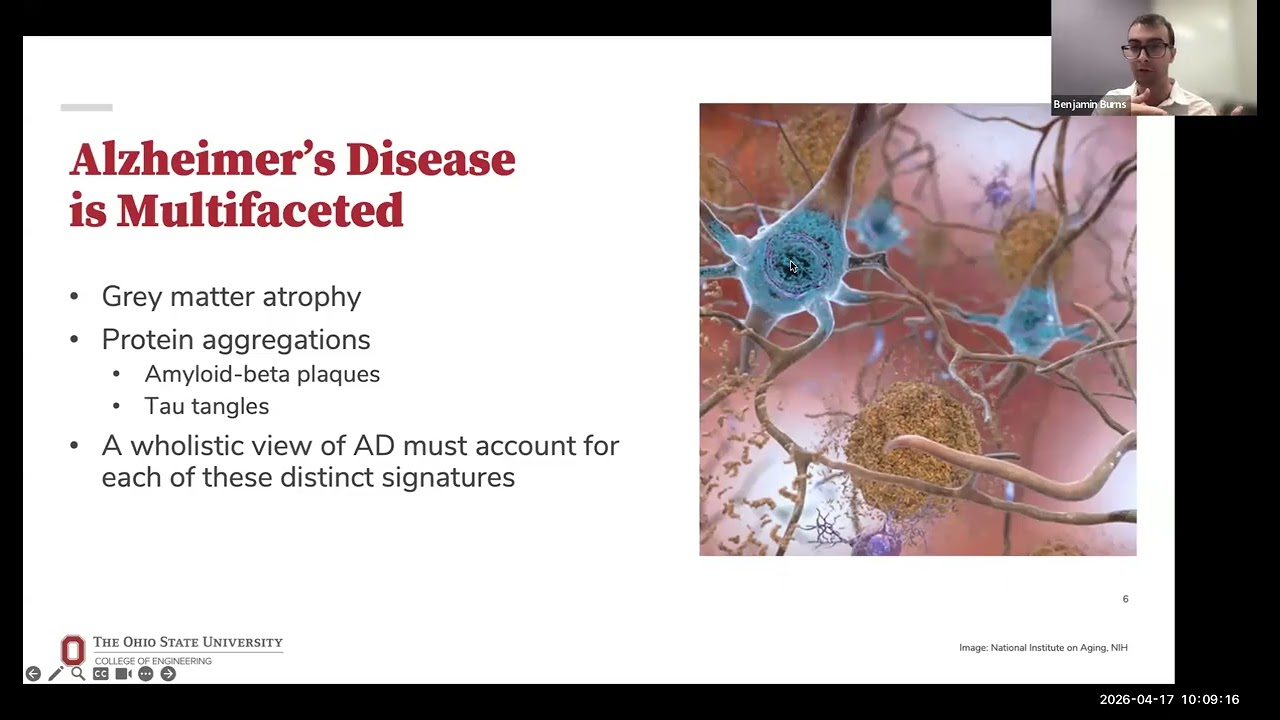
Flexible and Robust Fusion of Clinical Imaging Modalities
Keywords
Summary
103 words
Critical Evaluation
Value of the Information & Strength of the Argument
The talk provides valuable insights into the challenges of multimodal medical AI, particularly the issue of missing modalities and heterogeneous data. The argumentation is solid, grounded in the limitations of existing methods like FlexE and the need for more flexible and robust approaches. The presenter clearly explains the motivation, methodology, and results, making a compelling case for the proposed PERM method. The discussion of expert specialization and the analysis of routing behavior adds depth to the argumentation.
Scientific Rigor, Source Quality, Title Accuracy
The presentation demonstrates scientific rigor with clear methodology and evaluation on established datasets (ADNI, MIMIC). The sources cited are primarily the presenter’s own publications and the FlexE method, which is appropriate for a research talk. The title accurately reflects the content, focusing on flexible and robust fusion. The talk is well-structured and provides sufficient detail for reproducibility, though the lack of external validation and limited discussion of limitations slightly reduce the overall rigor.
165 words
Title / Content Match
The title accurately reflects the content, focusing on flexible and robust fusion of clinical imaging modalities.
Quality & Reliability
8/10
Presentation by a PhD student with NSF fellowship, based on peer-reviewed research (ICLR, EMNLP, npj Precision Oncology). Methods are clearly described, but limited external validation and no direct access to code or data.
Key Moments
Markers derived by PSI from the transcript: the creator did not define chapters.
- Introduction and overview of the presentation
- Motivation for multimodal AI in Alzheimer's disease
- Challenges of missing modalities and imputation
- Introduction to FlexE and mixture of experts
- Proposed PERM method and its advantages
- Experimental setup and results on ADNI
- Analysis of expert specialization and routing
- Second application: cardiopulmonary disease prediction
- Challenges of heterogeneous modalities and alignment
- Conclusion and future directions
Cited Sources
- FlexE: Flexible Fusion with Missing Modalities — Mentioned as state-of-the-art baseline for missing modality handling
- ADNI dataset — Used for Alzheimer's disease progression prediction
Concurring Sources
- FlexE: Flexible Fusion with Missing Modalities — The proposed method builds upon and improves FlexE, showing concordance with its approach.
Dissenting Sources
- Imputation-based methods — The talk criticizes imputation-based approaches as unreliable quick fixes, contrasting with the proposed method.
Contribution & Novelties
The talk presents a novel method (PERM) for handling missing modalities in multimodal medical imaging, which improves performance over existing methods like FlexE, especially when only one modality is available. The approach of using per-modality routers in a mixture of experts is a creative contribution. The second part addresses the challenge of fusing heterogeneous modalities (ECG, CXR, EHR) for cardiopulmonary disease prediction, highlighting the importance of robust fusion. The talk provides a clear framework for thinking about these challenges.
Pour aller plus loin :
- Mixture of Experts — Background on the technique used in the proposed method.
- Alzheimer’s Disease Neuroimaging Initiative — The dataset used for the first study.
- MIMIC-III database — Commonly used for emergency care prediction tasks, relevant to the second study.
124 words
Radar Profile
The radar profile shows high scores in information quantity and quality, reflecting the detailed and well-structured presentation. The technical level is high, indicating a specialized audience. The reliability is strong due to the presenter's credentials and peer-reviewed work, but the lack of external validation slightly lowers the score.
💬 No comments were provided for analysis.