The Precision Resuscitation With Crystalloids in Sepsis (PRECISE) Trial: A Trial Protocol
Keywords
Summary
173 words
Critical Evaluation
Value of the Information & Strength of the Argument
The talk provides valuable insights into the real-world implementation of an AI CDS in a clinical trial, highlighting the complexity of clinician interactions and the importance of understanding non-compliance. The argumentation is logical, based on a well-designed substudy with clear definitions and statistical methods. The speaker acknowledges limitations, such as the lack of reasons for non-compliance and the potential for alert fatigue. The comparison with traditional CDS compliance rates adds context, though the speaker notes the heterogeneity in the literature.
Scientific Rigor, Source Quality, Title Accuracy
The presentation demonstrates scientific rigor through a clear protocol, use of validated models (trajectory modeling, SOFA, KDIGO), and appropriate statistical analysis (chi-square, mixed-effects logistic regression). The speaker cites a meta-analysis of traditional CDS studies and references the SMART trial, but specific citations are not provided in the video. The title accurately reflects the content, focusing on the trial protocol and the compliance substudy. No comments were provided, so no analysis of public feedback is included.
170 words
Title / Content Match
The title accurately reflects the content, which focuses on the PRECISE trial protocol and a substudy on clinician compliance with an AI CDS.
Quality & Reliability
7/10
The talk presents a detailed protocol and preliminary results from a prospective substudy of a clinical trial, with clear methodology and statistical analysis. However, it is a conference presentation, not a peer-reviewed publication, and lacks full transparency on some data (e.g., exact numbers, confidence intervals).
Key Moments
Markers derived by PSI from the transcript: the creator did not define chapters.
- Introduction and overview of the PRECISE trial
- Background on IV fluids and the need for precision
- Development of the sepsis trajectory model and identification of Group D
- PRECISE trial design: enrollment, intervention, and CDS alert
- Education and implementation timeline, including pause due to fluid shortage
- Definition of compliance: alert-level vs order-level
- Results: alert interactions by setting, provider, and patient factors
- Compliance rates and significant factors (ED vs ICU, provider type, acuity)
- Order-level compliance and the 8% increase, suggesting confusion
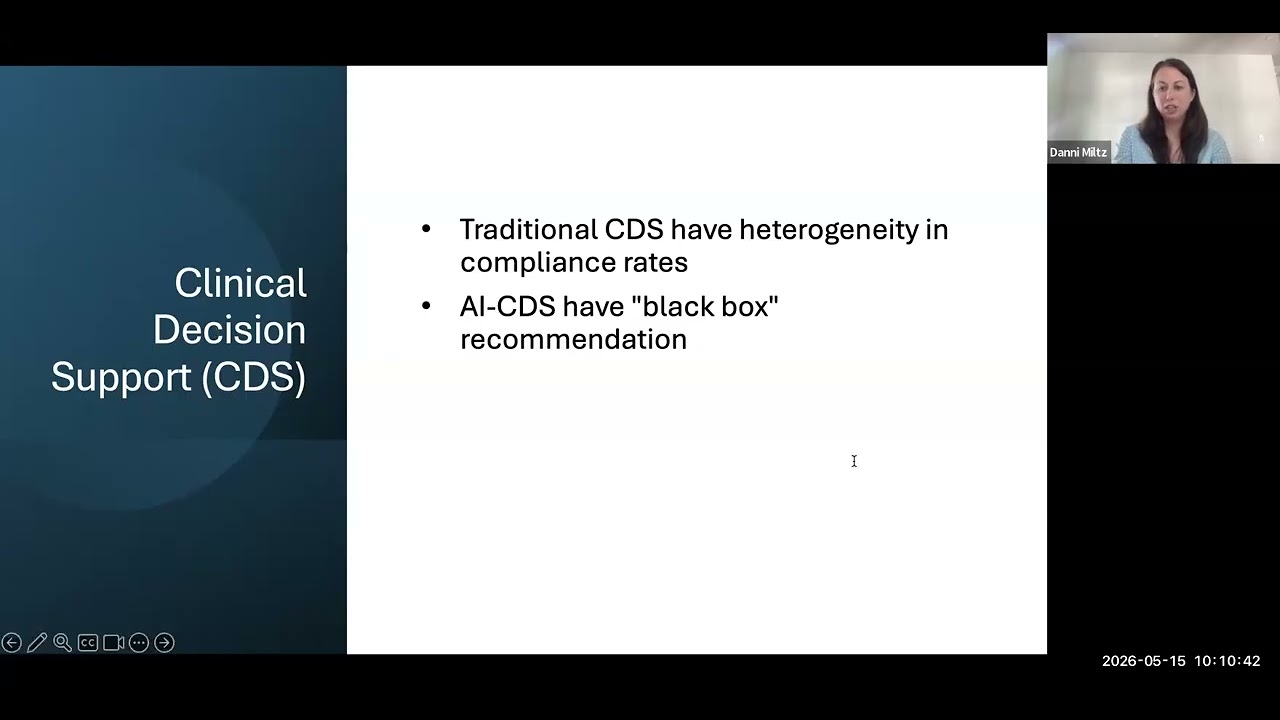
- Comparison with traditional CDS and implications for AI CDS implementation
Cited Sources
- SMART trial — Mentioned as a secondary analysis for the trajectory model.
Concurring Sources
- SMART trial — The SMART trial is referenced as the basis for the secondary analysis that identified the subgroup benefit.
Contribution & Novelties
This talk provides a detailed analysis of clinician compliance with an AI-based CDS in a real-world clinical trial, offering insights into the factors that influence acceptance of AI recommendations. It highlights the complexity of alert interactions and the need for better understanding of non-compliance. The comparison with traditional CDS compliance rates is valuable for future AI implementation.
Pour aller plus loin :
- Clinical Decision Support Systems — Overview of CDS and their challenges.
- Sepsis — Background on sepsis and its management.
- Artificial Intelligence in Healthcare — General context on AI applications in medicine.
93 words
Radar Profile
The radar profile shows high scores in information quantity and technical level, reflecting the detailed protocol and statistical analysis. The quality and reliability scores are slightly lower due to the preliminary nature and lack of peer review. The overall balance suggests a solid but not exceptional presentation.